HUB 06 · Guides & Answers
Can You Have a Toaster Oven in a Dorm?
Almost certainly not in the room, and the reason is not the wattage. Housing policies ban toaster ovens by name as an exposed-element fire risk while permitting microwaves up to 900 watts — so shopping for a smaller oven does not solve the problem a policy is actually describing.
We earn a commission if you buy through our links. It does not change the price you pay, and it does not decide our picks — the scoring rubric is published in full, including what disqualifies an oven. How this works.
The short answer
In a traditional residence hall room, almost certainly not.Of the three universities' published policies we read directly for this page, two name toaster ovens in the prohibited list outright and the third bans every appliance with an exposed heating element. All three permit microwaves, with a wattage cap.
The crucial detail — and the one that most “best dorm toaster oven” advice gets wrong — is that a lower-wattage oven does not help. The policies do not cap the wattage of a toaster oven; they prohibit the appliance category. A 1,100-watt toaster oven is as banned as an 1,800-watt one, while a 900-watt microwave is explicitly allowed. It is a rule about exposed glowing elements, not about electrical load.
Where a toaster oven usually is allowed: university apartments and suites with a proper kitchen, and off-campus housing. Several policies permit in a shared kitchen exactly what they ban in a bedroom.
What three published policies actually say
These are quoted from the institutions' own policy pages, read this week. We are not characterising a summary of them.
Northern Kentucky University — named and banned everywhere
NKU's housing regulations are the bluntest: “Washing machines, dryers, toaster ovens, and dishwashers are NOT permitted in any residential facility.” Not just rooms — any residential facility. Its separate fire-safety list prohibits “toasters; hot plates”among items carrying “a significant risk of fire”, and bans “high wattage electrical appliances (e.g. space heaters, heat lamps, open coil electrical devices)” without defining a number. Meanwhile: “Microwave cooking may occur in all residential rooms.” All appliances must be UL approved.
Kalamazoo College — named, with a catch-all behind it
Kalamazoo's prohibited-items list reads “This includes, but is not limited to, hotplates, camp stoves, toasters, toaster ovens, grills, and bread makers”, followed by “All other cooking appliances are prohibited in the residence halls.” Microwaves are the carve-out, at “900 watts or less and no more than 1 per student room”. Air fryers are not named, which under that catch-all is not permission.
Kenyon College — the mechanism, stated as the rule
Kenyon publishes an approved list and an unapproved list, and the unapproved one is the most informative sentence on this page: alongside air fryers, crock pots, deep fryers, electric woks, indoor grills, instant pots, pressure cookers and panini presses, it prohibits “any appliances with exposed heating elements”. Approved: “Microwave ovens of 900 watts or less” and “coffee makers with no exposed hot surface (such as Keurig)”.
The distinction the policies are drawing
Read the three together and the logic is consistent. A microwave excites water molecules inside the food; its cavity does not get hot and there is nothing glowing. A toaster oven cooks with a radiant element at several hundred degrees, sitting an inch and a half from whatever you put under it — BLACK+DECKER publishes exactly that figure as a minimum clearance, and its manual warns that “a fire may occur if the toaster oven is covered or touching flammable material including curtains, draperies, walls and the like when in operation or after, when still hot.”
In a bedroom with fabric, paper, a bed and no ventilation hood, that is the risk a housing office is pricing. Kenyon's phrasing — “exposed heating elements” — is the policy stated as a mechanism rather than a brand list, and it is the version to apply when your own policy is silent about the exact appliance you are holding.
It also explains why air fryers get banned alongside toaster ovens even though they look like sealed boxes: a basket air fryer and an air fryer oven both heat with a radiant element plus a fan. The mechanical difference between the two is here, and it is not the difference a fire policy cares about.
What to do before you buy anything
Find your own institution's policy page and read the list.There is no national rule and the variation is wide — some schools permit air fryers while banning toasters, some ban both, some allow either in an apartment kitchen and neither in a hall. The policy that governs you is the one with your university's name on it.
Check which building you are in, not just which university. Several policies distinguish traditional halls from apartment-style housing with a kitchen, and the same appliance can be banned in one and permitted in the other on the same campus.
Do not assume a confiscation is the worst case. Policies of this kind typically carry removal plus a conduct process, and an appliance-caused fire in a residence hall is a far larger problem than a lost oven.
If a toaster oven IS allowed where you are living
For a university apartment, a suite with a kitchen, or off-campus housing, the student constraints are real and specific — and they are different from the constraints that drive every other ranking on this site. Three figures decide it, all published.
1. Published wattage, for the circuit rather than the bill. Student housing runs a great deal on one or two circuits: a fridge, a kettle, a laptop and a microwave already on the same breaker. At 1,100 to 1,150 watts you are drawing roughly 9 to 9.6 amps and can share. At 1,800 watts you are at about 15 amps, which is a full household circuit on its own, and Breville recommends a dedicated one in its own manual. The amperage arithmetic is here. This is the figure most worth optimising, and it is the figure most student advice ignores.
2. Published footprint, including depth. A dorm-apartment counter is often less than two feet deep with a cupboard above. The Hamilton Beach 31403 publishes 11.5 inches deep by 14.9 wide by 8.7 high; the BLACK+DECKER TO1785SG publishes 11.54 by 11.22 by 8.31; the Our Place Wonder Oven publishes 11.5 by 10.6 by 11.6. All three are genuinely small boxes, and all three publish the numbers so you can check before moving in.
3. A published warranty term, because this oven gets four hard years. Student cooking is daily, unceremonious and shared. The Proctor Silex 31260 publishes a three-year limited warranty — the longest term anywhere on this site — on the cheapest oven here, and both BLACK+DECKER models publish two years. Every published term is collected here.
And the running cost, which is smaller than students expect
At the EIA's published US average of 18.34¢ per kWh, a 1,120-watt oven is 20.5 cents an hour — about 8.6 cents for a 25-minute meal, or roughly $31 a year at a meal a day. An 1,800-watt oven is 33.0 cents an hour and about $50 a year on the same pattern. If electricity is included in your housing cost the figure is academic; if it is not, the whole spread is nineteen dollars a year. The full cost-per-meal table is here.
One safety habit worth adopting whatever you buy: the manuals agree the only guaranteed off state is unplugged, and in shared housing the oven is the appliance most likely to be left on by somebody who did not set the timer. What the automatic shut-off actually does, and the override that defeats it.
The hardware
The ovens this page is about
The ovens referred to above, with prices pulled live from Amazon and dated on every card. Full rankings live in the roundups linked from this page.
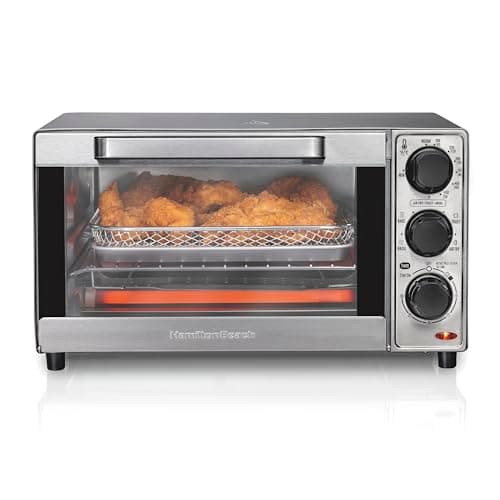
1,120 W
Hamilton Beach Sure-Crisp 4 Slice Air Fryer Toaster Oven Combo (31403)
The cheapest oven on this site with a fan AND a manufacturer-published wattage: Hamilton Beach prints 1,120 watts and the exact dimensions on its own page for model 31403, which is the model Amazon's listing data names. Four slices, a 9-inch pizza, four functions, and nothing electronic to fail.
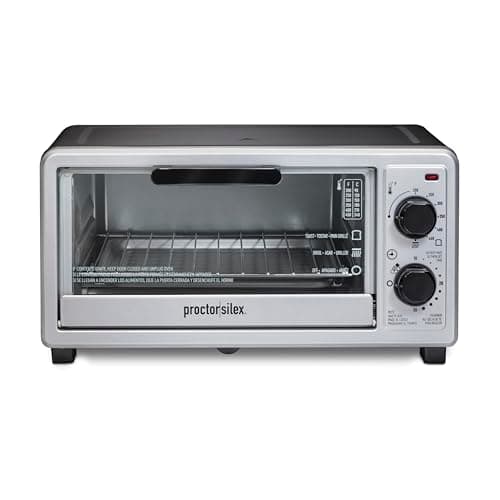
1,100 W
Proctor Silex 4 Slice Countertop Toaster Oven (31260)
Fifty dollars, four slices, three manual controls — and, unusually for the price, a published wattage and a three-year warranty. It does the same three things the ovens at four times the money do; what you give up is the fan, the evenness and the interior.
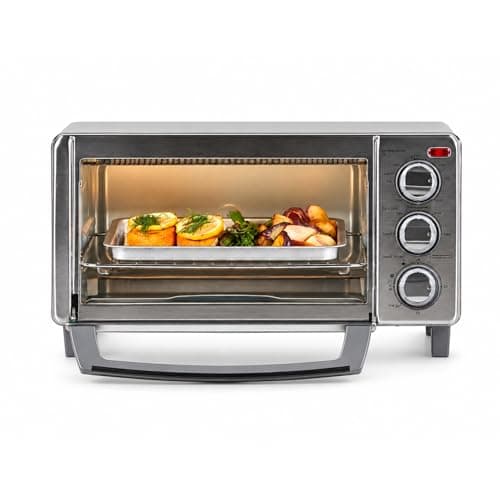
1,150 W
BLACK+DECKER 4-Slice Toaster Oven with Natural Convection (TO1785SG)
1,150 W, 120 V, four slices, a 9-inch pizza and a two-year warranty — all published by BLACK+DECKER on its own site. For sixty-five dollars that is a more complete specification than several ovens here costing three hundred.
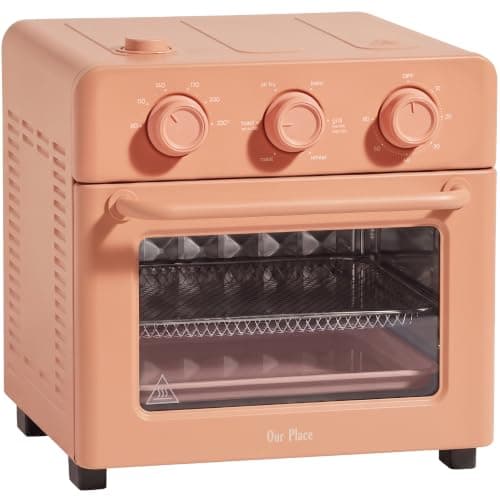
1,400 W
Our Place Wonder Oven (6-in-1, 13 Qt)
The most completely documented small oven we have covered, from a brand better known for pans. Our Place publishes the rating-plate wattage, the temperature range, the interior dimensions and the warranty term — all four things we score documentation on. At 1,400 W it costs less per hour than the 1,800 W field; at four slices and a 9-inch pizza it is genuinely small; and the limits are published too — a 200°F floor and a 60-minute timer.
#ad · As an Amazon Associate we earn from qualifying purchases.
Questions
Frequently asked
Why are toaster ovens banned in dorms but microwaves are not?
Will a small or low-wattage toaster oven get around the rule?
Are air fryers allowed in dorms?
Can I use a toaster oven in a dorm's shared kitchen?
What should a student buy instead?
Does a UL listing make it allowed?
Keep reading
Related
- The best budget toaster ovensThe ranking for an apartment kitchen on a student budget.
- The best oven gifts for a college studentThe same constraints from a gifter's side, ranked on wattage and footprint.
- Do air fryer ovens need a dedicated circuit?The amperage arithmetic behind the shared-circuit problem in student housing.
- Do toaster ovens turn off automatically?What the shut-off actually is, which matters most in shared housing.
Receipts
Sources
- Northern Kentucky University — University Housing regulations: “Washing machines, dryers, toaster ovens, and dishwashers are NOT permitted in any residential facility”, the fire-safety list naming toasters and hot plates, the high-wattage-appliance clause and the UL-approval requirement
- Kalamazoo College Residential Life — items prohibited in rooms: “hotplates, camp stoves, toasters, toaster ovens, grills, and bread makers”, “all other cooking appliances are prohibited in the residence halls”, and microwaves at 900 watts or less, one per student room
- Kenyon College Office of Residential Life handbook — electrical equipment, appliances and cooking: microwave ovens of 900 watts or less approved; air fryers and “any appliances with exposed heating elements” unapproved
- BLACK+DECKER — TO3250XSB / TO3260XSBD / TO3240XSBD use and care manual [PDF]: “You must set the timer or select Stay On for the oven to function”, the end-of-cycle shut-off, the 60-minute Bake/Broil knob, the placement and on-top warnings, the 1½-inch top-element rule, the below-set-point disclosure and the warranty exclusions
- BLACK+DECKER — Crisp 'N Bake Air Fry 4-Slice Toaster Oven (TO1785SG) product page (1150 W, 120 V, 4 slices / 9" pizza, 8.31"H x 11.22"W x 11.54"D, two-year limited warranty)
- Hamilton Beach — Sure-Crisp Air Fryer Toaster Oven, 4 Slice, model 31403 product page: 1120 watts, 200–450°F, a 30-minute timer with automatic shutoff, a stay-on setting and a ready bell
- Proctor Silex — 4 Slice Toaster Oven Broiler (31260G) product page: three-year limited warranty, a 30-minute timer with auto shutoff and a ready bell, a “Stay On” option, and a temperature floor stated twice at two different values
- US EIA, Electric Power Monthly Table 5.3 — average residential price, US total, June 2026
We have not cooked in these ovens and we do not pretend to have. Specifications come from the manufacturer's own published documents; electricity rates come from the US Energy Information Administration; prices come from the live Amazon API. Where a figure is not published, the page says “not published” rather than guessing. Read the full method.