HUB 06 · Guides & Answers
How Does a Toaster Oven Work?
It is the simplest appliance in your kitchen: resistance wire, a thermostat that cycles it, and a timer that ends the job. Understanding those three parts explains almost every complaint people have about these ovens — including why the dial setting is not the temperature inside.
We earn a commission if you buy through our links. It does not change the price you pay, and it does not decide our picks — the scoring rubric is published in full, including what disqualifies an oven. How this works.
The short answer
A toaster oven passes household current through resistance elements — wire or quartz tubes that get hot because they resist the current flowing through them. A thermostat switches those elements on and off to hold roughly the temperature you dialled. A timer ends the job and, on most of these ovens, is also the thing that turns the oven off. That is the entire machine. There is no compressor, no magnetron, no pump.
Everything that distinguishes a forty-dollar oven from a four-hundred-dollar one is a variation on those three parts: how many elements, whether a fan moves the air, how precisely the thermostat cycles, and how much of it the maker is willing to publish.
The elements: where the heat comes from
Most of these ovens use two to six elements, split between the top and the bottom of the cavity. They cook in two ways at once. Radiant heat travels in straight lines from the glowing element to whatever faces it — this is what browns the top of a casserole and what toasts bread, and it is why the distance to the element matters so much. Conducted and convected heat warms the air and the metal around the food, which is what actually cooks the inside.
The radiant component is the reason BLACK+DECKER publishes a clearance rule in its manual: “be sure food or baking dish does not come within 1½ inches of the top heating elements.” That is the only published food-to-element distance in this entire catalog, and it is a direct statement about radiant intensity at close range.
Element count is published more often than element behaviour. Breville publishes thirteen functions and a 1,800-watt rating line for the BOV900; Panasonic publishes something different in kind, describing a double infrared heater positioned at the front and back rather than above and below, which delivers instant heat that eliminates the need for preheating— Panasonic's own words on its own product page. We have not cooked in one, so we report that claim and its source rather than grading it, but it is a genuine published description of a mechanism, which is rare here.
The thermostat, and why your dial reads high
A thermostat in one of these ovens is not a precision instrument. It is a switch that opens when a sensor reaches a threshold and closes when it falls back, so the real temperature inside swings above and below the number on the dial continuously. That swing is why two ovens set to 350°F can brown a tray of vegetables quite differently.
One manufacturer states the consequence outright, in the manual, and it is the most useful sentence we have found in this category:
“Temperatures in the oven will be lower than your set point. This is due to advanced heating elements used in this oven. Temperature dial settings have been calibrated to provide expected results for most recipes taking into account the advanced heating elements.”
That is BLACK+DECKER telling you its dial is a recipe-calibrated control rather than a thermometer. No other brand here publishes anything comparable, and the behaviour is almost certainly not unique to BLACK+DECKER — it is simply the only one that wrote it down. If you bake and need an actual number, an oven thermometer inside the cavity is the fix, and it is why our cake ranking leans on published temperature behaviour rather than dial markings.
The published range is a different and more reliable figure, because it is a commitment about what the oven will attempt. The floor matters more than the ceiling: 120°F on two Brevilles, 170°F on the Instant Omni Plus, 200°F on Our Place, 250°F on the Panasonic, 50°F on the Nuwave Bravo XL Pro. Every published band in the catalog is collected here.
The fan: what convection actually changes
Add a fan and the hot air moves instead of stratifying. Moving air strips the insulating boundary layer off the surface of the food, so heat transfers faster at the same temperature — which is why convection recipes call for a lower setting or a shorter time than conventional ones.
“Air fry” in a countertop oven is this same fan run harder, usually with the food raised on a perforated basket so air reaches the underside too. It is a fan speed and a rack position, not a separate technology, which is the subject of a whole page here. Panasonic is the interesting exception on this page: the FlashXpress publishes no fan at all and relies on infrared intensity instead, which is a genuinely different design rather than a cheaper one.
The timer, which is usually also the off switch
On most of these ovens the timer does not just ring — it cuts the power. BLACK+DECKER is explicit that this is structural rather than convenient: “You must set the timer or select Stay On for the oven to function.”On Breville's digital ovens the cook ends when the timer does, and the oven then “goes into standby mode if not used for 10 minutes”.
This is worth understanding as part of the mechanism rather than as a feature, because it explains a common confusion: there is no separate safety sensor doing the switching off. What each manual commits to, and the override that defeats it.
Why the simplicity is the point
Three parts and nothing else has consequences that show up all over this site. A toaster oven heats a small cavity, so it reaches temperature far faster than a full-size oven and costs a fraction as much to run for one meal — the arithmetic is here. It has almost nothing to break, which is why the longest published warranty in this catalog is on the simplest and cheapest oven in it. And because the mechanism is radiant, proximity does most of the work, so rack position changes results more than it does in a big oven — which the manuals mostly decline to tell you about.
What the mechanism means when you are choosing one
Once you know it is elements, a thermostat and a timer, four published figures carry almost all the information and the rest of the spec sheet is decoration.
Rated power tells you heat density, with the cavity size beside it.Watts alone mean little — 1,300 watts into Panasonic's 7.2 quarts is a harder heat than 1,800 into thirty. Both figures published together is the useful pair, and only nine ovens in this catalog publish both. That ranking is here.
The published floor tells you what the thermostat will attempt. Anything below 200°F — proofing, holding, drying — needs a maker willing to print a low number. A silent floor is not a low floor.
Element arrangement tells you what it is good at. Top-and-bottom elements with a tall cavity suit baking; close top elements suit browning and toasting; a fan suits anything you want crisp. The broiler ranking turns entirely on top-element behaviour.
Whether the brand publishes any of this at all is the fourth figure, and on this site it is a scored metric rather than a footnote, because an unverifiable claim is not a specification. The brand-by-brand record is here.
The hardware
The ovens this page is about
The ovens referred to above, with prices pulled live from Amazon and dated on every card. Full rankings live in the roundups linked from this page.
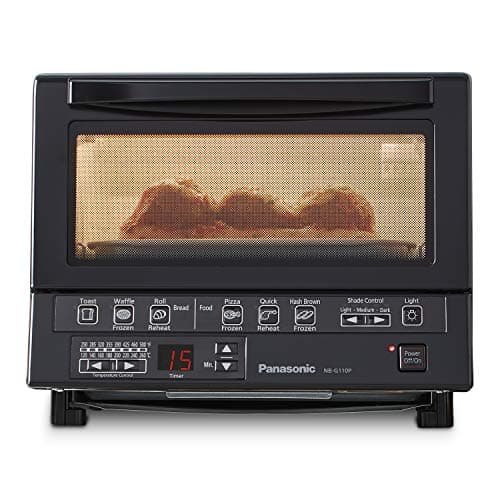
1,300 W
Panasonic FlashXpress Toaster Oven (NB-G110P)
The most completely documented oven on this entire site relative to its size: 1,300 W, 120 V, 60 Hz, 7.2 quarts, 250–500°F, exact millimeter dimensions and a stated weight. Panasonic publishes all of it, and almost nobody else does.
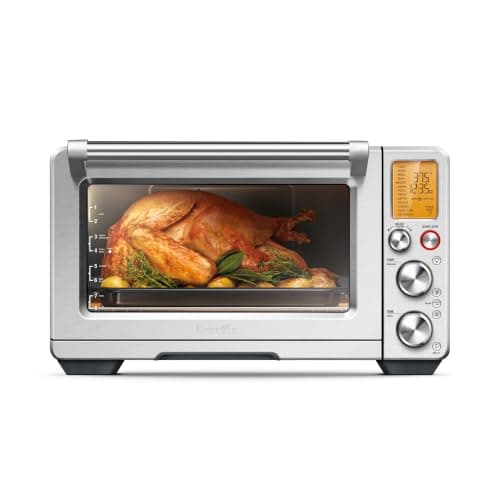
1,800 W
Breville Smart Oven Air Fryer Pro (BOV900BSS)
The most completely documented oven in the category, and the only one at any price whose manufacturer publishes a rated wattage, an interior volume and a full element layout in the same place. You pay roughly four times the category floor for that, and about a third of the premium is the documentation itself.
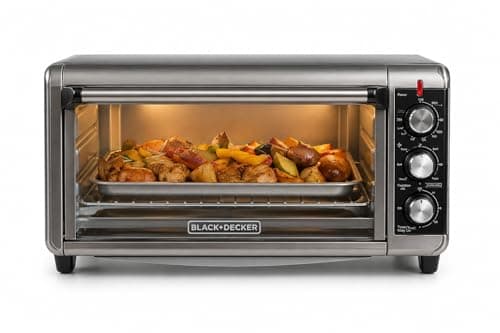
1,500 W
BLACK+DECKER 8-Slice Extra Wide Convection Toaster Oven (TO3250XSB)
A dial-controlled convection toaster oven whose maker publishes the wattage, the dimensions, the weight and a two-year warranty on its own page, and prints the rating line in the manual — 1500 W, 120 V, 60 Hz. Eight slices, a 12-inch pizza and a 9 x 13 pan with handles, for under a hundred dollars. It is a convection baker, not an air fryer: there is no basket and no air-fry setting.
#ad · As an Amazon Associate we earn from qualifying purchases.
Questions
Frequently asked
Is a toaster oven just a small oven?
Why does my toaster oven not reach the temperature I set?
Does a toaster oven use radiation?
What is the difference between convection and a plain toaster oven?
Why does the oven click while it is cooking?
Keep reading
Related
- How air fryers workThe same mechanism with the fan turned up, and what that changes.
- How hot does a toaster oven get?Every published temperature band in the catalog, floors included.
- True convection vs fan convectionWhat brands mean by each, and which of them publish the difference.
- Toaster oven brands, ranked by what they publishWhich makers will describe their own heating at all.
Receipts
Sources
- BLACK+DECKER — TO3250XSB / TO3260XSBD / TO3240XSBD use and care manual [PDF]: “You must set the timer or select Stay On for the oven to function”, the end-of-cycle shut-off, the 60-minute Bake/Broil knob, the placement and on-top warnings, the 1½-inch top-element rule, the below-set-point disclosure and the warranty exclusions
- BLACK+DECKER — Extra-Wide 8-Slice Toaster Oven (TO3250XSB) product page, specifications block (1500 W, 22 x 14.5 x 11.5 in, 12.1 lb, two-year limited warranty)
- Breville — the Smart Oven Air Fryer Compact (BOV680) instruction book [PDF]: the end-of-cook-timer behaviour, “the oven goes into standby mode if not used for 10 minutes”, the dedicated-circuit recommendation, the external-timer prohibition and Rating Information 120 V ~ 60 Hz 1800 W
- Panasonic — FlashXpress Toaster Oven NB-G110P product page (1300 W, 120 V 60 Hz, 7.2 quart, 250–500°F, 330 x 304 x 260 mm, the double infrared heater and the published no-preheat claim)
- Breville — Smart Oven Air Fryer Pro (BOV900) product page (1800 W, 1 cubic ft, thirteen functions)
We have not cooked in these ovens and we do not pretend to have. Specifications come from the manufacturer's own published documents; electricity rates come from the US Energy Information Administration; prices come from the live Amazon API. Where a figure is not published, the page says “not published” rather than guessing. Read the full method.