What this page ranks on, and what it refuses to
No manufacturer in this category publishes a control-legibility specification. Nobody states a font size, a button force, a handle diameter or a display contrast ratio, and we have not cooked in these ovens or handed them to anyone. So this page does not score “ease of use”, because that score would be invented. It ranks on four things that are either published or physically observable from the manufacturer's own photographs and manuals: which way the door goes, whether the controls are mechanical or capacitive, what the oven weighs, and how long the maker will warrant it.
Those four are not a proxy for age. They are the specifications that decide whether an oven is workable for anyone with reduced grip, reduced reach, a shoulder that does not like being extended over a hot surface, or eyes that do not read a low-contrast panel in a bright kitchen. They are also, not coincidentally, the specifications that get left out of every roundup in this category.
The door is the whole safety argument
A standard toaster oven door hinges at the bottom and drops toward you, so the hot glass ends up horizontal, at chest height, directly between you and the food. To take a tray out you reach over it. That is the single riskiest motion in countertop cooking and it is a design decision, not a law of physics.
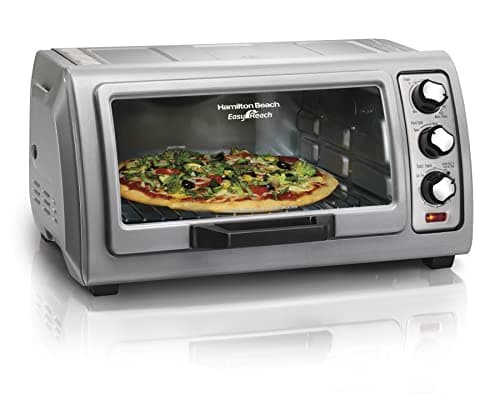
The Hamilton Beach Easy Reach leads this page because its door rolls up and backinstead of dropping down. There is nothing in front of the oven while it is hot and nothing to lean across. Six slices, and the whole Easy Reach line exists for this one idea. The honest limitation is documentation: Hamilton Beach publishes no wattage for this SKU that we could find, and we are not willing to borrow the four-slice sibling's figure and call it this one's, so it carries no running-cost number. Its review is here.
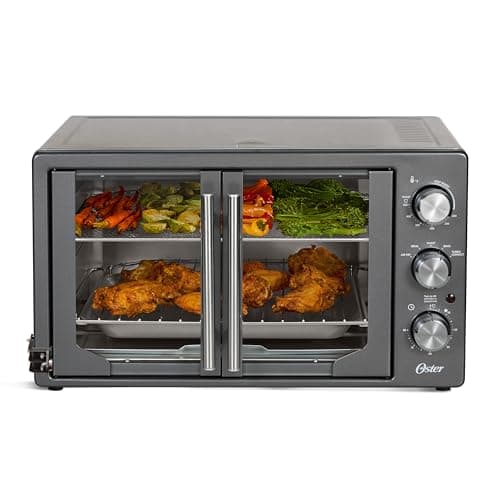
The Oster Extra Large 42 L French Door is second and solves the same problem a different way: two doors that open outward from the middle, each one clearing about half the width, so nothing horizontal sits in front of the cavity. It can be opened with one hand, which matters if the other one is holding a tray. Oster publishes the interior as a figure — 42 liters, roughly 1.5 cubic feet — which is rarer than it should be, and publishes no wattage, which is not. The review covers both.
Controls you can feel
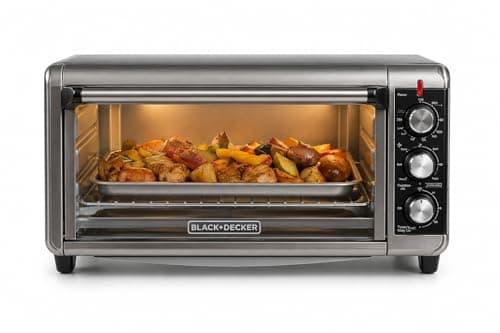
The BLACK+DECKER 8-Slice Extra Wide (TO3250XSB) is third and is the best-documented oven on this page by a wide margin. Three dials and a mechanical timer — temperature, function, time — each with a physical detent you can feel and a bell at the end. BLACK+DECKER publishes the wattage (1,500 W, printed on the rating line in its own manual), the dimensions, the weight at 12.1 pounds, and a two-year limited warranty. A published weight is unusual and it is practical information: 12 pounds is a two-handed lift for cleaning rather than a three-person job.
The one thing to check before buying it is width. At 22 inches it is the widest oven in its price band, and an oven that does not fit the counter is not accessible to anyone. Clearance under a wall cabinet is worth reading first.
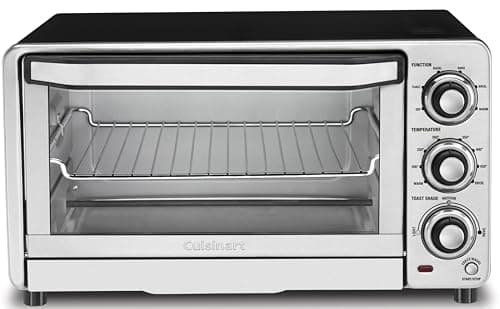
The Cuisinart Custom Classic (TOB-40N)is fourth: a full 1,800 watts behind three knobs, with essentially nothing to fail electronically. It has been sold substantially unchanged for over a decade, which in small appliances is the strongest reliability signal available short of taking one apart. No fan, no panel, no menu. If the requirement is “works the way a toaster oven worked in 1995, but hotter”, this is it.
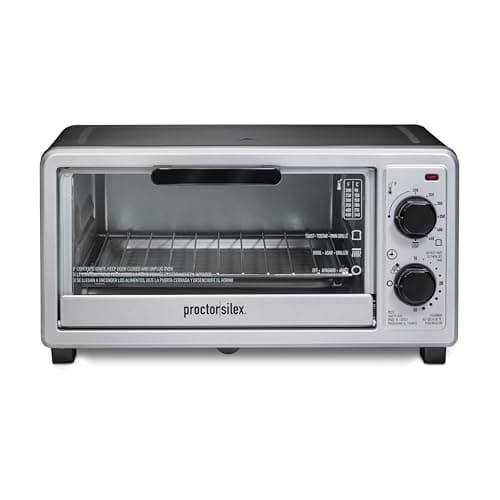
The Proctor Silex 31260 is fifth and is the simplest machine here: three manual controls, four slices, 1,100 watts and a 200–450°F range in the listing data, and the longest published warranty of any oven on this site at three years. It is also the lightest and the cheapest, which makes it the easy answer for a second oven, a small kitchen, or a situation where the oven may need to be carried.
What we deliberately left off
Every touchscreen oven in the catalog. Capacitive panels are not inherently worse, and some of the best-documented ovens on this site use them — but a flat panel gives no tactile confirmation, can require a firmer or drier press than expected, and on several models the labels are low-contrast gray on stainless. Since no manufacturer publishes anything measurable about any of that, the defensible position is to rank the ovens whose controls you can feel and say plainly why.
We also left off the ovens with no published warranty term. A warranty is the one durability claim a manufacturer has to honor, and on a purchase made partly for reliability it is the number worth weighting. Across this whole catalog the published terms run from one year to three, and the spread does not track price the way you would expect.
Before it goes on the counter
Two practical checks that have nothing to do with the model. First, clearance: every one of these ovens vents real heat from the top and the back, and the manufacturers' own requirements range from one inch to five depending on the brand. The published clearance figures are collected here. Putting a hot oven where the door swing or the vent is obstructed is a bigger hazard than any control panel.
Second, the circuit. The Cuisinart above draws 1,800 watts, which is 15 amps at 120 volts — the entire capacity of a standard kitchen circuit. Running it at the same time as a kettle or a microwave on the same circuit trips breakers, and a breaker that trips while an oven is hot is its own hazard. The arithmetic is worked through here, and the 1,100 W and 1,500 W picks above leave real headroom.
A four-question checklist before you buy one for someone
1. Which way does the door go, and what is in front of it? A drop-down door needs clear counter in front of the oven, permanently, and it puts hot glass at chest height. A roll-top or French door needs almost none. If the oven has to live in a corner or against a backsplash, this decides the purchase on its own.
2. Can the controls be operated without reading anything? Dials have detents and end stops; you can learn them by feel and set them in the dark. A touch panel has to be read every time. Neither is inherently safer, but only one of them works when the kitchen light is behind you.
3. What does it weigh, and will it ever be moved? Countertop ovens get moved for cleaning, and a crumb tray has to come out either way. BLACK+DECKER publishes 12.1 pounds for the TO3250XSB; most brands publish nothing, and the large French-door models are substantially heavier. If it will be lifted, the published figure is the one number worth chasing.
4. How long is the warranty, and who has to make the claim? Terms on this site run from one year to three. Proctor Silex publishes three years on the 31260; BLACK+DECKER publishes two on both models above; several premium ovens publish one. Buy the term, not the price bracket — and keep the receipt somewhere the person using the oven can find it.
One thing that is not on this list: function count. An oven with eleven presets is not more capable than an oven with three in any way that matters for toast, baking and reheating, and every extra preset is another thing to be found on a menu. The budget ranking makes the same argument with prices attached.