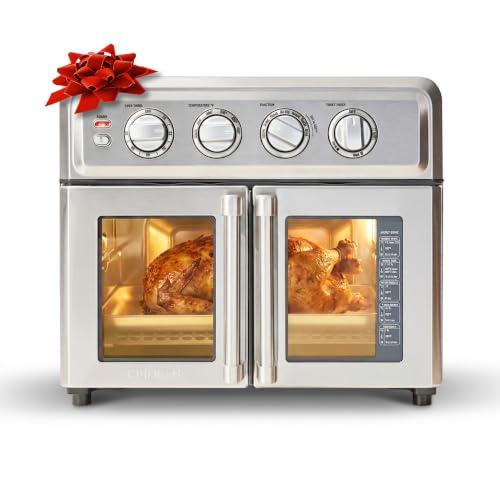
The short answer
Buy it if you want a French-door oven and you care more about the warranty than the specification sheet. Three years is the longest published term in our entire catalog, tied with a fifty-dollar Proctor Silex and three times what Ninja publishes on the French-door oven it is directly across from on the shelf. The capacity claim is also the only one on this site that survives a calculator: 0.6 cubic feet really is about eighteen quarts, which sounds like a low bar until you read what the rest of this category does. Skip it if you want to know what you are buying before it arrives, because no instruction booklet has been published for this model — there is no rating plate, no clearance figure, no interior dimension and no published minimum temperature anywhere.
We have not cooked in this oven. There is no test kitchen behind this site and our rubric says so in those words. What follows is what Cuisinart publishes, where each figure is published, which figures are a retailer's rather than Cuisinart's, and the arithmetic those figures support.
The capacity claim checks out, and that is genuinely news
Four times in the last three weeks this site has taken a manufacturer's own published interior figures, multiplied them out, and found the headline capacity inflated. Nuwave publishes 30 QT and interior dimensions that describe 24.9. The Our Place Large Wonder Oven is published with the Pro's exact interior. Midea publishes two different weights for the same oven. Each time the finding was the same shape, and each time it was only visible because the maker published enough to be checked.
Do the same sum here. Cuisinart publishes an interior of 0.6 cubic feet. A cubic foot is 1,728 cubic inches, so 0.6 cu ft is 1,036.8 cubic inches. A US quart is 57.75 cubic inches, so that is 17.95 quarts — about 17 liters. The specification table says 18 Quart. The two figures describe the same box, to within a rounding you would make yourself.
That is worth publishing precisely because this site has published the failures. A capacity claim is not news when it is right and a scandal when it is wrong; it is one check, and here it passes. Read against the Nuwave Bravo XL Pro, where it does not, the difference is seventeen percent of the number on the box.
The caveat that belongs with it: oven capacity has no industry definition, so an agreement between two of a maker's own figures is not the same as a measurement. What it does tell you is that the two numbers Cuisinart publishes were derived from each other rather than from a marketing meeting, and that the one to plan with is either of them. Our pan-fit guide covers which makers publish an interior you can measure — and Cuisinart, on this model, is not one of them.
What is published in objects rather than adjectives
The second thing this listing does well. Instead of a quart count and a function list, Cuisinart states what the cavity takes: six slices of toast, a 12-inch pizza, 3 lbs of wings, or a 4.5-lb chicken. Every one of those is checkable against something in your own kitchen, and the chicken figure is notably modest — most ovens this size claim five or six pounds, and a 4.5-lb bird is an honest reading of eighteen quarts.
Seven functions, named: air fry, toast, bake, broil, roast, pizza and warm. That is four to six fewer than the twelve-and-thirteen-function ovens this category likes to advertise, and the shorter list is not a limitation so much as a different piece of marketing — the presets on any of these ovens are the same elements at different set points, which we worked through separately. What matters more is the control type: Cuisinart publishes dial controls here, with the timer settable to 60 minutes and the temperature to 450°F.
The three named mechanisms are HeatSeal (stated as locking heat in where the doors meet), SoftHold doors that stay open, and DualSync one-hand door operation. Those are claims about a door, which is the one part of a French-door oven that is genuinely different from a single-door one, and the stated behavior — doors that stay open while you load — is the real argument for the format. Our French-door roundup explains what the format buys and what it costs, and the honest summary is that it buys reach and costs depth.
The 450°F ceiling, and what it rules out
450°F is the published maximum. It is enough for everything most people cook in a countertop oven and it is 50 degrees short of the field's better numbers: Nuwave publishes 500°F, Panasonic publishes 500°F, Breville's larger ovens go to 480°F. Where that bites is pizza — a 12-inch pizza fits, and the oven that bakes it will do so at the bottom of the useful band rather than the top — and broiling, where the advice in most recipes assumes a hotter element than this.
The number that is missing is the other end. No published minimum temperature exists for this model, which means there is no way to check it against proofing, dehydrating or any low-and-slow job before you buy. Compare that with the ovens where the floor is published: the Our Place Wonder Oven Pro states 80°F, Midea 100°F, and the ovens that can genuinely dehydrate are the ones that say so. A 450°F ceiling with an unpublished floor is a specification with one end.
There is no manual, and that is the review
This is the part a buyer should read twice. The TOA-FD70 is a 2026 release, and no instruction booklet, use-and-care guide or Cuisinart specification table for it could be reached this run. Searched by model number, searched for a PDF, and checked against the retailer-hosted copies that do carry the TOA-70 series booklet — which is a different oven: single door, with a grill, a different cavity and a different control layout. Its figures are not used anywhere on this page and should not be borrowed for this one.
What falls out of that gap is specific and it is not trivial. There is no rating plate reproduction, so the wattage below is a retailer's number. There is no clearance requirement, so you do not know how much air the manufacturer wants around it — and the makers who publish one ask for between two and four inches. There is no rack-position count. There is no warranty document, only the term. And there is no statement of whether a setting exists that holds the oven on past the 60-minute timer, which is exactly the sort of thing a manual answers in one line.
The practical move, if you buy it: the rating plate is on the back of the oven. Read it on the day it arrives, inside the return window, and you will have settled in ten seconds the figure this whole page has to hedge.
The wattage, and where it actually came from
1,800 watts, and the source is Target's specification table rather than Cuisinart's. That is one rung below “the manufacturer's own listing copy” on the source hierarchy this site publishes — a retailer typed it out of a vendor data sheet nobody outside the trade can read, and it can be corrected without a changelog. We publish it because it is the only figure that exists and because it is consistent: Cuisinart publishes 1,800 W for the TOA-70 and the TOA-60 in the same line, and nothing about a seven-function French-door oven suggests a different element set.
Taking it at face value, the arithmetic is the same as for most of this category. 1,800 W at 120 V is 15 amps — the entire rating of a standard 15-amp branch circuit, before anything else is on it. Our dedicated-circuit guide works through why that matters at home, and our office ranking is the version of that problem you cannot fix with an electrician, because at work you do not get to add a circuit.
At the US average residential rate of 18.34¢ per kWh, 1,800 watts costs 33.0¢ an hour of oven-on time. Half an hour a day every day is about $60 a year, written out in full on our air-fryer-oven electricity page. That is identical to a Breville BOV900, a Nuwave Bravo XL Pro and a Cuisinart TOA-70, because all four draw the same rated power — in this category spending more does not buy efficiency. Watts by model lists the field and says where each figure came from.
Footprint: three published dimensions that do not form one box
Target publishes 13.75 inches high, 15.75 wide and 12.25 deep, at 25 pounds. Amazon's own item data for the same ASIN gives 13.75, 15.75 and 16.5. The 13.75 and the 15.75 agree; the third figure does not, and Amazon does not label which axis is which. Plan clearance around the larger number and you cannot be caught out.
If the 12.25 is right it is the most interesting number on the page, because 12.25 inches is shallower than every other French-door oven in our catalog — the Midea, the Emeril, the Oster and the Elite Gourmet are all deeper, and depth is what decides whether a French door can open on a standard counter without the handles meeting the backsplash. 15.75 inches wide also clears the 21.4-inch problem that keeps a Breville BOV900 out of most under-cabinet gaps.
25 pounds is substantial for an eighteen-quart oven and roughly what the format costs: two doors, two hinges and the mechanism that syncs them. Our size guide puts the whole catalog on one scale if the counter is the binding constraint.
The warranty is the strongest published thing here
Three years, limited. In context that is remarkable: our brand-by-brand warranty audit found that a published term is the exception rather than the rule here — thirteen of the forty products in this catalog carry one — that the longest anyone publishes is three years, and that price order and warranty order are close to unrelated. Breville's own warranty page declines to state a length at all. A $220 Nuwave publishes one year. This $160 Cuisinart publishes three, and so does a $50 Proctor Silex — the only two three-year terms on the site.
It matters most on this format. A French-door oven has two doors, two hinge sets and a synchronizing linkage, which is more moving metal than any single-door oven carries — and the hinge is the part that fails on this class of appliance. Our longevity guide covers what actually breaks. Three years of cover on the one mechanism that distinguishes the product is the most sensible thing on this page, and it is the reason this oven ranks where it does on the French-door roundup.
Who should buy it, and who should not
Buy it if you want the French-door format on a shallow counter, if the three-year warranty is worth more to you than a published specification, or if an honest eighteen quarts at a hundred and sixty dollars is simply the right size for the money. It undercuts every other French-door oven we cover except the Elite Gourmet, and it is the only one of them that publishes a multi-year term.
Skip itif you read specifications. Every figure on this page is listing copy or a retailer's table: no rating plate, no interior dimension, no clearance requirement, no temperature floor. If that is the thing you are buying, the Our Place and Breville ovens publish all four of the things we score documentation on, and the Midea Flexify publishes a 5°F control step and a 100°F floor in the same format.
Also skip it if you want 500°F, a published dehydrate range, or more than seven functions. And if the competition you are actually weighing is the new Ninja French Door Premier, the two ovens fail in opposite directions: Ninja names ten functions and publishes no capacity figure at all, Cuisinart names seven and publishes a capacity that checks out.
How to check a capacity claim in cubic feet
Cubic feet is the harder unit to sanity-check and that is part of why makers use it. Multiply by 1,728 for cubic inches, then divide by 57.75 for US quarts or 61.02 for liters. 0.6 cu ft → 1,036.8 in³ → 17.95 quarts. One cubic foot — Breville's figure for the BOV900 — is 29.9 quarts, which is why a “1 cu ft” oven and a “30 QT” oven are the same size and sound like different products.
The check only runs on makers who publish two figures. An oven that publishes only “18 QT” is not more honest than one whose two numbers disagree; it is unfalsifiable. That is why our Documentation score weighs publishing a figure above the figure being flattering, and it is the one axis on which this oven both wins and loses — the capacity pair is its best result and the missing manual is its worst.
Reading a retailer's specification table
The hierarchy this site applies, in order: a rating plate reproduced in the manual, then a manufacturer's specification table, then the manufacturer's own listing copy, then a manufacturer's answer to a customer question — and below all four, a retailer's table. A retailer's table is not worthless: the figures come from a vendor data sheet and they are usually right. But nobody outside the trade can read that sheet, the retailer is not the party making the representation, and the table changes without notice.
The practical rule for a new release, which is what this is: treat a retailer-sourced wattage as a planning figure and verify it on the rating plate when the box arrives. If the figure decides whether the appliance can share a circuit, do not buy on it — buy an oven whose maker published one. Every wattage this site holds is listed here, each with the document the number came from, so you can tell a rating plate from a retailer's table before you spend anything.
What a French door actually buys
Two things, and neither is cooking performance. The first is reach: both doors swing clear of the opening, so you load from directly in front of the cavity rather than over a hot drop-down door. That matters most to anyone with limited shoulder reach or a tight counter, which is why the format shows up in our accessibility ranking. The second is counter behavior: a drop-down door needs clear space in front of the oven that a French door does not.
What it costs is depth and moving parts. Side-hinged doors put the hinge on the width, so French-door ovens in this catalog run wide, and the mechanism that keeps two doors in sync is the part with something to go wrong. That combination — a format whose distinctive feature is mechanical — is exactly why the warranty term on this one is worth as much as it is.