HUB 06 · Guides & Answers
Air Fryer Oven Times and Temperatures
Not a recipe list — a method. How to convert what you already cook, what each oven's published temperature range genuinely allows, and the four habits that separate a good first month from a drawer full of regret.
We earn a commission if you buy through our links. It does not change the price you pay, and it does not decide our picks — the scoring rubric is published in full, including what disqualifies an oven. How this works.
Start here
You do not need new recipes. You need one conversion and four habits. The conversion: drop the temperature about 25°F below what the recipe says, cut the time by roughly a fifth, and check at two-thirds.The habits: preheat, single layer, know your oven's published temperature ceiling, and write down what worked. Everything else is cooking, which you already know how to do.
We have not cooked in these ovens and we do not publish times we have not measured — a stance this site holds everywhere, and the methodology page says so in these words. What we can give you is the arithmetic, which is reproducible, and the manufacturers' own published ranges, which are checkable. That is more useful than a table of numbers someone else guessed.
Converting a recipe you already use
Recipes are written for still air. An air fryer oven moves it, which delivers heat to the surface faster, so the same numbers overcook. The conventional correction is 25°F down or 20% of the time off — pick one, not both, or you will undercook.
Our conversion chart runs this for every common temperature if you would rather look it up than do it. And if you are converting from a basket air fryer recipe rather than an oven one, the change goes the other way: an oven format has more room and less crowding, so it needs less shaking, but a full tray can take a little longer than the same food packed into a small basket right against the element. The two formats differ more than the marketing suggests.
What temperature range your oven actually has
This matters more than any recipe, and most manufacturers never publish it. Three ovens on this site do, and the spread between them is instructive:
| Oven | Published range | What that allows |
|---|---|---|
| Panasonic FlashXpress | 250–500°F | The highest ceiling here — real browning heat, in a 7.2-quart cavity that holds four slices. |
| Instant Omni Plus | 170–450°F | The lowest floor here. A stated 170°F is what makes dehydrating and proofing genuine rather than a label. |
| Proctor Silex 31260 | 200–450°F | The budget band's honest ceiling: enough for roasting and baking, short of hard searing. |
Note what the floor buys and what the ceiling buys. A low floor is what a dehydrate or proof setting needs to mean anything — our dehydrator ranking is built on exactly that number. A high ceiling is what browning and pizza need. Our pizza page ranks on the ceiling for the same reason — and states plainly that none of these reaches pizzeria heat. If your oven publishes no range at all, which most do not, the practical assumption is roughly 200 to 450°F and the manual is the only authority worth trusting over that guess.
The four habits
Preheat, even though it is quick. A countertop oven reaches temperature in three to five minutes because there is so little air to heat. Food that goes into a cold cavity spends those minutes drying instead of searing, which is the difference between crisp and leathery.
Single layer, always.Air frying is moving hot air over a surface. Cover the surface and it stops. A crowded tray steams; two uncrowded batches routinely beat one packed one on both time and result. This is the single most common cause of “my air fryer doesn't crisp” and it is not the oven's fault.
Use the right rack position. The elements sit inches from the food in a cavity this small, so rack height changes the outcome more than it does in a full-size oven. Middle for bakes, higher for browning, lower for anything that catches. Two-level ovens like the Ninja DT201 rotate trays halfway for the same reason.
Write it down.Your oven, your food, your portion size. After ten cooks you will have a better reference than any published table, because it will be measured on the machine you own rather than on someone else's.
Why there is no time chart on this page
Because it would be fiction. Cooking time depends on the oven's wattage, its cavity, the rack height, the portion thickness and whether the food went in from the fridge or the counter — and we have no test kitchen to measure any of it. Every “air fryer time chart” that gives you one number for chicken thighs across every machine is copying another chart that did the same. The conversion above is arithmetic you can check; the published ranges above come from the manufacturers. Both are things we can stand behind, which a table of invented minutes is not.
Two things the manufacturers do publish per function, and which change results more than a minute either way: the rack position each function calls for — bake belongs low in a countertop oven, not in the middle — and which functions run a preheat cycle at all. Both are printed in the books and both are free.
The hardware
The ovens this page is about
The ovens referred to above, with prices pulled live from Amazon and dated on every card. Full rankings live in the roundups linked from this page.
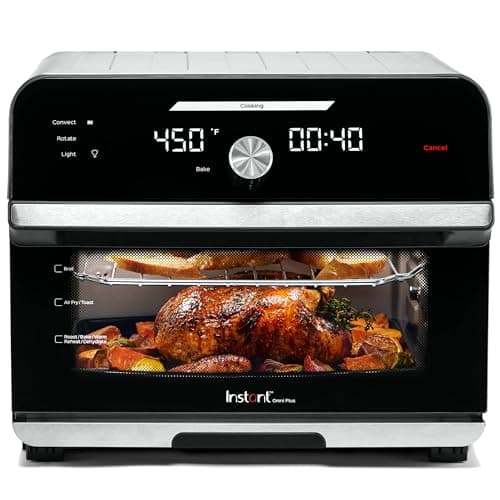
Wattage not published
Instant Pot Omni Plus 19QT/18L Toaster Oven Air Fryer, 10-in-1
One of the few ovens here that publishes its interior in liters, which makes it the easiest in the category to compare on paper. The rotisserie is a genuine mechanical addition rather than a relabeled fan setting.
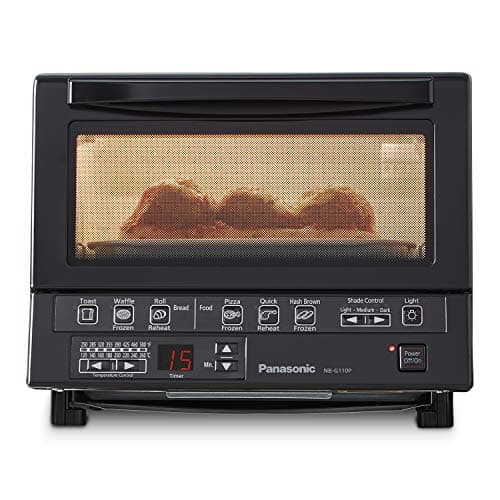
1,300 W
Panasonic FlashXpress Toaster Oven (NB-G110P)
The most completely documented oven on this entire site relative to its size: 1,300 W, 120 V, 60 Hz, 7.2 quarts, 250–500°F, exact millimeter dimensions and a stated weight. Panasonic publishes all of it, and almost nobody else does.
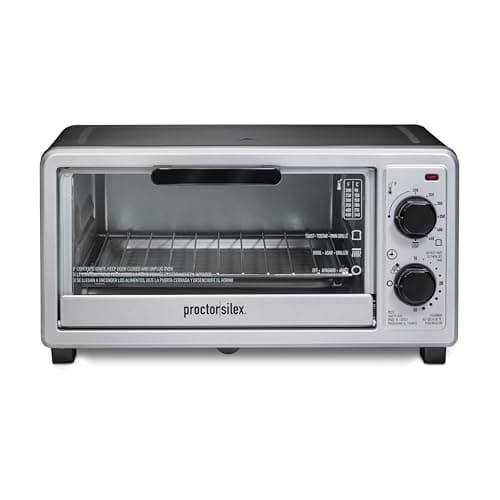
1,100 W
Proctor Silex 4 Slice Countertop Toaster Oven (31260)
Fifty dollars, four slices, three manual controls — and, unusually for the price, a published wattage and a three-year warranty. It does the same three things the ovens at four times the money do; what you give up is the fan, the evenness and the interior.
#ad · As an Amazon Associate we earn from qualifying purchases.
Questions
Frequently asked
How do I convert an oven recipe for an air fryer oven?
What temperature should an air fryer oven be set to?
Do you have to preheat an air fryer oven?
Why is my food cooking unevenly?
Why don't you publish an air fryer time chart?
Keep reading
Related
- Convection conversion chartThe 25°F adjustment for every common temperature.
- Best air fryer ovens for beginnersThe models with controls you can read at a glance.
- Basket vs oven formatWhy a basket recipe converts differently.
- Why does my air fryer oven smoke?The other thing that goes wrong in the first month.
Receipts
Sources
- Panasonic — FlashXpress Toaster Oven NB-G110P product page
- Instant Brands — Instant Pot Omni Plus 18L Air Fryer Toaster Oven product page
- Amazon listing (manufacturer-supplied copy) — 31260 adjustable temperature range
We have not cooked in these ovens and we do not pretend to have. Specifications come from the manufacturer's own published documents; electricity rates come from the US Energy Information Administration; prices come from the live Amazon API. Where a figure is not published, the page says “not published” rather than guessing. Read the full method.