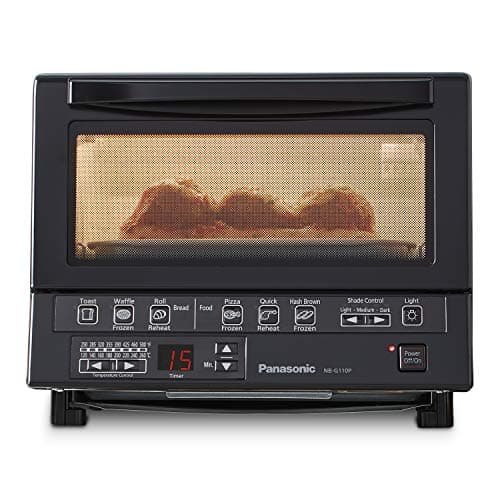
The most honest spec sheet in the category
Panasonic publishes what everyone else leaves out. For the FlashXpress that means 1,300 watts of power consumption, stated at 120 volts and 60 Hz; a 7.2-quart capacity; a 250-to-500°F range; exact dimensions in millimeters; and a weight. That is the complete set, and no other brand on this site provides it. On a site that scores documentation, this small oven earns a perfect mark on that metric — you can know everything about it before it arrives.
The engineering is unusual too. Instead of conventional wire elements, it uses double infrared heating, which reaches temperature effectively instantly — there is no preheat in the usual sense — and it holds a genuinely high 500°F in a small cavity, which is a real heat density for pizza or a hard-finished roast vegetable.
The trade: it is small, and priced like it is not
7.2 quarts is a small oven. It takes four slices, and a 9-inch pizza is optimistic. It is also expensive for its size, because you are paying partly for the infrared elements and partly for the engineering discipline that produced that spec sheet. If you need to cook for more than two, no amount of documentation adds capacity, and a larger oven — even a less well-specified one — is the right buy.
Who should buy it
One or two people who want a small, fast, high-quality oven and value knowing exactly what they own. It is the oven for a reader of this site: the one that publishes everything, holds a high temperature, and does not pretend to be bigger than it is. Just do not ask it to roast a chicken for four. The cross-shop almost everyone considers alongside it is the small Breville, and the two published temperature bands do not contain each other — which decides that comparison before price does.
One published claim deserves separating out, because no other manufacturer on this site makes it: Panasonic states that the double infrared heater gives instant heat that eliminates the need for preheating. That is the company's own claim rather than a test result of ours, and it is the outlier in what the manuals say about preheating, where Breville names the functions that preheat and BLACK+DECKER publishes ten minutes. For the job this oven is bought for most often, the toast ranking puts that claim in context.
There is one niche where the absence of a fan stops being a compromise and becomes the feature. Polyform's own published instructions for curing polymer clay tell you to turn convection off, and this is the only oven on the site with no fan to turn off — which is why it leads the clay ranking.
The published 500°F ceiling has a second niche, and it is the only specification on this page that is a hard pass-or-fail rather than a preference. Measured against a published lead-free reflow profile — a 240 to 245°C peak, or 464 to 473°F — a 450°F oven cannot reach the peak at all, and 500°F clears it with 15°C to spare. Why that puts this oven and two others in a category of their own, with the honest caveats: Panasonic publishes nothing about soldering, and an oven used for flux should not go back to food.
How we picked
Ovens we claim to have cooked in: 0
Everyone in this category tells you they roasted forty chickens. We have roasted none, and we say so. Here is what we do instead: read the manufacturer's manual and spec sheet, record the published wattage, interior volume, temperature range and warranty term, work out what the oven costs to run for an hour and for a year, show the arithmetic so you can redo it with your own electricity rate, and cite all of it. Where a brand publishes no wattage, we print no running cost rather than borrowing a number from a similar model. Prices come live from Amazon's API and disappear rather than go stale.
The scores above are judgments from that documented research — not test results. One of the five metrics is Documentation: whether the manufacturer will tell you what its oven draws at all. The full rubric, including what disqualifies an oven, is published in full.