HUB 03
Toaster Ovens
The entry price band, where the honest advice is often to spend less rather than more. A $45 toaster oven and a $200 one do the same three things; what changes is how evenly, how fast, and how long the thing survives. We say which of those you are actually paying for.
We earn a commission if you buy through our links. It does not change the price you pay, and it does not decide our picks — the scoring rubric is published in full, including what disqualifies an oven. How this works.

Start here
The Best Toaster Ovens
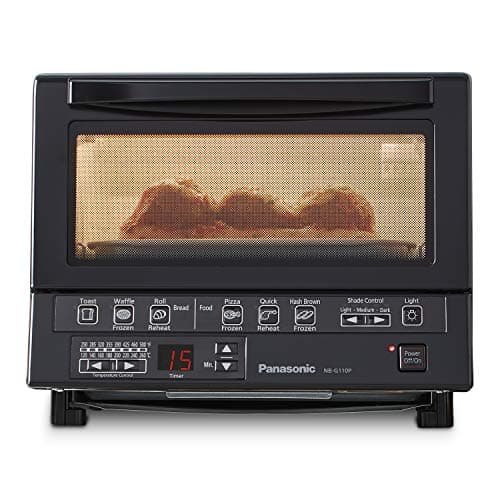
Our top pick: Panasonic FlashXpress Toaster Oven (NB-G110P) — The most completely documented oven on this entire site relative to its size: 1,300 W, 120 V, 60 Hz, 7.2 quarts, 250–500°F, exact millimeter dimensions and a stated weight. Panasonic publishes all of it, and almost nobody else does.
The category where spending less is often correct
A toaster oven has one job that a full-size oven does badly: heating something small, quickly, without warming up the kitchen. At the bottom of this market — around $50 — you can buy an appliance that does exactly that and nothing else, and for a great many households that is the right purchase. This is the only hub on this site where the honest advice regularly points downward.
What you give up as you go cheaper, in the order you give it up: the convection fan, digital temperature setting, interior room, and finally build quality. What you do not give up is the ability to toast bread, melt cheese, reheat pizza and roast a tray of vegetables — which is what most toaster ovens are used for on most days.
What the price steps actually buy
$45–$70. Two elements, three knobs, a bimetallic thermostat, four slices. No fan. The thermostat is an approximation — set 350°F and the cavity will oscillate around it by a noticeable margin — which matters for baking and does not matter at all for toast. Often 1,100–1,300 W rather than 1,800, which makes them the cheapest ovens on this site to run per hour.
$70–$120. A fan appears, usually badged as air fry. Six slices instead of four. Sometimes a digital panel. This is the sweet spot for most people: the fan is the single biggest improvement available in this category, and it arrives here.
$120–$200. Better thermostats, more elements, a real temperature range, and — critically — brands that publish specifications. The reason to spend here is not that the toast is better; it is that you can find out what you bought.
Above $200. You have left the toaster-oven category and entered countertop convection ovens. Different product, different argument.
The wattage question, answered plainly
A budget toaster oven at 1,150 W costs about $38.49 a year to run at 30 minutes a day, 365 days a year, against $60.25 for an 1,800 W machine — a difference of about $22 a year. That is real but small, and it comes with a genuine cost: a 1,150 W oven takes longer to preheat and longer to cook, so the per-hour saving is partly eaten by more hours.
Where the lower draw genuinely helps is electrical headroom. 1,150 W is about 9.6 amps; 1,800 W is 15 amps, the entire rating of a standard circuit. If your kitchen outlet is shared with a kettle, a microwave or a coffee machine, the lower-wattage oven is the one that does not trip the breaker. The full electricity arithmetic is here.
The thing nobody mentions about doors
A standard toaster-oven door drops down and becomes a hot horizontal shelf directly in front of the appliance, at exactly the height at which you reach across it. You then have to lean over that shelf to get anything out. Roll-top and French-door designs exist to solve this and they solve it well; if you have ever burned a forearm on an oven door, that mechanism is worth more to you than a fourth preset.
Buy the size you cook, not the size you imagine
Four slices is genuinely four slices. Six is genuinely six. The temptation is always to size up for the dinner party, but the dinner party happens twice a year and the two rounds of toast happen every morning — and the larger cavity is slower and more expensive on all the other days. Match the oven to the ordinary Tuesday.
Two questions this band answers better than the premium tier
The first is toast, which is the job the category is named after and the one almost every roundup skips. Manufacturers publish very little about it — a slice count, sometimes a shade knob, rarely a rack position — so we ranked these ovens on what they do publish, and the best-documented toaster in the band costs under a hundred dollars.
The second is who is going to use it. A hot door that drops into your working space and a capacitive panel that gives no feedback are design decisions, not laws of physics, and the ovens that avoid both are almost all in this price band — ranked on door mechanism, controls, published weight and warranty. That last figure is the only durability claim any manufacturer makes, and across this catalog it runs from one year to three without tracking price at all.
Two jobs this hub takes seriously that others do not
The first is the money end: the ovens that come in under a hundred dollars are ranked on published wattage and published capacity rather than on star counts, and several of them publish more than ovens at four times the price. The second is a job this category genuinely gets bought for and nobody writes about honestly: curing polymer clay, which depends on the bottom of the temperature band rather than the top, and on whether there is a fan to switch off. A third is the one the marketing makes hardest to answer: which of these ovens is deliberately not an air fryer — and what the published figures say that actually costs you, which on this catalog is close to nothing. And when an oven stops working, three manuals give the same first answer and it is not a fault.
Two jobs where the smallest oven wins
Reheating is the one task in this category where a large cavity is a disadvantage, and it is rankable on a figure nobody else computes: watts per published quart. Divide the two numbers and the densest oven here is the smallest — though the division is only possible for nine ovens out of thirty-four, because both figures have to be published first. The other is not cooking at all: reflow soldering turns on the published temperature ceiling, and a published lead-free profile needs 464 to 473°F against this category's 450°F convention — which three ovens here clear and the rest do not.
One door design with a documentation problem
French doors swing out from the middle instead of dropping down and sweeping the counter, which is a real ergonomic gain on a tight worktop. Ranking the French-door ovens surfaced something none of the brands says out loud — not one of the four publishes a rated wattage, so the running-cost arithmetic every other page here depends on cannot be done for any of them. Only one publishes a temperature range at all, which is why the Midea Flexify wins that page on documentation rather than on cooking, and why the oven with twenty-four published functions places third despite having the longest feature list in the category.
The oldest function here is the least documented
Broiling is radiant heat at close range, so it is decided by how far the food sits beneath the top element and what that element does while it is on — and almost nobody publishes either figure. Ranking the broilers turned up exactly one manufacturer willing to describe the procedure: a ten-minute preheat, the top rack position, an element that remains on throughout rather than cycling, and a minimum of an inch and a half between the food and the elements — the only published food-to-element clearance anywhere in this catalog.
Which brands will tell you anything at all
Every score on this site rests on documentation, so it is worth asking the question of the makers rather than the models. Scoring all fifteen brands on whether they publish a wattage, a temperature range, an interior figure and a warranty term produces an answer price would not predict: four brands publish all four, five publish none of them, the most complete publisher is a direct-to-consumer cookware company, and the longest warranty term in the category — three years — is on the cheapest oven here, while the most expensive brand's own warranty page declines to state a length. The warranty picture in full, exclusions included is the sharpest version of that inversion.
Everything in this section
All of Toaster Ovens
Roundup
The Best Toaster Ovens
$50 to $200, ranked on what each price step buys. The Panasonic wins on documentation; the Cuisinart Custom Classic on plain 1,800 W value.
Top pick: Panasonic FlashXpress Toaster Oven (NB-G110P) · 6 ranked, 6 with live prices
$149.99on Amazon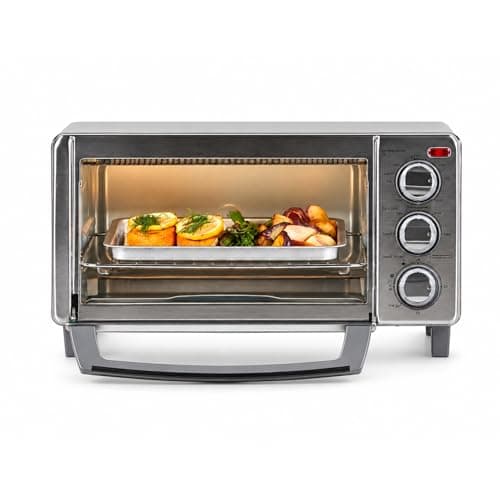
Roundup
Best Budget Toaster Ovens Under $80
The sub-$80 picks. The BLACK+DECKER TO1785SG is the standout because it actually publishes what it draws.
Top pick: BLACK+DECKER 4-Slice Toaster Oven with Natural Convection (TO1785SG) · 4 ranked, 4 with live prices
$64.99on Amazon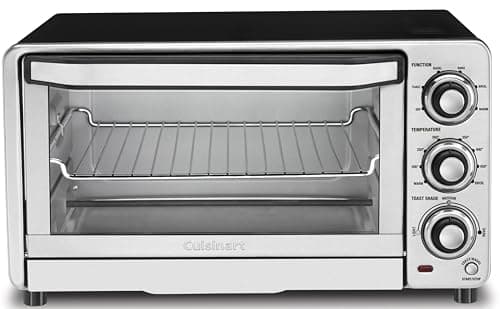
Roundup
The Best Stainless Steel Toaster Ovens
Stainless ovens ranked on what lasts, not just the finish. The Cuisinart Custom Classic wins on full 1,800 W behind knobs; the BLACK+DECKER on published specs.
Top pick: Cuisinart Custom Classic Toaster Oven Broiler (TOB-40N) · 4 ranked, 4 with live prices
$108.22on AmazonRoundup
The Best Small Toaster Ovens
Compact toaster ovens for a tight counter, ranked on published footprint and what they still do at that size. The Panasonic FlashXpress wins on a fully specified 7.2-quart cavity; two budget picks follow.
Top pick: Panasonic FlashXpress Toaster Oven (NB-G110P) · 3 ranked, 3 with live prices
$149.99on AmazonRoundup
The Best Toaster Ovens Under $100
The most oven you can get and still stay under $100. The Cuisinart Custom Classic wins with a full 1,800 W behind durable knobs; a roll-top pick and two published-spec BLACK+DECKER ovens follow.
Top pick: Cuisinart Custom Classic Toaster Oven Broiler (TOB-40N) · 4 ranked, 4 with live prices
$108.22on Amazon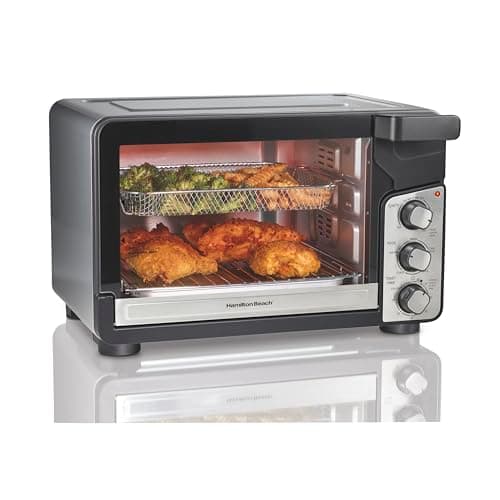
Roundup
The Best Convection Toaster Ovens
The entry-band ovens that genuinely have a fan, from about $60. Plus the trap: 'natural convection' on a listing means there is no fan at all.
Top pick: Hamilton Beach Easy View XL Toaster Oven with Sure-Crisp Air Fry, 6 Slice · 3 ranked, 3 with live prices
$69.99on Amazon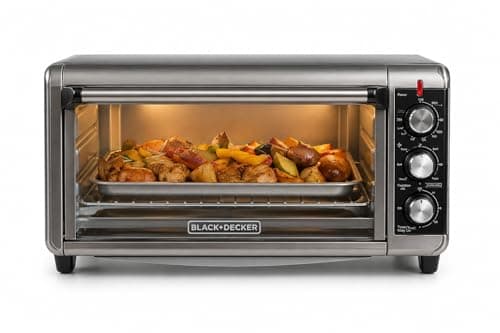
Roundup
The Best Toaster Ovens for Actual Toast
Ranked on published toast documentation: how many slices the maker will commit to, how many darkness steps, which rack the manual names, and whether toasting needs a preheat. Live prices, and the ovens that publish nothing are marked as such.
Top pick: BLACK+DECKER 8-Slice Extra Wide Convection Toaster Oven (TO3250XSB) · 5 ranked, 5 with live prices
$86.87on Amazon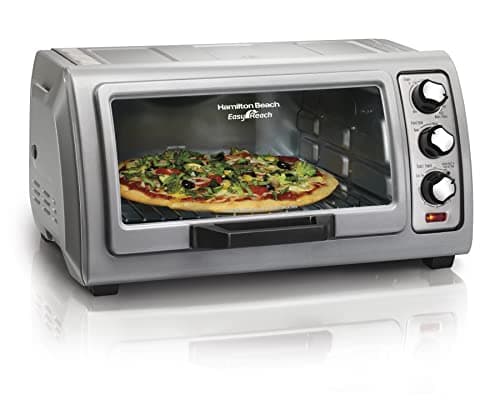
Roundup
The Best Toaster Ovens for Seniors
Ranked on door mechanism, whether the controls are physical, published weight and published warranty. The roll-top door wins; French doors come second; every pick after that is dials rather than a touch panel.
Top pick: Hamilton Beach Easy Reach 6 Slice Countertop Toaster Oven · 5 ranked, 5 with live prices
$96.95on AmazonRoundup
The Best Toaster Ovens for Polymer Clay
Ranked against Polyform's own published cure temperatures: the low end of each oven's published band, whether it has a convection fan to defeat, and how precisely the set point can be entered. Live prices, and no claim about cure quality anywhere.
Top pick: Panasonic FlashXpress Toaster Oven (NB-G110P) · 5 ranked, 5 with live prices
$149.99on Amazon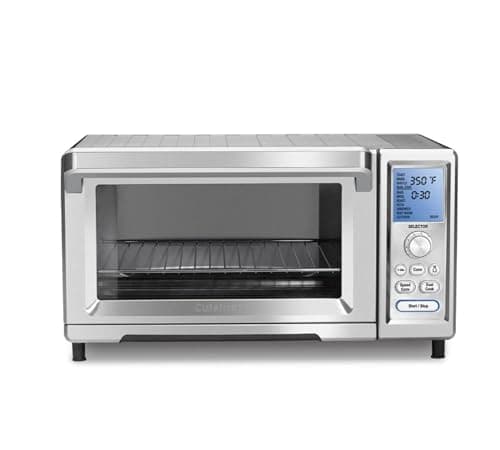
Roundup
The Best Toaster Ovens Without an Air Fryer
Ranked on an exclusion: the maker's own function list has to omit air fry. What is left is a field with the site's highest published temperature ceiling, its only handles-included pan-fit claim, and its longest warranty -- which is the finding.
Top pick: Cuisinart Chef's Convection Toaster Oven (TOB-260N1) · 6 ranked, 6 with live prices
$299.95on AmazonRoundup
The Best Toaster Ovens for Reheating Food
Ranked on watts per published quart -- heat density -- rather than on wattage or capacity alone. The winner has the smallest interior on the page and half again the density of anything else in the catalog.
Top pick: Panasonic FlashXpress Toaster Oven (NB-G110P) · 5 ranked, 5 with live prices
$149.99on Amazon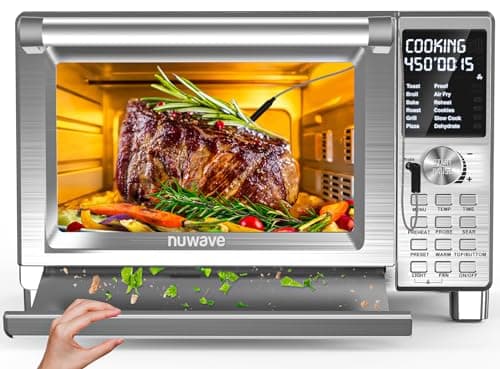
Roundup
The Best Toaster Ovens for Reflow Soldering
Ranked on published temperature ceiling against a published reflow profile. Lead-free needs 464-473F; most of this category stops at 450F. Three ovens clear it, and the finest published set-point step in the catalog is 5F.
Top pick: Nuwave Bravo XL Pro Air Fryer Toaster Oven (30 Qt, with probe) · 4 ranked, 4 with live prices
$219.99on Amazon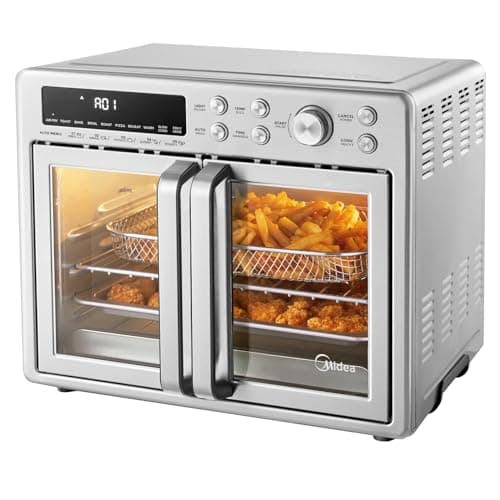
Roundup
The Best French Door Toaster Ovens
Four French-door ovens, two size classes and three incompatible capacity units. The Midea Flexify wins because it is the only one whose maker publishes a temperature range -- and none of the four publishes a wattage, which is the finding.
Top pick: Midea Flexify French Door Air Fryer Oven (MET26C3AST, 26.4 Qt) · 4 ranked, 4 with live prices
$159.82on AmazonRoundup
The Best Toaster Ovens With a Broiler
Broiling is an element-proximity job, so the figures that decide it are the distance from the food to the top element and whether that element stays on. Exactly one oven in this catalog publishes either. Ranked on the published broil procedure, not on crust.
Top pick: BLACK+DECKER 8-Slice Extra Wide Convection Toaster Oven (TO3250XSB) · 5 ranked, 5 with live prices
$86.87on Amazon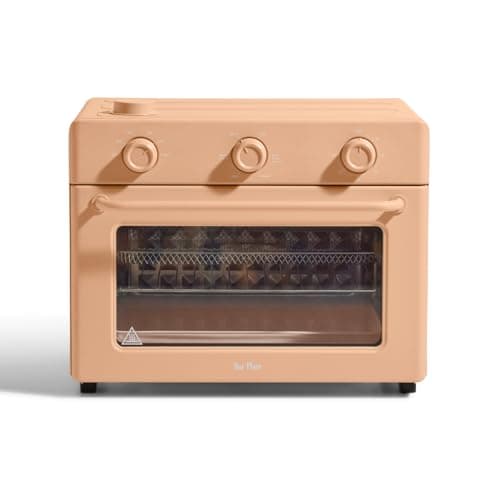
Roundup
The Best Toaster Oven Brands, Ranked by What They Publish
A brand ranking rather than a product ranking. Every maker in this catalog scored on whether it publishes the four figures that decide a purchase, with its best-documented oven as the pick. The premium brands do not win it.
Top pick: Our Place Large Wonder Oven (6-in-1, 28 L) · 6 ranked, 6 with live prices
$245.00on AmazonGuide
Toaster Oven Sizes, and What to Measure First
External footprint, door clearance, and how slice and quart capacity map to real food. Measure these before you buy.
Covered here: Panasonic FlashXpress Toaster Oven (NB-G110P)
$149.99on Amazon
Filed elsewhere, written for you
Also worth reading
These live under a different section of the site but answer the same question a toaster ovens buyer is actually asking.
Running Costs & Power
How Much Electricity Does a Toaster Oven Use?
A few cents an hour, with the sum written out. The method page every other running-cost page on the site links back to.
Covered here: Panasonic FlashXpress Toaster Oven (NB-G110P)
$149.99on Amazon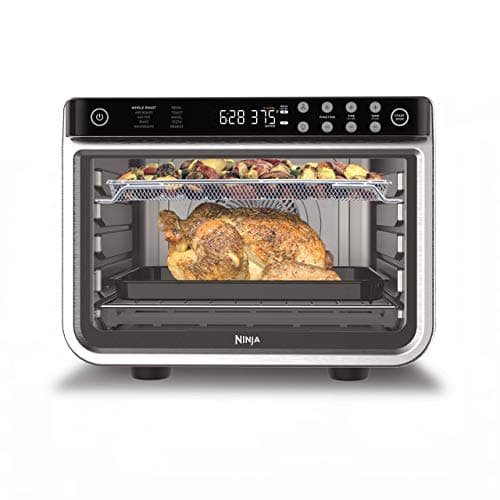
Comparisons
Air Fryer vs Toaster Oven
The only real difference is the convection fan. The rule: pay for the fan if you crisp and roast; skip it if you mostly toast.
Top pick: Ninja Foodi 10-in-1 XL Pro Air Fry Oven (DT201) · 2 ranked, 2 with live prices
$379.99on AmazonAir Fryer Toaster Ovens
Best Air Fryer Toaster Ovens Under $100
Sub-$100 picks that don't oversell themselves. Two of the three publish a real wattage, which the premium tier often won't.
Top pick: Hamilton Beach Easy View XL Toaster Oven with Sure-Crisp Air Fry, 6 Slice · 3 ranked, 3 with live prices
$69.99on Amazon