The short answer
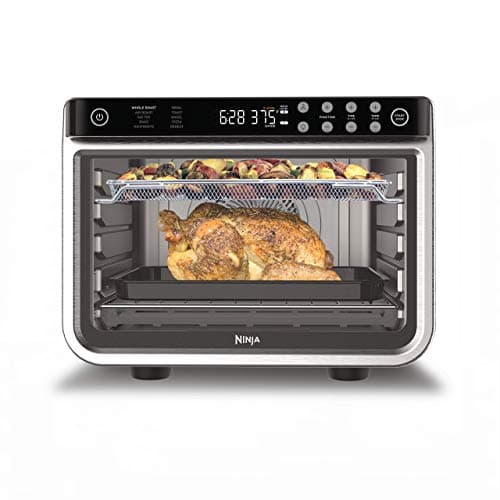
Buy the Ninja Double Oven (DCT401) if you regularly cook two things that want two different temperatures at the same time — wings at 400°F above a tray of vegetables at 350°F, or a pizza while something else roasts. That is the only thing it does that the cheaper oven cannot, and it is a mechanism rather than a preset. Buy the Ninja Foodi 10-in-1 XL Pro (DT201) if you cook one thing at a time and want the most usable interior per dollar in this category, with a wattage you can put in a calculator.
The reason to be blunt about that is the specification gap underneath it. SharkNinja publishes 1,800 Wfor the DT201 on its own product page. For the DCT401 it publishes no wattage at all — not on the listing, not in the copy we could read, nowhere — which means this site will not print a running cost for it and will not borrow the DT201's figure and call it the Double Oven's. Two cavities heated independently is not obviously the same electrical load as one, and a plausible guess is indistinguishable from a fabricated one. The wattage table lists the ovens that publish, and it is shorter than the number of ovens on this site for exactly this reason.
What Ninja actually publishes for each
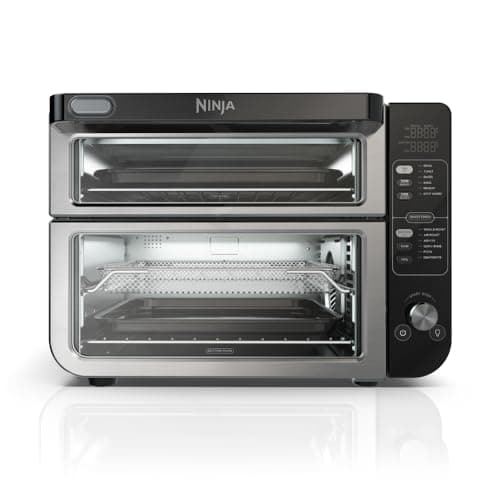
The DCT401.Twelve functions, split six per cavity — and the split is the specific part worth having. Ninja states which cavity does what: the top toasts, bakes, broils, reheats and does bagels; the bottom air fries, convection bakes, roasts and dehydrates. That is more precise than the bare “12-in-1” badge almost everything in this category settles for, and it is what tells you the two halves are not interchangeable. Capacity is stated as objects rather than a volume: six pounds of wings and a 12-inch pizza at once. Warranty, one year.
The DT201. 1,800 watts, ten functions, two full cooking levels, and a capacity claim of two 12-inch pizzas. No interior volume in cubic feet or liters from SharkNinja for either oven, so cross-brand space comparison against a Cuisinart that publishes 0.95 cubic feet remains guesswork in both directions.
Neither oven has a published interior height, which is the dimension that decides whether a whole chicken or a tall casserole fits. Splitting one box into two necessarily costs headroom in each half, and by how much, Ninja does not say. If that is the question you are buying on, size is worth working through first.
The divider is the whole product
Everything you pay extra for on the DCT401 is the FlexDoor. It is a real piece of hardware: the door splits so the two cavities can be opened and controlled separately, and they run at different set points simultaneously. In a category where the tenth function is usually the ninth function at a different fan speed, that is unusual and it is worth saying so.
It is also narrow. If you cook one thing at a time — which is what most countertop-oven cooking is — a single-cavity Ninja gives you more usable height in one piece for less money, and you have spent the premium on a partition. The question is not which oven is better; it is whether your cooking has two temperatures in it on a normal weeknight.
Where the DT251 comes in
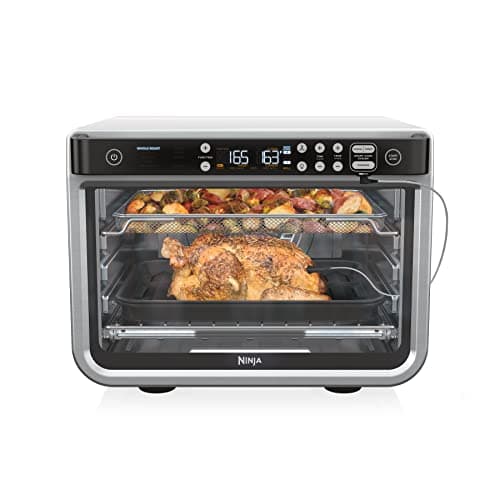
The third pick above is the Ninja Foodi 10-in-1 Smart XL (DT251), and it is here because it is the third corner of this decision rather than a filler. It is the DT201 cavity with an integrated probe, which is a different upgrade from the same starting point: the DCT401 spends the money on a second temperature zone, the DT251 spends it on knowing the internal temperature of what is in the first one. If you roast meat often, the probe changes more about your cooking than the divider does. We price that pair against each other separately, and the probe ovens are ranked as a group here.
SharkNinja publishes no wattage for the DT251 either, so of these three only the DT201 gets a running-cost figure from us. Two of the three most expensive options in this comparison are the two we cannot cost out, which is worth noticing on its own.
The documentation score, and why it moves the ranking
One of the five metrics behind every score on this site is Documentation: whether the manufacturer will tell you what its oven draws, how big the inside is, what temperature range it holds and how long the warranty runs. The full rubric is published. It is an unusual thing to score a product on and it is the most defensible number here, because you can check it yourself in ten minutes.
On that metric the DT201 beats the DCT401, and it is the reason the cheaper oven is not simply the budget option. A brand that will not print a wattage has told you something about how it expects the oven to be compared. Ninja is not unusual in this — Oster publishes a 42-liter interior and no wattage, Hamilton Beach publishes neither on several SKUs — but it is worth pricing in rather than assuming the spec sheet was just tidy.
The decision rule
Two temperatures at once, on a regular basis: the DCT401, knowing you will never get a running-cost figure for it. One thing at a time, the biggest sensible cavity, a number you can check: the DT201. Cooking to internal temperature rather than to the clock: the DT251. If none of those describe you, the honest recommendation points out of this page entirely — the full ranking is here, and a fully documented 1,800-watt oven in a smaller box suits more kitchens than any of these three.
How to check the FlexDoor claim against your own cooking
The useful test is not whether two-zone cooking sounds good; it is whether you can name the last three times you wanted it. Most countertop-oven cooking is sequential — the tray goes in, it comes out, the next thing goes in — and sequential cooking gets no benefit from a divider at all. Two-zone helps when the two dishes have to arrive at the same moment at different temperatures, which in practice means entertaining, roast dinners and families eating on different schedules.
The second thing to check is height. Neither Ninja publishes an interior dimension, so measure the tallest thing you regularly cook — a whole chicken, a covered casserole, a loaf tin with the lid on — and treat a divided cavity as roughly half the vertical space of an undivided one until Ninja says otherwise. On a single-cavity oven you can put the rack low and use the whole box. The pans that fit a countertop oven is the page that goes through this properly.
The third is the circuit. The DT201 draws 1,800 watts, which is 15 amps at 120 volts — the full rating of a standard kitchen circuit with nothing left over. Running it alongside a kettle or a microwave on the same circuit is how breakers trip. Whether these ovens need a dedicated circuit works through the arithmetic. For the DCT401, with no published figure, assume it is in the same class and give it the same respect.