HUB 06 · Guides & Answers
Convection vs Air Fry Setting: What's the Difference?
If your oven has both a convection setting and an air fry setting, you have probably wondered what actually changes when you press one instead of the other. The honest answer is less than the labels suggest.
We earn a commission if you buy through our links. It does not change the price you pay, and it does not decide our picks — the scoring rubric is published in full, including what disqualifies an oven. How this works.
The answer, in one paragraph
They are the same technology. Both the convection setting and the air fry setting use a fan to circulate hot air; “air fry” typically just runs the fan faster and the temperature higher, and pairs it with a perforated tray so air reaches the underside of the food. There is no separate air-frying mechanism inside your oven — there is a fan, and two presets that drive it differently. Which you choose matters far less than which tray you put the food on.
What each preset actually does
Convectionruns the fan at a moderate speed to even out the heat and speed up cooking, usually on a solid rack or pan — it is for baking and roasting where you want even browning without blasting the surface. Air fryruns the same fan faster and often at a higher set point, to drive maximum airflow across the food's surface for a crisp exterior, and it expects a perforated basket or tray so the moving air can reach the bottom of the food too. On many ovens the air fry preset is, mechanically, convection turned up. The underlying airflow mechanism is explained here.
The tray matters more than the button
Here is the part manufacturers underplay: the single biggest factor in whether food crisps is not the preset, it is whether air can reach the underside. Food sitting in a solid pan steams on the bottom no matter which button you pressed; food on a perforated tray or basket crisps all over. That is why you can “air fry” on a plain convection setting simply by using a perforated tray — and why pressing air fry with a solid sheet pan gives you a disappointing result. Choose the tray for the texture you want first, then the preset.
When to use which
Use convection for baking, roasting a tray of vegetables, and anything where you want even heat and gentle browning on a solid pan. Use air frywith a perforated tray for fries, wings, nuggets and anything you want crisp on every side. If your oven only has a convection setting, you have not missed out — add a perforated tray and you have an air fryer. This is exactly why an air fryer and a convection oven are the same thing at different scales. For ovens that do both settings well, with independently driven elements to back them up, the Breville Pro and Cuisinart TOB-260N1 are the most controllable on the site.
One variable the setting does not control for you is where the food sits. The manuals publish a rack position for every function and the air-fry position is higher than most people assume — we tabulated every published map across five brands, and the brands do not even number their racks in the same direction.
The hardware
The ovens this page is about
The ovens referred to above, with prices pulled live from Amazon and dated on every card. Full rankings live in the roundups linked from this page.
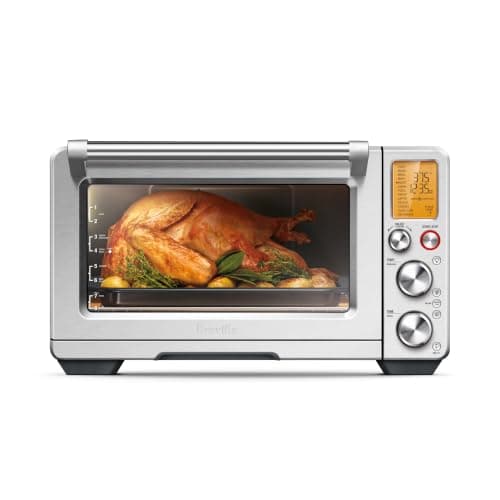
1,800 W
Breville Smart Oven Air Fryer Pro (BOV900BSS)
The most completely documented oven in the category, and the only one at any price whose manufacturer publishes a rated wattage, an interior volume and a full element layout in the same place. You pay roughly four times the category floor for that, and about a third of the premium is the documentation itself.
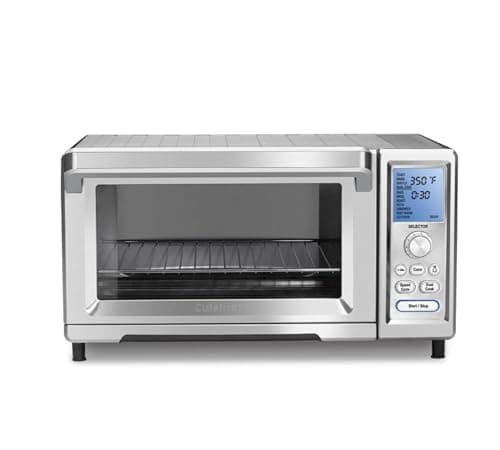
1,800 W
Cuisinart Chef's Convection Toaster Oven (TOB-260N1)
The only oven here whose manufacturer publishes both a wattage and an interior volume in cubic feet on the same page. 0.95 cubic feet at 1,800 W, with a stated list of what fits — a 13-inch pizza, a 9x13 pan, nine slices.
#ad · As an Amazon Associate we earn from qualifying purchases.
Questions
Frequently asked
Is the air fry setting the same as convection?
Can I use convection instead of air fry?
Why isn't my food crispy on the air fry setting?
Keep reading
Related
Receipts
Sources
- Breville — the Smart Oven Air Fryer Pro (BOV900) instruction book [PDF]
- Cuisinart — Chef's Convection Toaster Oven TOB-260N1 product page
We have not cooked in these ovens and we do not pretend to have. Specifications come from the manufacturer's own published documents; electricity rates come from the US Energy Information Administration; prices come from the live Amazon API. Where a figure is not published, the page says “not published” rather than guessing. Read the full method.