The short answer
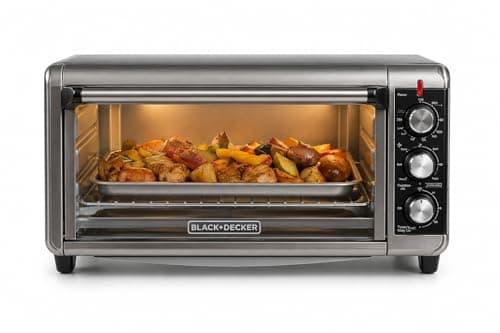
This is a wide, plain convection toaster oven from the brand that publishes more about its cheap ovens than most brands publish about their expensive ones. BLACK+DECKER prints the rating line in the manual — 1500 W, 120 V, 60 Hz — and puts the wattage, the outer dimensions, the weight and a two-year limited warranty in the specifications block of its own product page. The cavity is the point: it fits a 13 x 9 pan with the handles on, a 12-inch pizza or eight slices, which almost nothing else at this price does. What it lacks is equally plain. There is no air-fry setting and no basket; the fan is for convection baking. And at 22 inches wide it is the widest oven in its band, which is a measuring-tape problem before it is anything else.
What BLACK+DECKER publishes
This site has no test kitchen and says so on every page of the rubric. What we can do is read what a manufacturer is willing to put in writing, and one of our five scoring metrics is exactly that. For a sub-$100 oven the TO3250XSB clears more of it than it has any right to.
| What is published | Figure | Where |
|---|
| Rated power | 1500 W 120 V~ 60 Hz | Use and care manual, rating line |
|---|
| Wattage | 1500W | Product page, specifications block |
|---|
| Exterior (W×L×H) | 22 × 14.5 × 11.5 in | Product page, specifications block |
|---|
| Weight | 12.1 lb | Product page, specifications block |
|---|
| Functions | Bake, broil, toast, keep warm; convection fan | Product page |
|---|
| Fits | 13 × 9 pan with handles; 12-inch pizza; 8 slices | Product page |
|---|
| Timer | 60-minute timer with stay-on; separate toast timer; 3 rack positions | Amazon listing copy (brand-supplied) |
|---|
| Warranty | 2 years from date of original purchase (US and Canada) | Product page and manual |
|---|
Two gaps, stated rather than filled. BLACK+DECKER publishes no interior volume for this model — the “fits” row is a list of objects, which is honest but not a number — and no temperature range or tolerance. The listing copy does say something unusual on the second point, and we come back to it below.
1,500 watts: what it costs to run
Most full-size countertop ovens are rated at 1,800 watts, because 15 amps at 120 volts is 1,800 watts and that is where a standard kitchen circuit stops. This one is rated at 1,500, which BLACK+DECKER prints in the manual rather than leaving to listing copy. At the US average residential rate that is about 27.5 cents an hour at full draw, against 33.0 cents for an 1,800-watt oven — or roughly $50 a year instead of $60 at 30 minutes a day, 365 days a year.
1,500 W ÷ 1,000 × 18.34¢ per kWh = 27.5¢ per hour
× 182.5 hours a year (30 minutes a day, 365 days a year) = $50.21 a year
Rate: US EIA, Electric Power Monthly Table 5.3 — average residential price, US total, June 2026. Upper bound — elements cycle off once the cavity is hot and no maker publishes a duty cycle.
The honest reading of a lower rating is the same one we give every sub-1,800-watt oven: it is cheaper per hour and slower per cook, and a cheaper hour is only a cheaper meal if the oven does not have to stay on proportionally longer. In a cavity this wide, expect the preheat to be the part you notice. The circuit benefit is more concrete — 1,500 watts is 12.5 amps, which leaves headroom on a 15-amp circuit that an 1,800-watt oven does not. The circuit arithmetic is worked through here, and every published wattage we hold is tabulated here.
The cavity is the reason to buy it
Almost every toaster oven under a hundred dollars is a four-slice box, and the honest ceiling on those is a 9-inch pizza and an 8 x 8 pan. This one is built around a different object: the 13 x 9 pan with handles that most kitchens already own, which BLACK+DECKER says goes in as-is. That is the difference between reheating for one and baking a lasagna, a tray of brownies or a sheet of vegetables for a household without turning on the full-size oven — which is the whole efficiency argument for a countertop oven. Three rack positions, per the listing copy, are what make the height usable.
The price of that width is width. Twenty-two inches is wider than both Breville Pros and close to the widest oven we cover; on a standard 24-inch counter with a backsplash it is fine, under a low upper cabinet it may not be. At 11.5 inches tall it is not the problem dimension — the width is — and our sizing guide is the place to check before ordering.
Dials, and the set-point note
Three dials and a mechanical timer. Everything that retires a cheap countertop oven early — a capacitive panel that stops registering, a control board that dies while the elements are fine — is absent here, and that is the same argument that makes the Cuisinart Custom Classic a durable recommendation. What a dial cannot give you is precision, and BLACK+DECKER's own listing copy says something worth quoting on that point: temperatures in the oven will be lower than the set point, by design, because the dial has been calibrated around its heating elements to give expected results for most recipes. Read plainly, that means the number on the dial is not the air temperature in the box. For toast, reheating and a tray of vegetables that does not matter. For bread, where a stable, known temperature is the whole job, it does, and our bread ranking explains why that rules this class of oven out.
What the fan does and does not do
The fan makes this a convection oven: moving air browns more evenly and speeds a bake, and that is a real, binary advantage over a radiant box. What the various convection terms mean is here. What the TO3250XSB does not have is an air-fry setting or a basket, and on this site we do not pretend a convection bake setting is the same thing as a fast fan over a mesh basket. If crisping is what you are buying an oven for, the two ovens ranked above it on our convection page have a basket and cost less. If a wide, checkable convection baker is what you are buying, this is the one with the paperwork.
The warranty
Two years from the date of original purchase, with proof of purchase, in the United States and Canada — stated on the product page and spelled out in the manual's warranty section, which also lists the exclusions (commercial use, misuse, unauthorized repair). Two years is the same term BLACK+DECKER publishes on its budget TO1785SG, and it is twice what most of this band offers or states.
Against the alternatives
Against the Cuisinart TOB-135N it replaces in our rankings: that oven is discontinued by Cuisinart and unavailable on Amazon, which settles the comparison; while it was current it published no spec sheet at all. Its review stays up for the record. Against the Cuisinart Custom Classic: the Custom Classic is 1,800 watts behind three knobs with no fan; this is 1,500 with one. Against the Oster 42 L French Door in the tier above: the Oster publishes a bigger interior in liters and adds air fry, and publishes no wattage. Against the BLACK+DECKER Crisp 'N Bakebelow it: the Crisp 'N Bake has the basket and a four-slice cavity; this has the pan and the paperwork.
Who should skip it
Anyone who wants to air fry — there is no basket and no setting, and the crisping this site spends most of its pages on needs both. Anyone with a shallow or cabinet-constrained counter, because 22 inches is the number that decides. And anyone baking bread to a set temperature, because BLACK+DECKER tells you in its own words that the dial and the air do not agree. Buy it if you want the 13 x 9 pan to fit, a two-year warranty and a wattage you can check, in an oven with nothing electronic to fail.