The short version
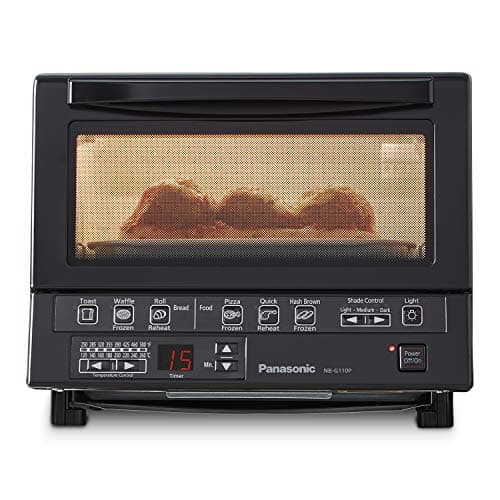
The pick is the Panasonic FlashXpress (NB-G110P), and it is not close. Panasonic publishes 1,300 watts and a 7.2-quart cavity, which works out at about 181 watts per quart — half again the density of the next oven on this page and nearly three times that of the big 1,800-watt boxes. For reheating that is the whole ballgame: a small cavity with a lot of element in it gets to temperature while a larger one is still warming its own air. It uses twin infrared elements, publishes a 250–500°F band, and is the single most completely specified oven on this site. It is for the person reheating a plate, a slice or a portion — not a casserole.
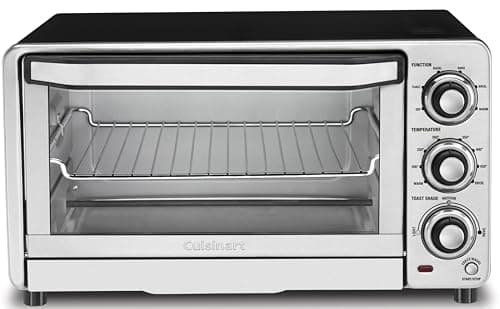
Spend less and the answer is the Cuisinart Custom Classic (TOB-40N): the full 1,800 watts behind three knobs in a cavity Cuisinart now states as half a cubic foot, which is about 120 watts per quart — second on the page. There is nothing electronic in it to fail, it has been sold essentially unchanged for over a decade, and it costs a fraction of the Panasonic.
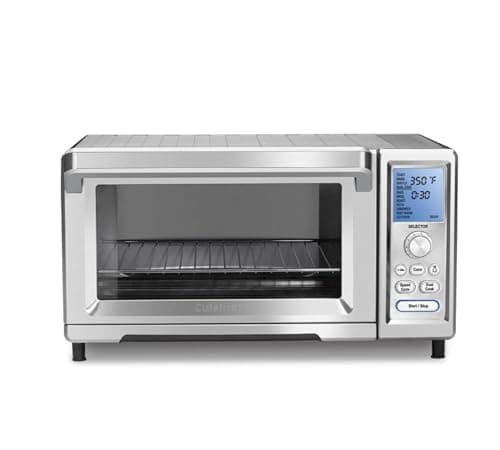
If you reheat dishes rather than plates, skip to the Cuisinart Chef's Convection (TOB-260N1) at number four. Its density is middling at 63 watts per quart, but it is the only oven here with a published 9 x 13 pan fit and 0.95 cubic feet printed next to its 1,800-watt rating, and a tray of lasagna does not fit in a 7.2-quart box at any wattage.
We have reheated nothing in any of these ovens. There is no test kitchen behind this site and the rubric says so in those words. Every number below came off a manufacturer document.
Why reheating is ranked on density and not on watts
Wattage on its own tells you the size of the fire. It does not tell you how much air and steel that fire has to warm before your food feels it. Two ovens rated at 1,800 watts can behave completely differently on a single plate of leftovers if one of them is a half-cubic-foot box and the other is a thirty-quart cabinet, because the big one spends the first several minutes heating itself.
Divide the published wattage by the published cavity volume and you get a crude but genuinely comparable figure: watts per quart. It is not a time-to-temperature measurement and we are not presenting it as one — the real thing depends on element placement, thermal mass, door sealing and the fan, and no manufacturer publishes any of those. What it is, is the only density proxy that can be built entirely out of numbers brands actually print.
The catch is that both numbers have to exist. Here is every oven in our catalog where they do:
| Oven | Published watts | Published cavity | Watts per quart |
|---|
| Panasonic FlashXpress | 1,300 W | 7.2 qt | 181 |
|---|
| Cuisinart Custom Classic (TOB-40N) | 1,800 W | 0.5 cu ft (14.96 qt) | 120 |
|---|
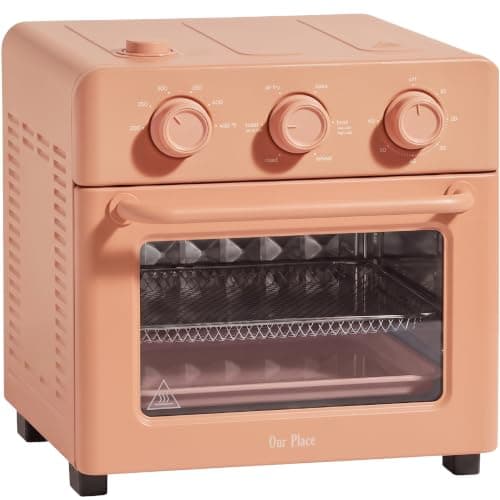
| Our Place Wonder Oven | 1,400 W | 13 qt | 108 |
|---|
| Cuisinart Chef's Convection (TOB-260N1) | 1,800 W | 0.95 cu ft (28.43 qt) | 63 |
|---|
| Breville BOV900 / BOV950 | 1,800 W | 1 cu ft (29.92 qt) | 60 |
|---|
| Nuwave Bravo XL Pro | 1,800 W | 30 qt | 60 |
|---|
| Our Place Wonder Oven Pro / Large | 1,700 W | 28 L (29.59 qt) | 57 |
|---|
Nine ovens out of thirty-four. Every other machine we cover publishes a wattage with no volume, a volume with no wattage, or neither — and in those cases we print no density figure rather than estimating a cavity from the outside of the box. Every published wattage we hold is here.
Read the table and the pattern is hard to miss: density runs opposite to size, and almost opposite to price. The three densest ovens in the catalog are a 7.2-quart Panasonic, a half-cubic-foot Cuisinart from a decade-old design, and a 13-quart Our Place. The flagships cluster at 57 to 63. For reheating, the expensive ovens on this site are the wrong ovens.
What else decides a reheat, and who publishes it
- A published top-down radiant capability. Reheating pizza well is a crisping problem on the bottom and a melting problem on the top, which radiant heat from above does better than circulating air. The Panasonic is explicit about its mechanism — twin infrared elements, no fan — and what “infrared” means here is set out in full.
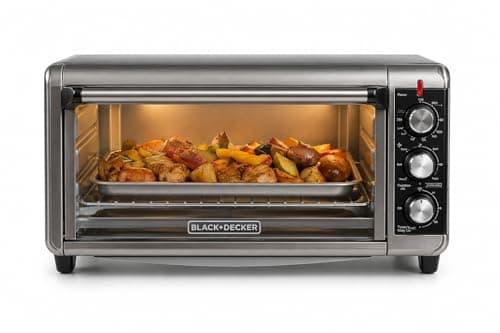
- A named hold function in the maker's own function list. Not a marketing bullet. On this page exactly one oven qualifies: BLACK+DECKER publishes its TO3250XSB function list as bake, broil, toast and keep warm with a convection fan. That is the only published hold mode in this field, and it is the main reason that oven is on the page.
- A published temperature floor.Reheating gently matters more than reheating hot. Published floors across our catalog run from 50°F (Nuwave) and 80°F (Breville BOV950, Our Place Pro) to 250°F (Panasonic) — and most of the field publishes nothing at all. The Panasonic's 250°F floor is the highest published floor here and is a genuine limitation we count against it below.
- Published fit for the thing you are reheating. A slice, a plate, or a 9 x 13 dish are three different ovens. The pan geometry is worked through here.
Why the order is the order
1. Panasonic FlashXpress (NB-G110P). First on density by a margin nothing else approaches, and first on documentation outright: Panasonic publishes power consumption, supply voltage and frequency, capacity, the 250–500°F band and exact millimetre dimensions. Twin infrared elements and no fan means no preheat in the usual sense, and the 500°F ceiling is the highest published figure anywhere in our catalog. The honest costs are real and they are the same ones that make it good here: 7.2 quarts is small, four slices is the ceiling, a 9-inch pizza is optimistic, and the 250°F floor is the highest published floor on this page — there is no low hold. It is also expensive for its size. Full review here.
2. Cuisinart Custom Classic (TOB-40N).1,800 radiant watts in half a cubic foot, behind a timer, a bell and three knobs. Second on density at about 120 watts per quart, and the cheapest route on this page to a genuinely fast reheat. No fan at all, which for pizza and pastry is closer to an advantage than a compromise. Against it: the 0.5 cubic foot figure comes from Cuisinart's own Amazon listing title rather than a spec sheet, there is no published temperature range, and it is roughly half the cavity of the TOB-260N1 at the same wattage. Full review here.
3. Our Place Wonder Oven. Third on density at 108 watts per quart, and on the page for a capability nothing else here has: Our Place publishes a steam-infusion function, and steam is the one mechanism that brings day-old bread, pizza crust and rice back without drying them. It is also the most completely documented small oven we cover — a rating-plate 1,400 W read off the manual cover, a 200–450°F band, interior dimensions, weight and a warranty term. The limits are published too and they bite here: a 200°F floor and a 60-minute timer, four slices, a 9-inch pizza, and no accessory is dishwasher safe. Full review here.
4. Cuisinart Chef's Convection (TOB-260N1). The dish-reheating pick. Density is middling at 63 watts per quart, but it is the only oven in our whole catalog whose maker publishes a wattage and an interior volume in cubic feet in the same place — 1,800 W and 0.95 cu ft — with a stated fit list of a 13-inch pizza, a 9 x 13 pan and nine slices. Fifteen functions including a dual-cook that runs two temperatures in sequence, which is the closest thing in this field to a reheat-then-hold. Against it: it is the deepest oven on this site at 530 mm, and Cuisinart lists the model as discontinued on its own site so availability moves around. Full review here.
5. BLACK+DECKER 8-Slice Extra Wide (TO3250XSB). Last on the page and the only oven on it with a publishedkeep-warm function in BLACK+DECKER's own function list — which, if you reheat for people who arrive at different times, may matter more than everything above it. It prints the rating line in its own manual at 1,500 W, 120 V, 60 Hz, states a 13 by 9 pan fit with the handles included, carries a two-year warranty and costs under a hundred dollars. It is fifth because BLACK+DECKER publishes no interior volume, so its density cannot be computed at all, and because its own copy states that its ovens read below the set point by design. Twenty-two inches wide is the widest in its band. Full review here.
Is a toaster oven actually a microwave replacement?
For some of what a microwave does, yes, and better; for the rest, no, and not even close. A microwave heats water molecules throughout the food at once, which is why it is fast and why it leaves pizza crust limp. A toaster oven heats the surface and conducts inward, which is why it takes several times as long and why it is the only one of the two that makes anything crisp.
The honest division of labour: soup, a mug of liquid, steamed vegetables and anything you want done in ninety seconds are microwave jobs, and no oven on this page competes. Pizza, fries, fried chicken, pastry, bread, roasted vegetables and anything with a crust that mattered when it was fresh are oven jobs, and the microwave actively ruins several of them. If you only have counter space for one, we work the whole comparison through here, including the part where a toaster oven uses more electricity per reheat and still costs almost nothing — the arithmetic is here.
What a reheat costs
At the US average residential rate this site uses throughout — 18.34¢ per kWh, EIA Table 5.3, June 2026 — full rated draw is roughly 33.0 cents an hour for the two 1,800-watt Cuisinarts, 27.5 cents for the 1,500-watt BLACK+DECKER, 25.7 cents for the 1,400-watt Our Place and 23.8 cents for the 1,300-watt Panasonic. A ten-minute reheat is therefore four to six cents in any of them, and the denser oven that finishes sooner can be the cheaper one despite a higher rating — which is the opposite of how wattage is usually read.
Those are ceilings and we label them as such: an oven draws its rated wattage only while the elements are energized, and the thermostat cycles them off once the cavity is up to temperature. Nobody publishes duty cycles, so we compute at full draw rather than invent a correction factor. The full arithmetic, with the usage assumption stated.
How to compute density for an oven we do not cover
Find two figures on the manufacturer's own page — not the retailer's — and divide. The rated wattage, and the interior volume. If the volume is in cubic feet, multiply by 29.92 to get quarts; if it is in litres, multiply by 1.057. Then divide the watts by the quarts. Anything over about 100 is a dense, fast-reheating oven; anything near 60 is a big cabinet that will take its time on a single plate.
If either number is missing, that is your answer about the brand rather than about the oven. More than two-thirds of the ovens we cover fail this test, and they cluster at the cheap end — though not only there. Why Documentation is one of the five metrics we score.
Three habits that matter more than the oven
Do not preheat for a reheat. You are not baking: you want the food to come up with the cavity, so put it in cold and let both climb together. This is the opposite of the advice for bread, and it is why the preheat question has two different answers.
Use a lower set point than the original cook. The food is already cooked through; what you are fixing is temperature and texture. 300 to 325°F for most things gets the middle warm before the edges go leathery, which is also why a published floor is worth more than a published ceiling on a reheating oven.
Put it on the rack, not in a dish. A pizza slice straight on the wire rack crisps underneath; the same slice on a solid tray steams against the metal. That is the entire mechanism behind air-fry baskets, worked through in the basket-versus-oven comparison, and it costs nothing to apply.