HUB 06 · Guides & Answers
Do Air Fryer Ovens Need to Preheat?
Some functions do and some do not, and your oven already knows which is which. Breville lists them by name in its instruction books, BLACK+DECKER publishes a figure in minutes, and Panasonic claims the question does not apply to its oven at all.
We earn a commission if you buy through our links. It does not change the price you pay, and it does not decide our picks — the scoring rubric is published in full, including what disqualifies an oven. How this works.
The short answer
It depends on the function, not on the oven — and on most modern countertop ovens the decision has already been made for you in firmware. Breville's instruction books split the function list into two groups in as many words: settings without a preheat cycle and settings that feature a preheat cycle. On a Smart Oven Pro (BOV845) the split is:
- No preheat cycle: TOAST, BAGEL, BROIL, REHEAT, WARM. Put the food in and start.
- Preheat cycle: BAKE, ROAST, PIZZA, COOKIES, SLOW COOK. Press start before the food goes in — the screen blinks PREHEATING and an alert sounds when the oven is up to temperature.
The Smart Oven Air Fryer Pro (BOV900) runs the same logic over a longer function list. No preheat: TOAST, BAGEL, BROIL, WARM, PROOF, REHEAT, DEHYDRATE. Preheat: BAKE, ROAST, PIZZA, AIR FRY, COOKIES and SLOW COOK — with one exception the book flags specifically, which is that for SLOW COOK you put the food in before the preheat rather than after.
Air fry is a preheat function, and that surprises people
On the BOV900 and the BOV860, AIR FRY is in the preheat group. That is worth sitting with, because the entire selling point of an air fryer is speed, and a good deal of the internet advice on air frying says the preheat is optional.
The mechanism says otherwise. Air frying works by driving moisture off the surface of food faster than heat conducts into the middle of it, which is how you get a crisp exterior and a cooked interior at the same moment. The full explanation is one paragraph. Food placed into a cold cavity spends its first three to five minutes sitting in warming air, drying slowly and evenly rather than searing — you get a dehydrated surface instead of a crisp one. The saving in a countertop oven is that the preheat is short, not that it is skippable, because there is about a fifth as much air to heat as in a full-size oven. That arithmetic is worked through here.
Where a number is published
BLACK+DECKER is the only manufacturer on this site that puts a figure in minutes in its manual, and it publishes three separate rules for the TO3250XSB:
- Toasting: it is not necessary to preheat the oven for toasting.
- Baking: for best results, when baking or cooking, always preheat the oven for at least 10 minutes at the desired temperature setting.
- Broiling: when broiling, preheat oven for 10 minutes.
Ten minutes is a long time for a countertop oven and it is worth understanding why this one asks for it. The TO3250XSB is a wide 1,500-watt cavity with dial controls and no temperature display — there is no PREHEATING indicator to tell you when it is ready, so the manufacturer gives you a clock instead. An oven that tells you when it is hot does not need to publish a duration; an oven that does not, does.
The oven that says the question does not apply
Panasonic publishes the opposite claim for the FlashXpress (NB-G110P), on its own product page, in its own words: the double infrared heater delivers instant heat that eliminates the need for preheating, and the marketing copy repeats it as no preheating required. The heaters sit at the front and back rather than above and below, and infrared heats the surface of the food directly rather than heating the air first.
Whether that eliminates preheating for every job or mainly for toasting and reheating is not something Panasonic breaks down, and we have not cooked in one, so we report the claim and its source rather than grading it. It is a real published claim from the manufacturer, it is unusual in this category, and it is one of the reasons the FlashXpress scores as highly as it does on documentation. The full review is here.
Automatic preheats, and the ability to cancel one
Nuwave's Bravo XL Pro handles it a third way: the manual documents an Automatic Preheat and a dedicated PREHEAT button, with the instruction that you press PREHEAT to cancel the preheat process. So the oven preheats by default on the functions that call for it and gives you an explicit override.
Our Place's Wonder Oven takes the manual route in the other direction — its book describes preheating as something you do deliberately by setting the mode, temperature and a time on the dial and waiting for the oven to signal that it is preheated.
Four manufacturers, four designs: name the functions and automate them (Breville), publish a duration in minutes (BLACK+DECKER), automate with an override (Nuwave), or make it a user step (Our Place). None of them is wrong, and none of them is guessable from the box.
What to check on yours
Find the two lists. In a Breville book they are numbered steps 5 and 6 of the general operating instructions, before the individual functions. In other manuals the rule is usually printed under each function heading.
Watch for the indicator rather than the clock. An oven with a PREHEATING display and an end-of-preheat alert is telling you the truth about its own cavity on the day; a published ten-minute figure is a worst case. If you have the indicator, use it.
Preheat anything where the surface matters. Crisping, browning, baking, a pizza base, anything air-fried. Skip it for toasting, reheating and holding food warm — which is precisely the split Breville has already made for you.
Preheat the vessel, not just the oven, for heavy items.A pizza stone or a cast-iron pan has far more thermal mass than the air around it. Breville's own instruction is to heat the stone without a pizza on it first, and for bread work the vessel should come up from cold with the oven. The sourdough guide goes through this properly.
Do not count the preheat out of the running cost. The oven draws its full rated power while it is preheating, so a ten-minute preheat on a 1,500-watt oven is ten minutes of 1,500 watts. The cost arithmetic is shown in full.
The four ovens below are the ones whose published preheat behavior is quoted above.
The hardware
The ovens this page is about
The ovens referred to above, with prices pulled live from Amazon and dated on every card. Full rankings live in the roundups linked from this page.
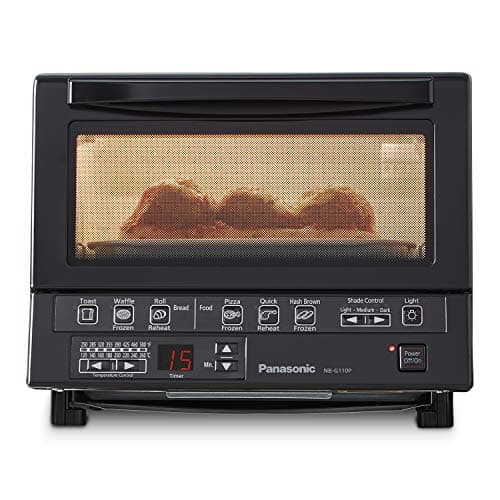
1,300 W
Panasonic FlashXpress Toaster Oven (NB-G110P)
The most completely documented oven on this entire site relative to its size: 1,300 W, 120 V, 60 Hz, 7.2 quarts, 250–500°F, exact millimeter dimensions and a stated weight. Panasonic publishes all of it, and almost nobody else does.
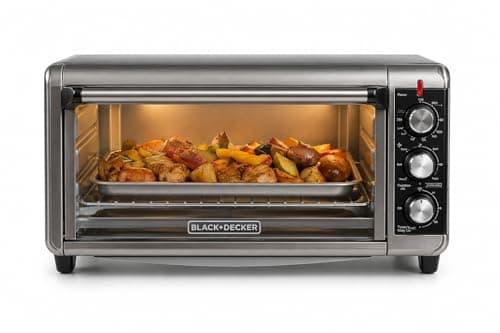
1,500 W
BLACK+DECKER 8-Slice Extra Wide Convection Toaster Oven (TO3250XSB)
A dial-controlled convection toaster oven whose maker publishes the wattage, the dimensions, the weight and a two-year warranty on its own page, and prints the rating line in the manual — 1500 W, 120 V, 60 Hz. Eight slices, a 12-inch pizza and a 9 x 13 pan with handles, for under a hundred dollars. It is a convection baker, not an air fryer: there is no basket and no air-fry setting.
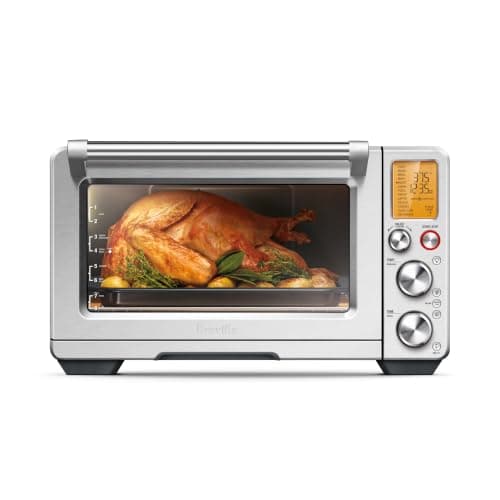
1,800 W
Breville Smart Oven Air Fryer Pro (BOV900BSS)
The most completely documented oven in the category, and the only one at any price whose manufacturer publishes a rated wattage, an interior volume and a full element layout in the same place. You pay roughly four times the category floor for that, and about a third of the premium is the documentation itself.
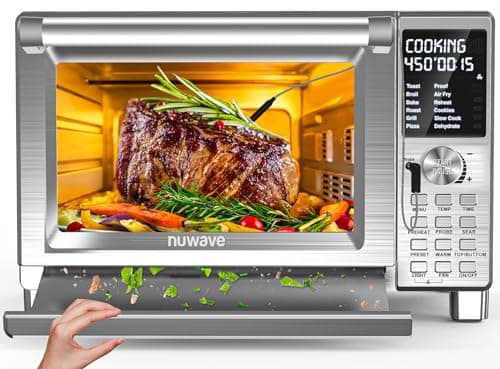
1,800 W
Nuwave Bravo XL Pro Air Fryer Toaster Oven (30 Qt, with probe)
A 30-quart, four-rack-level convection oven with an integrated temperature probe that stops the cook at a set internal temperature, and a maker that publishes its interior and exterior dimensions, weight, capacity, temperature range and warranty term — most of which the Ninja probe ovens do not. The 1,800-watt figure comes from a Nuwave support answer on its own product page rather than the manual's rating line, and we say so.
#ad · As an Amazon Associate we earn from qualifying purchases.
Questions
Frequently asked
Do you need to preheat an air fryer oven?
Do you need to preheat for air frying?
How long should you preheat a toaster oven?
Which toaster oven does not need preheating?
Does preheating use a lot of electricity?
Keep reading
Related
- Does an air fryer cook faster?Yes, and most of the saving is the preheat.
- Which rack position to useThe other per-function instruction the manuals publish.
- What an air fryer oven costs to runIncluding the preheat, at a cited rate.
- Times and temperaturesThe conversion arithmetic, with no invented cooking times.
Receipts
Sources
- Breville — the Smart Oven Pro (BOV845) instruction book [PDF]
- Breville — the Smart Oven Air Fryer Pro (BOV900) instruction book, L23 edition [PDF]
- Breville — the Smart Oven Air Fryer (BOV860) instruction book [PDF]
- BLACK+DECKER — TO3250XSB / TO3260XSBD / TO3240XSBD use and care manual [PDF]
- Panasonic — FlashXpress Toaster Oven NB-G110P product page
- Nuwave — Bravo XL Pro owner's manual, model 20813 [PDF]
- Our Place — Wonder Oven user manual, model APL.WDO.ESN [PDF, retailer-hosted copy]
We have not cooked in these ovens and we do not pretend to have. Specifications come from the manufacturer's own published documents; electricity rates come from the US Energy Information Administration; prices come from the live Amazon API. Where a figure is not published, the page says “not published” rather than guessing. Read the full method.