The short answer
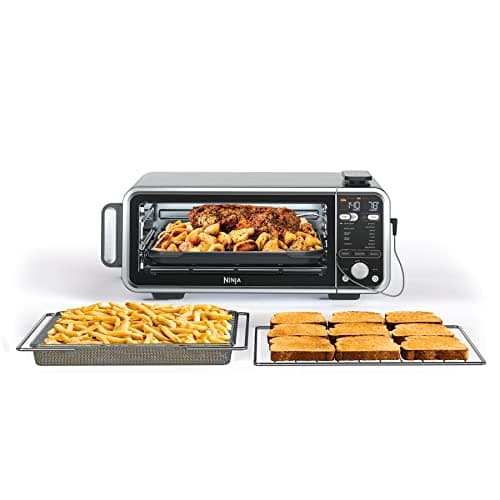
The SP351 takes the flip-away oven that solves the small-kitchen problem and adds the two things the cheaper version lacks: an integrated probe thermometer and a dedicated high-heat top element rather than the same element run harder. It is the only oven we cover that combines vertical storage with a probe. If your counter has to be clear between meals and you cook to temperature rather than to time, nothing else here does both. If your counter is permanently available, you are paying for a hinge you will never fold.
What Dual Heat actually means
A separate high-heat element at the top, used for searing and browning, instead of driving the general-purpose bake element beyond its comfortable range. This is a real hardware distinction rather than a preset — the same category of difference as Breville driving six elements independently rather than switching them in banks. What it buys is the ability to put aggressive heat on the top surface of something without cooking the whole cavity at that temperature, which is what finishing a piece of meat or the top of a gratin actually needs.
What we cannot tell you is how hot. Ninja publishes no temperature range for this model, and no wattage, so we can neither compute a running cost nor tell you where its ceiling sits. Our wattage table is shorter than our catalog for exactly this reason, and the SP351 is one of the ovens missing from it.
The probe is the other half of the price
A built-in thermometer changes how you cook meat more than any preset does: you stop opening the door to check, which means you stop dumping the cavity temperature every few minutes, which in a cavity this small matters more than it does in a range. The oven can also stop itself at a target rather than at a time. This is the same argument we make for the DT251 over the DT201, and the same caveat applies: it is worth real money if you roast frequently and close to nothing if you mostly reheat.
The flip-away chassis, and what it costs
The SP line's defining feature is that it rotates up against the backsplash when you are done, reclaiming the counter without unplugging and lifting a heavy box into a cupboard. That is a genuine solution to the only problem this category reliably creates, and it is why the simpler SP101 wins our under-cabinet ranking.
The cost is geometry. A chassis that folds flat is a shallow chassis, so there is one cooking level and no second rack position to gain. Ninja publishes no interior volume for this model either — none of the Ninja line does — so you are comparing a folding oven you cannot measure against fixed ovens you can. At this price the DT201 gives you two full cooking levels and a checkable capacity claim of two 12-inch pizzas, and it does not fold.
Thirteen functions
Thirteen is deep into the territory where the count is marketing. A function in this category is a heat profile at a set point; adding a fourteenth costs a manufacturer a line of firmware and a word on the box. We do not score ovens on function count and our rubric says so. What is worth noting is that the SP351 earns its number partly on real hardware — the second element is genuine — rather than entirely on labeling, which is not true of every thirteen-function oven.
Who should skip it
Anyone with permanent counter space. Everything expensive about this oven is the folding chassis, and if it never folds you have bought a small oven at a large price — an oven with more interior for the same money is the better buy, and this site has several. The larger cavities are ranked here. Also skip it if a paper trail matters to you: no published wattage, no published interior, no published temperature range, on an oven at this price is a fair thing to object to.
How we picked
Ovens we claim to have cooked in: 0
Everyone in this category tells you they roasted forty chickens. We have roasted none, and we say so. Here is what we do instead: read the manufacturer's manual and spec sheet, record the published wattage, interior volume, temperature range and warranty term, work out what the oven costs to run for an hour and for a year, show the arithmetic so you can redo it with your own electricity rate, and cite all of it. Where a brand publishes no wattage, we print no running cost rather than borrowing a number from a similar model. Prices come live from Amazon's API and disappear rather than go stale.
The scores above are judgments from that documented research — not test results. One of the five metrics is Documentation: whether the manufacturer will tell you what its oven draws at all. The full rubric, including what disqualifies an oven, is published in full.