The short answer
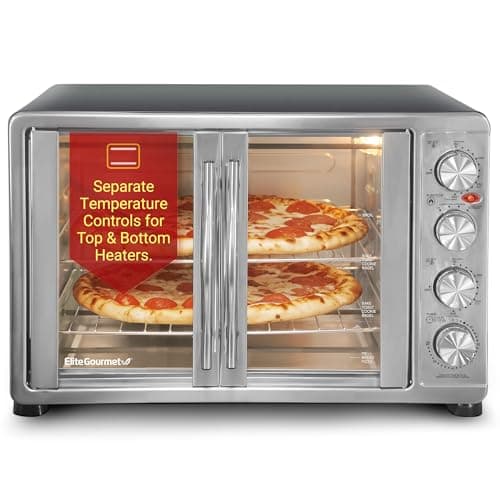
The Elite Gourmet ETO4510B is the cheapest way to get 47.5 quarts of oven onto a counter. Eighteen slices, French doors that open without a hot slab swinging into the room, four manual knobs and a rotisserie — all for well under two hundred dollars. What you give up for that volume is documentation and precision: there is no published wattage, and an analog thermostat at this price holds temperature loosely. It is a lot of oven, honestly priced, with honest limits.
The interior is the whole point
47.5 quarts is the largest stated interior on this site by a wide margin — it fits a full turkey breast or two sheet pans, which nothing else near this price does. The French doors matter more than they look: they open outward from the middle and need almost no clearance in front, unlike a single drop-down door that becomes a hot shelf eating your counter depth. For batch cooking, a crowd, or anyone who wants to stop heating a full-size range for large jobs, that combination of raw volume and easy access is genuinely unusual at the price. It is why the ETO4510B places on our under-$200 convection ranking.
Manual knobs are a feature here
On an expensive oven, knobs would feel like a downgrade; on a cheap one they are a durability advantage. There is no capacitive panel or control board to fail — just four knobs, a thermostat and a rotisserie motor. That is fewer things to break on an oven whose price makes professional repair uneconomic anyway, and it is the right engineering choice at this end of the market.
What it never published
A wattage, anywhere we could find. So the ETO4510B gets no running-cost figure from us, and it is one of the large French-door ovens our convection electricity page specifically cannot cost. That gap has a practical dimension too: a 47.5-quart cavity heats far more air than a 25-quart one, so it takes longer to come up to temperature and costs more per use — and with no published watt figure you cannot even check by how much. Buying big is buying air you pay to heat on every preheat, which is the exact inefficiency a countertop oven is supposed to solve.
The thermostat is the real limit
An analog knob thermostat in this price band is an approximation, not a setting. There is no published tolerance to check, and in practice the set temperature and the actual temperature drift apart. For roasting, batch cooking and general use that matters little. For bread, where a stable temperature floor beats raw volume, it matters a great deal — our bread ranking explains why, and it is the reason a big cheap oven is the wrong tool for a serious loaf.
Who should skip it
Anyone who cooks mostly for one or two, and anyone who needs the set temperature to be the real one. Heating 47.5 quarts of air to bake two potatoes is pure waste, and a loose thermostat is a poor foundation for precise baking. If you want a checkable running cost and a published interior in one place, spending up to the Cuisinart TOB-260N1 buys exactly that. But if you genuinely need the room and cook the kind of large, forgiving food that fills it, nothing else here gives you this much oven for the money.
How we picked
Ovens we claim to have cooked in: 0
Everyone in this category tells you they roasted forty chickens. We have roasted none, and we say so. Here is what we do instead: read the manufacturer's manual and spec sheet, record the published wattage, interior volume, temperature range and warranty term, work out what the oven costs to run for an hour and for a year, show the arithmetic so you can redo it with your own electricity rate, and cite all of it. Where a brand publishes no wattage, we print no running cost rather than borrowing a number from a similar model. Prices come live from Amazon's API and disappear rather than go stale.
The scores above are judgments from that documented research — not test results. One of the five metrics is Documentation: whether the manufacturer will tell you what its oven draws at all. The full rubric, including what disqualifies an oven, is published in full.