HUB 05 · Running Costs & Power
Air Fryer Oven vs Microwave: Electricity Cost
They draw similar power, so the difference is time. A microwave heats only the food for a few minutes; an air fryer oven heats a whole cavity for fifteen or twenty. For reheating, that makes the microwave far cheaper — and for crisping, it makes the oven the only option. Here is the full arithmetic.
We earn a commission if you buy through our links. It does not change the price you pay, and it does not decide our picks — the scoring rubric is published in full, including what disqualifies an oven. How this works.
The answer, first
For reheating a single portion, a microwave uses far less electricity than an air fryer oven — not because it draws less power, but because it finishes in a fraction of the time and heats only the food instead of a whole cavity. One reheat costs roughly 1.4¢ in a microwave against about 8.3¢ in an 1,800-watt oven, on the assumptions below. The oven only wins when the job is something a microwave cannot do: crisp, brown or bake. Match the machine to the task, not to a wattage on the box.
Why wattage is the wrong thing to compare
A microwave and a large air fryer oven pull broadly similar power from the wall — a common 1,000-watt-output microwave draws roughly 1500 watts, and a full-size oven draws 1,800. If you stopped there you would conclude they cost about the same, and you would be wrong, because the two never run for the same length of time. The microwave excites water molecules in the food directly and is done in a couple of minutes; the oven heats a large volume of air first, then the food, over fifteen to twenty minutes including preheat. Energy is power times time, and the time is where the whole difference lives.
The arithmetic, per reheat
Same method as every running-cost page here: watts ÷ 1000 × hours × rate. The only new inputs are the runtimes, stated so you can change them.
Why these are upper bounds
Both figures assume full rated draw for the whole runtime, which makes them ceilings, not meter readings. A microwave really does draw close to its rating the entire time it runs, so its figure is nearly exact. An oven does not: once the cavity is hot, the thermostat cycles the elements off and on, so a real reheat draws less than 1,800 watts for part of its fifteen minutes — which makes the oven's true cost somewhat lower than shown, but still several times the microwave's, because the runtime gap is so large. The microwave assumption is stated rather than sourced to a specific model because we do not spec microwaves; change 1500to your own microwave's draw and the sum holds.
When the oven is worth the extra energy
Whenever the result is the point. A microwave reheats fast and cheap but leaves food soft — it cannot crisp a fry, brown a crust or bake anything, because it does not apply dry radiant or convected heat to the surface. An air fryer oven costs more electricity per reheat and is the only one of the two that makes leftover pizza crisp again or roasts a tray of vegetables. So the honest rule is not “the microwave is cheaper” full stop; it is “the microwave is cheaper for reheating, and the oven is the only option for crisping.” A fast, high-density oven like the Panasonic FlashXpress narrows the time gap by skipping a long preheat, which is the closest an oven gets to microwave economy while still crisping.
What this means in practice
If most of what you do is reheat single portions, keep the microwave for that and do not feel you must run the oven — you would spend several times the energy for a softer result. If you regularly crisp, brown, toast or bake, the oven earns its higher per-use cost by doing something the microwave cannot, and the absolute figures are small either way: a few cents a reheat, a few dollars a year. Your electricity rate matters more than the machine — take any figure here, divide by 18.34, and multiply by your own cents-per-kWh. The broader oven-versus-oven comparison is on our air fryer vs toaster oven electricity page, and the method behind all of it is on the toaster-oven cost page.
The hardware
The ovens this page is about
The ovens referred to above, with prices pulled live from Amazon and dated on every card. Full rankings live in the roundups linked from this page.
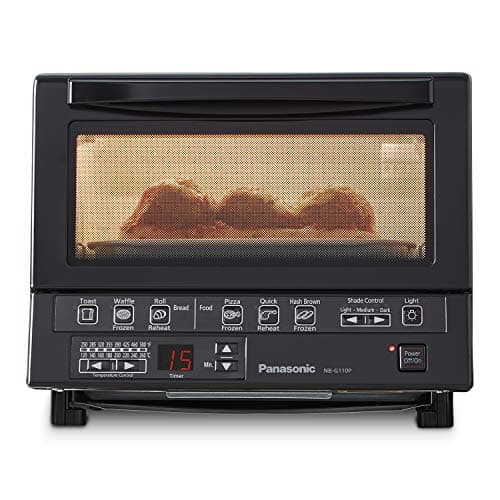
1,300 W
Panasonic FlashXpress Toaster Oven (NB-G110P)
The most completely documented oven on this entire site relative to its size: 1,300 W, 120 V, 60 Hz, 7.2 quarts, 250–500°F, exact millimeter dimensions and a stated weight. Panasonic publishes all of it, and almost nobody else does.
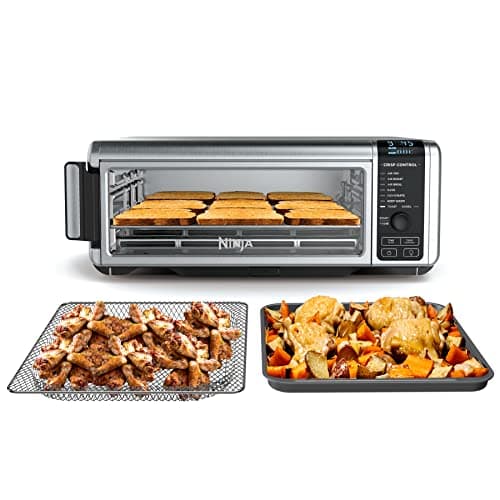
1,800 W
Ninja Digital Air Fryer & Toaster Oven, 8-in-1 flip-away (SP101)
The one genuine answer to a small kitchen that does not involve giving up power. It flips vertically against the backsplash when you are done, which is a real solution to the only problem this category consistently creates.
#ad · As an Amazon Associate we earn from qualifying purchases.
Questions
Frequently asked
Does an air fryer oven use more electricity than a microwave?
Why does a microwave cost less to run if it draws similar power?
Is it cheaper to reheat food in the microwave or the air fryer?
Keep reading
Related
Receipts
Sources
- US Energy Information Administration — Electric Power Monthly, Table 5.3 (average residential price)
- US EIA — How much electricity does an American home use? (FAQ)
- Panasonic — FlashXpress Toaster Oven NB-G110P product page
We have not cooked in these ovens and we do not pretend to have. Specifications come from the manufacturer's own published documents; electricity rates come from the US Energy Information Administration; prices come from the live Amazon API. Where a figure is not published, the page says “not published” rather than guessing. Read the full method.