HUB 06 · Guides & Answers
How Much Clearance Does an Air Fryer Oven Need?
Between one inch and six, depending entirely on whose oven you bought — and the manufacturers are not converging. These are the published figures, read out of the manuals, with what to do when your oven publishes nothing.
We earn a commission if you buy through our links. It does not change the price you pay, and it does not decide our picks — the scoring rubric is published in full, including what disqualifies an oven. How this works.
The short answer
There is no single figure, and the spread is much wider than anybody assumes. Across the manuals we read for this page the published clearance requirement runs from one inch to six, for ovens of broadly similar size doing broadly the same job. If your oven publishes a figure, use it. If it does not — and most do not — the defensible default is the largest published figure in its class, which is five inches behind and beside and six above.
What each manufacturer publishes
Breville — 4 inches at the sides, 6 inches above. The same requirement appears in the BOV680, BOV845, BOV860, BOV900 and BOV950 books, in the same words: ensure there is a minimum distance of 4″ (10cm) of space on both sides of the appliance and 6″ (15cm) above. Breville repeats it twice in each book — once in the safety pages and once in the setup instructions — which is unusual and suggests the company has a view about how often it is ignored. Notably, Breville publishes no rear figure.
Nuwave — 5 inches behind, beside and on top. The Bravo XL Pro manual asks that there be at least 5 inches of free space behind, to the sides of, and on top of the oven. It is the largest requirement on this page and the only one that specifies the back, which matters because the back is where most countertop ovens sit against a backsplash.
Our Place — 1 inch behind, above and each side. The Wonder Oven manual prints a diagram with the figures on it: at least one inch behind, at least one inch above, at least one inch on each side. It also adds a condition none of the others do — if the wall is made of heat-sensitive material such as plastic, leave more space around the appliance — and names the consequence as discoloration or deformation of the surrounding walls as well as fire.
BLACK+DECKER — nothing external, 1½ inches internal. The TO3250XSB manual publishes no surrounding-clearance figure at all. What it does publish is an interior one: be sure food or baking dish does not come within 1½ inches of the top heating elements. That is a different kind of clearance and it is the one that gets forgotten when a tall casserole goes in.
A factor of six is not a rounding difference
One inch and six inches are not two engineers landing in slightly different places. They describe different design assumptions about where the heat leaves the box.
The Wonder Oven is a 1,400-watt oven whose manual describes vents at the sides and underneath the door and at the bottom back — heat leaving low and to the side. Breville's 1,800-watt ovens vent upward through the top, which is why their figure above (6 inches) is larger than their figure at the sides (4), and why Breville also warns that the top of the oven is very hot during and after operation, as a result storing items on top of the oven is not recommended. Nuwave's 1,800-watt, 30-quart cavity asks for five inches everywhere including the back.
The practical rule that falls out of this: the vents decide the clearance. Look at your oven and find where the slots are, then give that face the most room. If you cannot find a published figure, the honest move is to use the biggest number in the class rather than the smallest — the downside of too much clearance is a slightly less tidy counter, and the downside of too little is a scorched cabinet.
The cabinet above is the real problem
A standard wall cabinet sits around 18 inches above the counter. A countertop oven 10 to 13 inches tall leaves five to eight inches of gap, which clears Breville's six-inch requirement only just, and clears Nuwave's five-inch requirement with almost nothing to spare once you account for the door.
Two things make that worse than the arithmetic suggests. Heat rising into a closed gap has nowhere to go, so the underside of the cabinet sees a sustained temperature rather than a brief one, and cabinet bottoms are usually thin veneered board. And the door has to open somewhere — a drop-down door that clears the cabinet may still put hot glass over the counter edge. The ovens that handle a tight vertical gap best are ranked here, including the one that folds away entirely.
What to check before you put it where you were going to
Measure the gap above, not the counter.Counter depth is the number everyone measures and vertical gap is the number that fails. Cabinet bottom to counter, minus oven height, against the manual's figure.
Find the vents and give that face priority. Sides, back, top and sometimes under the door. Whichever face has the slots gets the published figure at minimum.
Check what the back is made of. Our Place is the only manual that says it, and it applies to all of them: a heat-sensitive backsplash — plastic, laminate, painted board — needs more room than tile does.
Do not store anything on top. Breville states outright that the top is very hot during and after operation and that storing items there is not recommended. The top of a countertop oven looks like a shelf and is not one.
Account for the door swing as well as the box. Clearance figures describe the appliance at rest. A French-door or roll-top design needs far less room in front than a drop-down door does, which is a genuine siting advantage rather than a styling one.
The three ovens below are the ones whose published figures are quoted above — the widest spread we found, in ascending order of how much room they want.
The hardware
The ovens this page is about
The ovens referred to above, with prices pulled live from Amazon and dated on every card. Full rankings live in the roundups linked from this page.
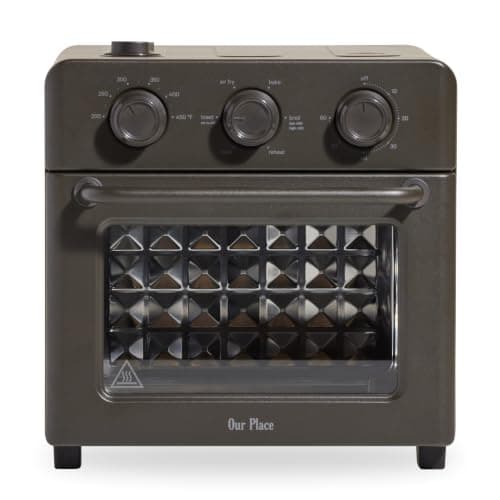
1,400 W
Our Place Wonder Oven (6-in-1, 13 Qt)
The most completely documented small oven we have covered, from a brand better known for pans. Our Place publishes the rating-plate wattage, the temperature range, the interior dimensions and the warranty term — all four things we score documentation on. At 1,400 W it costs less per hour than the 1,800 W field; at four slices and a 9-inch pizza it is genuinely small; and the limits are published too — a 200°F floor and a 60-minute timer.
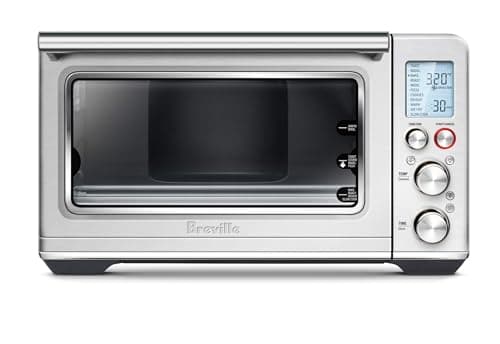
1,800 W
Breville Smart Oven Air Fryer (BOV860BSS)
The Pro's electronics in a chassis two and a half inches narrower, at meaningfully less money. Same 1,800 W rating plate, same published-spec discipline, two fewer functions and a noticeably more realistic footprint for a normal kitchen.
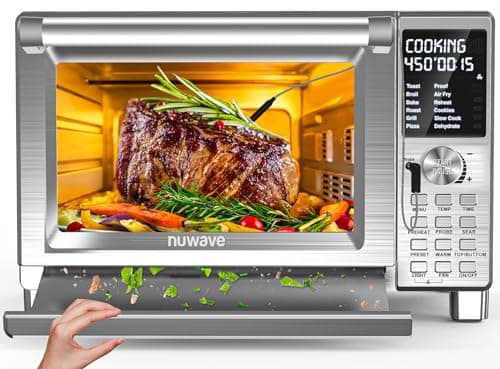
1,800 W
Nuwave Bravo XL Pro Air Fryer Toaster Oven (30 Qt, with probe)
A 30-quart, four-rack-level convection oven with an integrated temperature probe that stops the cook at a set internal temperature, and a maker that publishes its interior and exterior dimensions, weight, capacity, temperature range and warranty term — most of which the Ninja probe ovens do not. The 1,800-watt figure comes from a Nuwave support answer on its own product page rather than the manual's rating line, and we say so.
#ad · As an Amazon Associate we earn from qualifying purchases.
Questions
Frequently asked
How much space do you need around an air fryer oven?
How much clearance does an air fryer need above it?
Can you put an air fryer oven under a cabinet?
Can you put an air fryer oven against the wall?
Can you put things on top of an air fryer oven?
Keep reading
Related
Receipts
Sources
- Breville — the Smart Oven Air Fryer Pro (BOV900) instruction book, L23 edition [PDF]
- Breville — the Smart Oven Air Fryer (BOV860) instruction book [PDF]
- Breville — the Smart Oven Air Fryer Compact (BOV680) instruction book [PDF]
- Nuwave — Bravo XL Pro owner's manual, model 20813 [PDF]
- Our Place — Wonder Oven user manual, model APL.WDO.ESN [PDF, retailer-hosted copy]
- BLACK+DECKER — TO3250XSB / TO3260XSBD / TO3240XSBD use and care manual [PDF]
We have not cooked in these ovens and we do not pretend to have. Specifications come from the manufacturer's own published documents; electricity rates come from the US Energy Information Administration; prices come from the live Amazon API. Where a figure is not published, the page says “not published” rather than guessing. Read the full method.