The short answer
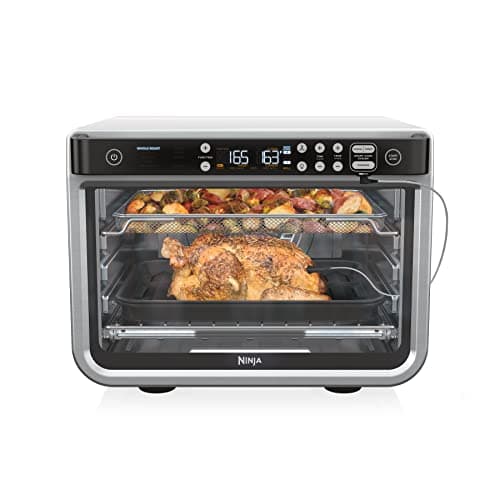
The DT251 is the Ninja DT201 with a smart thermometer added and roughly double the price. If you roast meat often, the probe is the single biggest upgrade a home cook can make — you stop guessing and cook to a real internal temperature. If most of what you make is toast, vegetables and reheated pizza, you are paying twice as much for a sensor those foods do not need.
What you get over the DT201
One thing, and it is a real one: an integrated probe. Everything else is the DT201 — the same two genuine cooking levels, the same XL cavity that SharkNinja describes as taking two 12-inch pizzas, the same ten functions on a dial that mostly changes fan speed and set point. Two levels matters more than the function count: it is the difference between cooking a tray of vegetables under a tray of chicken in one pass and doing them in two. The probe adds a second axis to that — you can roast the chicken to 165°F rather than to a timer that does not know how cold the meat started.
What Ninja publishes, and what it does not
Less than the price suggests. For this SKU SharkNinja publishes no rated wattage and no interior volume in cubic feet or liters, which is why this oven scores poorly on documentation on our DT201 reviewand does here too. The capacity is quoted as objects that fit rather than a number you can convert, and the whole Ninja line is consistent about that. We do not print a running cost for it, because there is no published watt figure to base one on and we will not borrow the DT201's or invent one — the by-model table lists only the ovens we could cost honestly.
Is the probe worth it?
It depends entirely on whether the food you cook has an internal temperature worth measuring. A roast, a whole chicken, a pork loin, a thick steak — all of these are cooked correctly to a number, not to a clock, and a probe removes the single largest source of home-roasting failure. A tray of fries does not have a meaningful internal temperature; neither does toast or a reheated slice of pizza. So the honest test is the frequency of the first kind of cooking. If it is weekly, the DT251 earns the premium. If it is a few times a year, buy the DT201 and a ten-dollar instant-read thermometer and pocket the difference.
The footprint problem it inherits
The DT251 is a big box, the same as the DT201 — genuinely furniture-sized rather than a tidy countertop appliance. Two cooking levels take vertical room and the XL cavity takes horizontal room, so before either Ninja goes on your list, measure the counter, including the depth from the wall to the front edge. If space is the binding constraint rather than money, the flip-away Ninja SP line keeps the power and folds against the backsplash, and our under-cabinet picks are built around exactly this constraint.
Who should skip it
Anyone whose cooking does not routinely involve a cut of meat with a target internal temperature. That is most of what these ovens actually do, and for it the probe is a feature you pay for and never select. If you want the same two-level interior for less than half the money, the DT201 is the buy; if you want the probe in a smaller-footprint oven, the flip-away SP-series pairs vertical storage with a thermometer in the higher trims. See where the DT251 lands against the field in our probe-thermometer roundup.
How we picked
Ovens we claim to have cooked in: 0
Everyone in this category tells you they roasted forty chickens. We have roasted none, and we say so. Here is what we do instead: read the manufacturer's manual and spec sheet, record the published wattage, interior volume, temperature range and warranty term, work out what the oven costs to run for an hour and for a year, show the arithmetic so you can redo it with your own electricity rate, and cite all of it. Where a brand publishes no wattage, we print no running cost rather than borrowing a number from a similar model. Prices come live from Amazon's API and disappear rather than go stale.
The scores above are judgments from that documented research — not test results. One of the five metrics is Documentation: whether the manufacturer will tell you what its oven draws at all. The full rubric, including what disqualifies an oven, is published in full.