HUB 05 · Running Costs & Power
Is a Countertop Oven Cheaper Than the Big Oven?
For anything that fits on a single tray, the countertop oven wins — it heats about a fifth of the air. This is where the real savings in the whole category actually are, and here is the sum.
We earn a commission if you buy through our links. It does not change the price you pay, and it does not decide our picks — the scoring rubric is published in full, including what disqualifies an oven. How this works.
The saving is in the air you do not heat
A full-size wall oven holds roughly five cubic feet and must heat all of it before it cooks anything. A countertop oven holds about one. For a tray of vegetables, a couple of chicken thighs or a single loaf, the countertop model reaches temperature far faster and spends far less energy getting there. This — not the price of the appliance, not the wattage — is where the real money in this whole category sits.
A wall oven's bake element is typically 2,000–3,500 watts and its preheat can take 10–15 minutes of near-continuous draw to bring five cubic feet up to temperature. A countertop oven at 1,800 watts preheats in a few minutes because there is so much less air and metal to warm. The gap on a short job is large.
Where it flips
The moment the food no longer fits in the countertop oven, the comparison inverts. Cooking two trays, a large roast or a holiday meal in a small oven either does not fit or takes so many batches that you have heated the little cavity repeatedly and spent more than one pass of the big oven would have. The rule is simple: countertop for what fits on one tray, wall oven for everything larger.
Do this consistently — stop reaching for the big oven to bake four potatoes — and the countertop oven pays for its own running cost many times over across a year. It is the single most effective saving in the category, worth more than choosing a lower-wattage model or skipping the preheat combined.
Two follow-on questions this page sets up and does not answer. The first is comfort rather than cost: the same kilowatthours become heat in your kitchen, and the EIA's published conversion of 3,412 Btu per kWh turns every figure above into a number — between 1,877 and 3,071 Btu for a half-hour countertop run, against several times that for a wall oven on the same tray. The second is whether the appliance is worth owning at all, which is not a question the electricity answers: three honest cases for yes, three for no.
The hardware
The ovens this page is about
The ovens referred to above, with prices pulled live from Amazon and dated on every card. Full rankings live in the roundups linked from this page.
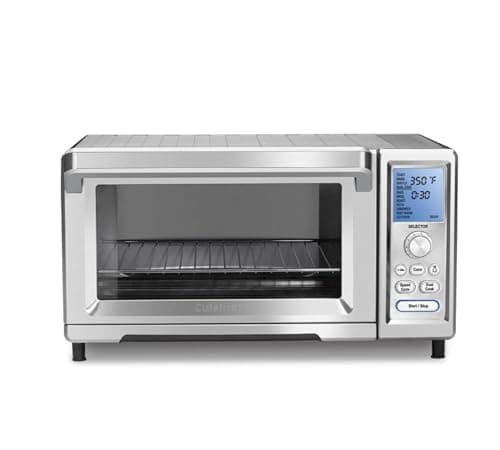
1,800 W
Cuisinart Chef's Convection Toaster Oven (TOB-260N1)
The only oven here whose manufacturer publishes both a wattage and an interior volume in cubic feet on the same page. 0.95 cubic feet at 1,800 W, with a stated list of what fits — a 13-inch pizza, a 9x13 pan, nine slices.
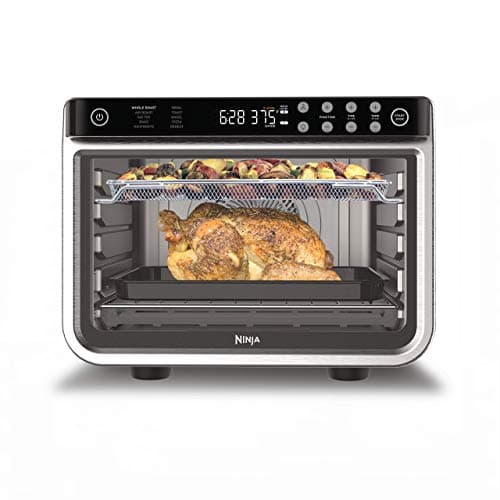
1,800 W
Ninja Foodi 10-in-1 XL Pro Air Fry Oven (DT201)
The value pick, and it is not close. Same 1,800 W as ovens costing more than twice as much, two full cooking levels, and a published capacity claim — two 12-inch pizzas — that is specific enough to be checkable rather than a vibe.
#ad · As an Amazon Associate we earn from qualifying purchases.
Questions
Frequently asked
Is it cheaper to use a toaster oven than the oven?
How much can I save using a countertop oven for small meals?
Keep reading
Related
Receipts
Sources
- US Energy Information Administration — Electric Power Monthly, Table 5.3 (average residential price)
- US EIA — How much electricity does an American home use? (FAQ)
- Cuisinart — Chef's Convection Toaster Oven TOB-260N1 product page
We have not cooked in these ovens and we do not pretend to have. Specifications come from the manufacturer's own published documents; electricity rates come from the US Energy Information Administration; prices come from the live Amazon API. Where a figure is not published, the page says “not published” rather than guessing. Read the full method.