Skip to content
CC

INDEX · Model Reviews

Cuisinart Custom Classic Toaster Oven Broiler (TOB-40N)

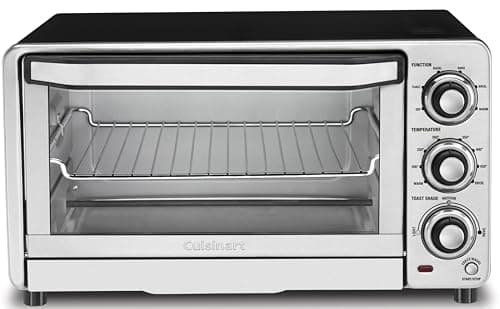
1,800 watts behind three knobs, in brushed stainless, sold essentially unchanged for over a decade. In small appliances a production run that long is the strongest reliability signal available short of taking one apart. There is no convection fan, which is the whole point of it.

By Stephen V.Updated How we rank
#ad

We earn a commission if you buy through our links. It does not change the price you pay, and it does not decide our picks — the scoring rubric is published in full, including what disqualifies an oven. How this works.

The short answer

Quick picks

#OvenBest forScorePrice
011,800 W
7.6
$99.95Amazon

#ad · Prices pulled live from the Amazon Product API, last checked Aug 8, 2026. Where we have no verified live price we show none — we would rather leave a gap than print a number that has gone stale. The wattage column is what the manufacturer publishes; “not published” means exactly that, and we have not estimated one. Scores are ours, compiled from published specifications, and are not test results.

The short answer

The Custom Classic is a full 1,800-watt oven with almost nothing on it to break: a bell, a timer and a thermostat, worked by three knobs. It has been sold in essentially this form for over a decade, which is the closest thing to a reliability guarantee this category offers. What it does not have is a convection fan, so it does not air fry — and if all you want is a solid toaster oven that toasts, bakes and broils, that is not a loss, it is a lower price.

Why the long production run is the headline

Most of what goes wrong with a countertop oven is electronic: a capacitive touch panel that stops registering, a control board that fails, a display that dies while the elements are fine. The Custom Classic has none of that. Its controls are mechanical, its failure modes are obvious, and because it has been on sale nearly unchanged for years, those failure modes are well documented by the people who own them. In an aisle full of newer SKUs with a thin service history, an oven whose long-term behaviour is actually known is worth more than another three preset buttons. That is why it wins our stainless steel toaster oven ranking.

What 1,800 watts buys at this price

Speed, and headroom you can spend. A full 1,800 watts is the ceiling of a standard 15-amp US kitchen circuit, and this oven sits right at it for well under half what an 1,800-watt Breville costs. On anything time-based — preheating, broiling, browning — it is on level terms with ovens three and four times the price, because watts are watts. Cuisinart states the 1,800-watt figure in its own listing copy rather than in a separate spec sheet, so we treat it as brand-supplied rather than manual-verified and say so; it is still a published number, which is more than several ovens here manage.

What it costs to run

The same as any 1,800-watt oven, because that is the only input that matters. At the US average residential rate, an 1,800-watt oven run half an hour a day for a year costs a few dollars — the full arithmetic is here, and the figure is a ceiling because the thermostat cycles the elements off once the cavity is hot. There is no efficiency penalty for buying the cheap 1,800-watt oven instead of the expensive one; your electricity bill cannot tell them apart.

The honest limits

Two, and they are the same fact from two directions. There is no convection fan, so there is no air fry and slightly less even baking than a fan oven gives — everything the rest of this site says about moving hot air simply does not apply here. And Cuisinart publishes no interior volume for it, so you cannot compare its usable space on paper to a TOB-260N1. The dated look is not accidental either; this design has not changed in years, and that is the source of both its reliability and its appearance.

Who should skip it

Anyone who wants convection or air fry. This is a radiant oven by design, and buying it and then wishing it blew hot air is the most predictable regret available. If a fan is on your list, an air fryer toaster oven is the category you actually want, and the difference is exactly one component. If it is not, the Custom Classic is as much oven as you need for the money.

In detail

The full spec

01
Cuisinart Cuisinart Custom Classic Toaster Oven Broiler (TOB-40N)

1,800 W without a control panel

Cuisinart Custom Classic Toaster Oven Broiler (TOB-40N)

Full 1,800 W
7.6/10

1,800 W behind three knobs. It has been sold essentially unchanged for over a decade, which in small appliances is the strongest reliability signal available short of taking one apart.

Power
9.5
Usable space
7
Footprint
7.5
Documentation
5
Value
9

What it gets right

  • Full 1,800 W at well under half what an 1,800 W Breville costs
  • Knobs, a bell and a timer — there is essentially nothing here to fail electronically
  • A production run long enough that its failure modes are well known

What it doesn't

  • No convection fan
  • No published interior volume
  • The dated look is not accidental; this design has not changed in years

What it costs to run

About 33.9¢ an hour at full draw, or $61.86 a year at 30 minutes a day, 365 days a year and 18.83¢ per kWh.

1,800 W ÷ 1000 × 182.5 h × 18.83¢ = $61.86

1800 Watt as stated in Cuisinart's own listing title and copy. Cuisinart publishes no separate spec sheet for this model, so this is brand-supplied rather than manual-verified. This is an upper bound: the elements cycle off once the cavity is at temperature, and no manufacturer publishes a duty cycle, so we compute at full rated draw rather than invent a correction factor. The full method is published.

Skip this if…

you want convection or air fry. This is a radiant oven, and everything the rest of this site says about moving air does not apply to it.

$99.95on Amazon

$129.9523% off

Price last checked Aug 8, 2026. Prices move constantly — Amazon's at checkout is the one that counts.

#ad · we may earn a commission from this link to Cuisinart Custom Classic Toaster Oven Broiler (TOB-40N)

How we picked

Ovens we claim to have cooked in: 0

Everyone in this category tells you they roasted forty chickens. We have roasted none, and we say so. Here is what we do instead: read the manufacturer's manual and spec sheet, record the published wattage, interior volume, temperature range and warranty term, work out what the oven costs to run for an hour and for a year, show the arithmetic so you can redo it with your own electricity rate, and cite all of it. Where a brand publishes no wattage, we print no running cost rather than borrowing a number from a similar model. Prices come live from Amazon's API and disappear rather than go stale.

The scores above are judgments from that documented research — not test results. One of the five metrics is Documentation: whether the manufacturer will tell you what its oven draws at all. The full rubric, including what disqualifies an oven, is published in full.
Questions

Frequently asked

Does the Cuisinart Custom Classic air fry?
No. The Custom Classic (TOB-40N) is a radiant oven with no convection fan, so it toasts, bakes and broils but does not air fry. If you want air fry you need a convection model — our air fryer oven picks are here.
How many watts is the Cuisinart Custom Classic?
1,800 watts, as stated in Cuisinart's own listing copy. Cuisinart publishes no separate spec sheet for this model, so we treat the figure as brand-supplied rather than manual-verified -- but it is a real published number, and it puts the oven at the ceiling of a standard 15-amp kitchen circuit.
Is the Cuisinart Custom Classic reliable?
It has been sold essentially unchanged for over a decade, which in small appliances is the strongest reliability signal available short of a teardown. Its controls are mechanical -- a bell, a timer and a thermostat -- so there is very little to fail electronically.

Keep reading

Receipts

Sources

We have not cooked in these ovens and we do not pretend to have. Specifications come from the manufacturer's own published documents; electricity rates come from the US Energy Information Administration; prices come from the live Amazon API. Where a figure is not published, the page says “not published” rather than guessing. Read the full method.