The short answer
A countertop convection oven and an air fryer ovenare the same appliance: a small oven with a fan. “Air fry” is that fan run fast, usually with a perforated basket. A plain toaster oven has no fan, and that is the only division here that describes different hardware. So the real question is not three-way. It is: do you want the fan, and if you do, how much interior do you want behind it?
The one component that separates them
Every oven in all three categories works the same way — resistive elements heat the air, a thermostat cycles them, the food cooks. The fan is the only structural difference, and it does exactly one thing: it moves the hot air instead of letting it sit. That produces even browning, because no side of the food is stuck facing a cooler wall, and it produces crisping, because moving air pulls moisture off a surface faster. The full mechanism is here, and it is shorter than the marketing suggests.
What that means in a shop: an oven advertised as a “countertop convection oven” and one advertised as an “air fryer toaster oven” at the same price are usually competing on interior, controls and door — not on capability. The label tells you which department the marketing team aimed at.
The three, with what each actually publishes
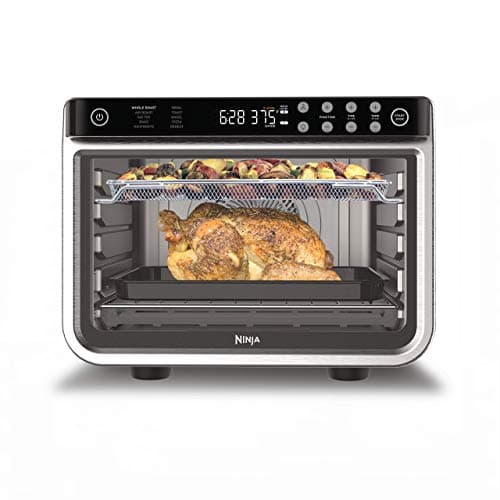
The Ninja Foodi 10-in-1 XL Pro (DT201) represents the air fryer oven: 1,800 watts published, ten functions, and a capacity claim specific enough to check — two 12-inch pizzas across two cooking levels. It is the most usable interior per dollar on this site. Its review is here.
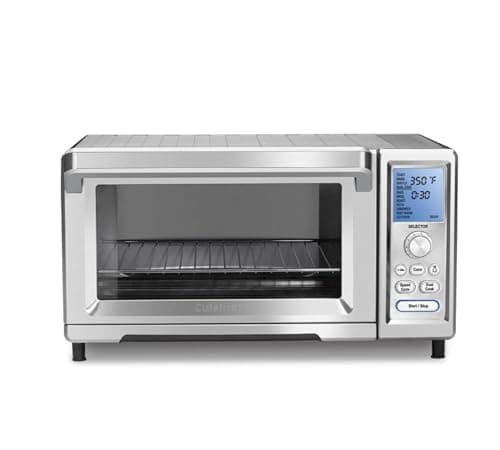
The Cuisinart Chef's Convection Toaster Oven (TOB-260N1) represents the convection oven, and it is the best-documented machine in the category: 1,800 watts and 0.95 cubic feet, published by Cuisinart on the same page — the only oven here whose maker does both. Fifteen functions, and a dual-cook mode that runs two temperatures in sequence. Its review is here.
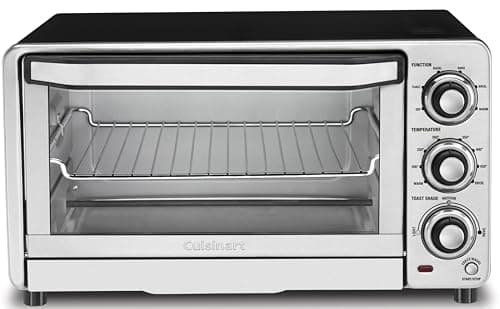
The Cuisinart Custom Classic (TOB-40N) represents the plain toaster oven: a full 1,800 watts behind three knobs, no fan, sold essentially unchanged for over a decade. It costs a fraction of the other two and does three jobs as well as they do.
Note what is identical across all three: 1,800 watts. That is not a coincidence, it is the ceiling of a standard 15-amp, 120-volt US kitchen circuit — 15 × 120 = 1,800 — and it means all three cost the same per hour to run. The published figures are tabulated here. Spending more in this category buys control over heat, never less of it.
The decision table
| Air fryer oven | Convection oven | Plain toaster oven |
|---|
| Fan | Yes, run fast | Yes | No |
|---|
| Crisps | Yes | Yes | No |
|---|
| Typical interior | Medium to large | Medium to large | Small — 4 to 6 slices |
|---|
| Best at | Fries, wings, vegetables, reheating | Roasting, baking, batch trays | Toast, melting, a small tray |
|---|
| Worst at | Delicate bakes, crowded trays | Nothing, at a price | Anything that needs to crisp |
|---|
| Cost per hour | Identical at the same wattage — and nearly all of them are 1,800 W |
|---|
How to choose, in one rule
Do you want crisping? If no, buy the plain toaster oven and spend the difference on wattage and build — it will do toast, bake and broil as well as anything above it and outlast most of them. The plain ranking is here.
If yes, ignore which of the two fan labels the box uses and buy on interior, controls and what the manufacturer publishes. Two ovens with a fan at the same wattage differ in how much fits and how precisely you can steer the heat, and nothing else. Our air fryer oven ranking and our convection ranking sort the same catalog against those two questions.
The one case where the three-way genuinely resolves differently: if you bake cakes and bread more than you crisp, prefer a fan oven that lets you switch the fan off over one that cannot — and our bread ranking is built entirely on that distinction.
How we picked
Ovens we claim to have cooked in: 0
Everyone in this category tells you they roasted forty chickens. We have roasted none, and we say so. Here is what we do instead: read the manufacturer's manual and spec sheet, record the published wattage, interior volume, temperature range and warranty term, work out what the oven costs to run for an hour and for a year, show the arithmetic so you can redo it with your own electricity rate, and cite all of it. Where a brand publishes no wattage, we print no running cost rather than borrowing a number from a similar model. Prices come live from Amazon's API and disappear rather than go stale.
The scores above are judgments from that documented research — not test results. One of the five metrics is Documentation: whether the manufacturer will tell you what its oven draws at all. The full rubric, including what disqualifies an oven, is published in full.