The clearance nobody measures
People measure the counter and forget the cabinet above it. A standard wall cabinet sits about 18 inches above the counter, and a countertop oven does two things in that gap that matter: it vents hot air straight up out of the top, and it opens a door that has to go somewhere. Most ovens are 10 to 13 inches tall, so they physically fit — but running one directly under a wooden cabinet bakes the cabinet, and a drop-down door in a shallow spot fouls the backsplash. This page ranks on the ovens that handle a crowded vertical space best, not just the smallest footprint.
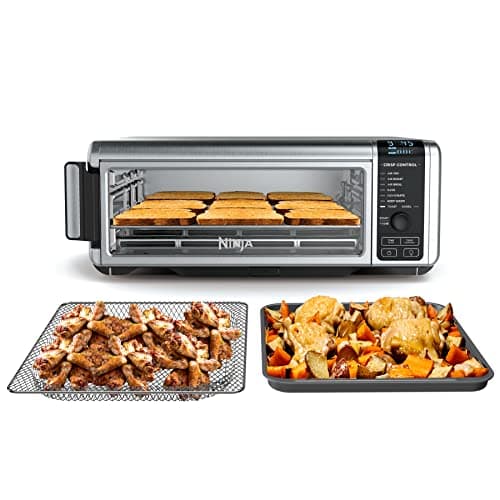
The Ninja SP101 wins because it is the only oven here that solves the problem structurally: when you are done, it flips up and back against the backsplash, clearing the counter and pulling its hot top away from the cabinet entirely. You still need clearance to run it, but it does not live under the cabinet the rest of the day, which is the real win in a small kitchen — and it keeps a full 1,800 watts while doing it. Its review is here.
Reading the order
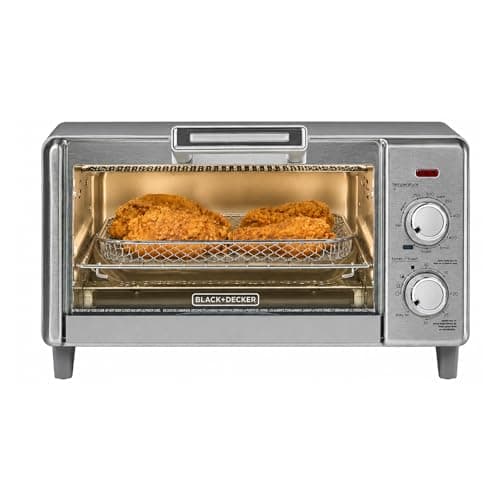
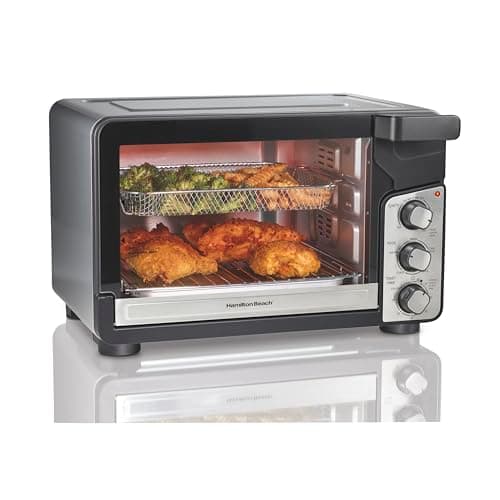
The BLACK+DECKER Crisp 'N Bake is second: a genuinely compact four-slice oven at the floor of the price band, low enough and small enough to tuck into a tight spot, from a line whose documented sibling publishes a 1,150-watt draw — a lower draw that also means less heat venting up into the cabinet. The Hamilton Beach Easy View XL is third and the practical middle: six slices, a glass door so you can watch without opening it into the space, and a price that makes it an easy always-out oven. Its full review of the range is on our budget picks.
The two rules for running one under a cabinet
First, leave a gap. Whatever the oven's height, do not run it flush against the underside of a cabinet — the top vents real heat, and even ovens rated for countertop use assume some air above them. The flip-away Ninja sidesteps this when idle but still needs room in use. Second, check the door. A drop-down door needs counter depth in front; a flip-away or roll-top design needs vertical room instead. Measure the gap above and the depth in front before you buy, not after — depth is the dimension people forget, and our sizing guide walks through exactly what to measure.
How to choose
If your counter is permanently short on space, the flip-away Ninja is the answer — it is the one oven here designed around the constraint. If you have a fixed tight nook and the oven will live there, take the most compact always-out pick that still does what you need; the BLACK+DECKER for one or two people, the Hamilton Beach for a bit more room and a viewing window. For the wider small-kitchen problem beyond cabinets, our small-spaces picks cover the full range, and the smallest plain toaster ovens are here.
Before you commit to a nook, check the figure your oven's own manual asks for rather than the rule of thumb above. The published clearance requirements run from one inch to six: Breville asks for six inches above, Nuwave asks for five on every face including the back, and Our Place asks for one. A gap that satisfies one of those brands is a fire risk on another.
How we picked
Ovens we claim to have cooked in: 0
Everyone in this category tells you they roasted forty chickens. We have roasted none, and we say so. Here is what we do instead: read the manufacturer's manual and spec sheet, record the published wattage, interior volume, temperature range and warranty term, work out what the oven costs to run for an hour and for a year, show the arithmetic so you can redo it with your own electricity rate, and cite all of it. Where a brand publishes no wattage, we print no running cost rather than borrowing a number from a similar model. Prices come live from Amazon's API and disappear rather than go stale.
The scores above are judgments from that documented research — not test results. One of the five metrics is Documentation: whether the manufacturer will tell you what its oven draws at all. The full rubric, including what disqualifies an oven, is published in full.