HUB 06 · Guides & Answers
Does a Toaster Oven Use Radiation?
Yes — infrared radiation, which is the technical name for radiant heat. It sits at the opposite end of the spectrum from X-rays, it is non-ionizing, and it is the same thing you feel standing near a campfire. This page is about the mechanism, because the mechanism is what the word is hiding.
We earn a commission if you buy through our links. It does not change the price you pay, and it does not decide our picks — the scoring rubric is published in full, including what disqualifies an oven. How this works.
The answer, first
Yes. A toaster oven cooks partly by infrared radiation — the heat you feel radiating off a glowing element, which is the same physical phenomenon as the warmth of sunlight on your face. Infrared is non-ionizing: as the EPA sets out, the electromagnetic spectrum runs from low-energy radio waves up through microwaves, infrared and visible light to the ionizing end — ultraviolet, X-rays and gamma rays — and only the ionizing end carries enough energy per photon to strip electrons from atoms. Infrared does not. It makes molecules vibrate, which is what “hot” means.
So the honest reframe: every oven ever built uses radiation, including a wood fire. The word is doing work in the question that it does not do in physics.
Scope note, because this page is deliberately narrow. If what you are actually asking is whether these ovens are safe — the coatings, the fumes, the high-heat-cooking chemistry — that is three other pages and they go into it properly: are air fryers toxic, are air fryers healthy and do air fryers cause cancer. This one is about the mechanism only.
Three different things the word “radiation” means
The confusion in this question is almost entirely vocabulary, and it resolves cleanly once the three senses are separated.
| Kind | Where it appears in a kitchen | Ionizing? | What it does to food |
|---|---|---|---|
| Infrared / thermal | Every toaster oven, every oven element, a grill, a fire | No | Heats the surface it lands on; browning and crisping happen here |
| Microwave (radio-frequency) | A microwave oven only | No | Excites water molecules throughout the food at once |
| Ionizing (X-ray, gamma) | Nowhere in a domestic kitchen appliance | Yes | Not applicable — no kitchen appliance emits it |
Both of the first two are non-ionizing, and they are nonetheless completely different cooking mechanisms — which is the genuinely useful thing to understand, and the reason the two appliances produce different food.
How the radiant heat in a toaster oven actually works
A resistance element gets hot when current is forced through it, and anything hot radiates energy. At the temperatures a toaster oven element reaches, a good deal of that energy comes off as infrared and a little of it as visible light, which is why the elements glow orange. That glow is not a side effect of the heating — it is the same emission, just the part of it your eyes can see.
Food in the cavity is heated three ways at once, and the proportions are what distinguish these ovens from each other:
- Radiation — infrared travelling in straight lines from element to food. This is the dominant mechanism in a small cavity with the food close to the element, and it is why the rack you choose changes the result more in a toaster oven than in a big one. Which rack, and why.
- Convection — hot air carrying heat to the food, either because hot air rises on its own or because a fan pushes it. That is the entire difference an air-fry setting makes: the mechanism in full.
- Conduction — the pan or rack touching the food, which is why a solid tray and a wire rack give different undersides.
The reason this matters commercially: a fanless oven is a mostly radiant oven, and radiant heat is directional and fast on surfaces. That is the right tool for toast, for melting cheese, for a pizza slice and for anything where you want the outside to change before the inside does. It is the wrong tool for even browning of a large item, which is what the fan exists to fix.
Which makers actually name the mechanism
One, out of the thirty-four ovens we cover. Panasonicspecifies the FlashXpress as using double infrared heating, and publishes the full electrical specification alongside it — 1,300 W at 120 V, 60 Hz, a 250–500°F band, 7.2 quarts and exact millimetre dimensions. Everyone else says “heating element”, prints a wattage if you are lucky, and leaves the mechanism to the pictures.
That is a documentation gap rather than a technical mystery — all of these ovens use resistive elements and all of them radiate — but it is the reason the Panasonic is the oven we point at whenever the mechanism is the question. It is also why it leads our reheating ranking and our polymer-clay ranking: predictable radiant heat with no fan to switch off is a genuine specification, not a nostalgia preference.
Toaster oven versus microwave, as mechanism
A microwave emits radio-frequency energy — the FDA, which regulates these appliances, describes microwaves being absorbed by water in the food and causing the molecules to vibrate, producing heat. The energy is deposited throughouta food's water content more or less at once, which is why a microwave is fast, why it heats unevenly where moisture is uneven, and why it cannot brown anything: the surface never gets hotter than the water in it, and browning chemistry needs a dry surface above about 300°F.
A toaster oven does the opposite. It heats the surface and lets heat conduct inward, which takes several times as long and is the only one of the two mechanisms that produces a crust. Neither is a superior appliance; they are different tools, and the honest division of labour between them is worked through here.
One practical consequence people get wrong: a toaster oven is not “safer radiation than a microwave”, because a working microwave does not leak meaningfully in the first place — the FDA regulates the emission limit on the appliance. The real differences between them are speed, texture, energy use and what they do to leftovers. Including the electricity, which the microwave wins.
Is the glow dangerous to look at?
No. A glowing oven element emits infrared and visible light, which is the same category of emission as a toaster, a space heater, an incandescent bulb or a campfire. There is no ultraviolet hazard and nothing ionizing to shield against; the hazard a hot element presents is that it is hot, which is why every manual in this category is far more concerned with surfaces and clearance than with emissions.
The published warnings bear that out. BLACK+DECKER's manual: “This oven gets hot. When in use, always use oven mitts or pot holders when touching any outer or inner surface of the oven.” Our Place requires an inch of clearance on every side and instructs that if smoke or fire appears during cooking you should not open the door until the flames go out and should not use water. Those are the real risks of a radiant appliance, and they are mechanical rather than radiological. What has actually gone wrong with these appliances, from the recall record.
What this means when you are choosing an oven
If you want radiant heat, buy a fanless oven on purpose. Three ovens in our catalog have no fan at all — the Panasonic FlashXpress, the Cuisinart Custom Classic (TOB-40N) and the Proctor Silex 31260 — and for toast, melting, pizza slices and anything where you want a surface to change fast, that is a feature. The field with no air-fry mode at all is ranked here.
If you want even browning, you want air movement. That is a fan, and the marketing for it is called convection or air fry depending on how fast the fan runs and whether a perforated basket comes with it. The difference between the two settings is smaller than the labels imply.
Do not pay extra to avoid “radiation”. There is no oven on the market that heats without it, no premium that removes it, and no specification that measures it. A brand that will tell you its wattage, its temperature band and its interior dimensions is telling you something checkable; that is what we score.
The hardware
The ovens this page is about
The ovens referred to above, with prices pulled live from Amazon and dated on every card. Full rankings live in the roundups linked from this page.
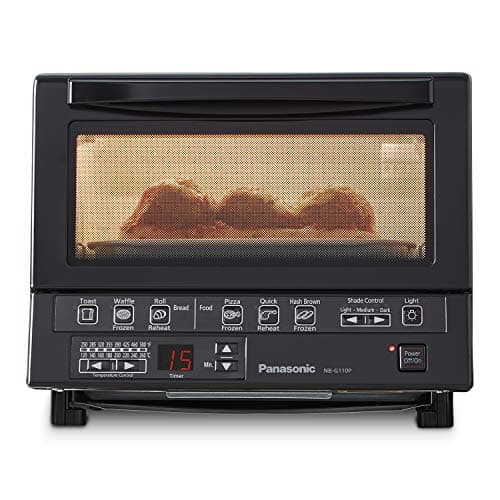
1,300 W
Panasonic FlashXpress Toaster Oven (NB-G110P)
The most completely documented oven on this entire site relative to its size: 1,300 W, 120 V, 60 Hz, 7.2 quarts, 250–500°F, exact millimeter dimensions and a stated weight. Panasonic publishes all of it, and almost nobody else does.
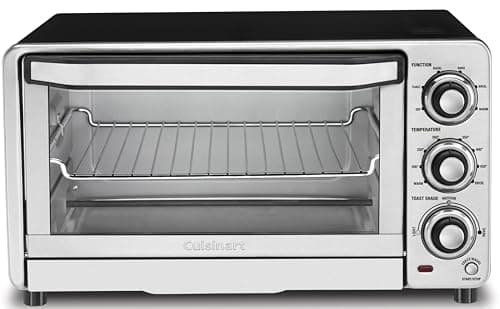
1,800 W
Cuisinart Custom Classic Toaster Oven Broiler (TOB-40N)
1,800 W behind three knobs. It has been sold essentially unchanged for over a decade, which in small appliances is the strongest reliability signal available short of taking one apart.
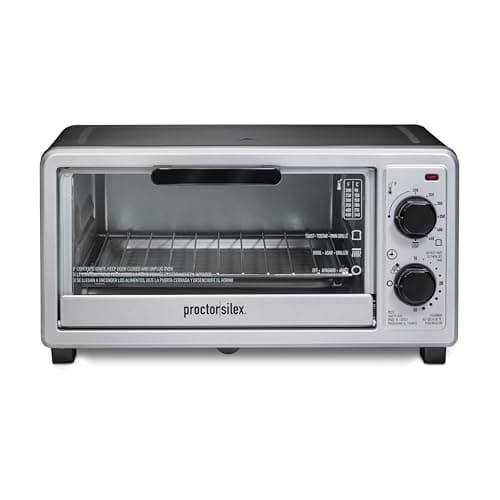
1,100 W
Proctor Silex 4 Slice Countertop Toaster Oven (31260)
Fifty dollars, four slices, three manual controls — and, unusually for the price, a published wattage and a three-year warranty. It does the same three things the ovens at four times the money do; what you give up is the fan, the evenness and the interior.
#ad · As an Amazon Associate we earn from qualifying purchases.
Questions
Frequently asked
Does a toaster oven emit radiation?
Is toaster oven radiation harmful?
Is a toaster oven the same as a microwave in how it heats?
Do infrared toaster ovens work differently?
Why do the elements glow orange?
Which toaster ovens have no fan at all?
Keep reading
Related
- How air fryers actually workThe convection half of the mechanism, in full, with the marketing removed.
- Toaster oven vs microwaveThe two mechanisms as a buying decision rather than a physics lesson.
- Are air fryers toxic?The coatings-and-materials question this page deliberately does not cover.
- Best toaster ovens without an air fryerWhere buying a mostly-radiant oven on purpose is ranked.
- Panasonic FlashXpress reviewThe one oven in our catalog whose maker names the infrared mechanism.
Receipts
Sources
- US EPA — Radiation Basics (the electromagnetic spectrum, and the distinction between ionizing and non-ionizing radiation)
- US FDA — Microwave Oven Radiation (what a microwave emits, how it heats food, and the standard it is regulated under)
- Panasonic — FlashXpress Toaster Oven NB-G110P product page (power consumption, supply, capacity, 250–500°F range, dimensions)
- Cuisinart — toaster ovens product line
- Proctor Silex — 4 Slice Toaster Oven Broiler (31260G) product page (temperature range, timer, 3-year limited warranty)
- BLACK+DECKER — TO3250XSB / TO3260XSBD / TO3240XSBD use and care manual [PDF]: “During first few minutes of use you may notice smoke and a slight odor. This is normal and should cause no concern.”; “Temperatures in the oven will be lower than your set point.”; the 1½-inch top-element clearance rule; the timer rule; the short-power-supply-cord note
- Our Place — Wonder Oven user manual, model APL.WDO.ESN [PDF, retailer-hosted copy]: rating line 120V 60Hz 1400W, Before Your First Use steps 5–7 (1 inch clearance; trial run without food at 400°F for 10 minutes on Bake; “conduct the trial run in a well-ventilated area as a small amount of smoke and odor may be detected”), carbonised-residue warning, smoke-or-fire instruction
- Nuwave — Bravo XL Pro owner's manual, model 20813 [PDF]: Before First Use (remove glue and labels; “it is perfectly normal for your new unit to produce a heated plastic smell when used for the first time”), automatic shut-off odor note, white-smoke troubleshooting entry, probe target range
We have not cooked in these ovens and we do not pretend to have. Specifications come from the manufacturer's own published documents; electricity rates come from the US Energy Information Administration; prices come from the live Amazon API. Where a figure is not published, the page says “not published” rather than guessing. Read the full method.