The problem this page solves
Ninja's countertop ovens are good. Working out which one to buy is not, because the model numbers encode nothing you can rely on and the marketing names sit on top of each other: an XL Pro, a Smart XL, a Digital Air Fry Pro, a Dual Heat, a Double Oven. A higher number is a longer feature list, not a larger oven — nothing in Ninja's published specifications says an SP351 holds more food than an SP101.
So this ranking ignores the names and sorts on three published things: whether Ninja states a wattage, how many cooking levels the oven actually has, and whether the extra functions are hardware you can point at or presets that run the same elements at a different set point. Every figure below is one Ninja publishes, and every one links to where it is published.
The finding: four of the six publish no wattage
This is the single most useful fact about the line, and it is not on any box. SharkNinja publishes a rated 1,800 wattsfor the DT201, on its own product page, and for the SP101, in the quick start guide on its support site. For the SP201, the SP351, the DT551 and the DCT401 there is no wattage figure in Ninja's own materials that we could find, so those four get no running-cost calculation from us — not an estimated one, not a “probably the same,” nothing.
That matters more than it sounds. Running cost on a countertop oven is decided almost entirely by rated wattage and time, and 1,800 W is not a coincidence: it is the ceiling of a standard 15-amp, 120-volt US kitchen circuit, because 15 × 120 = 1,800. We tabulate every published figure on the site here. An oven that publishes one can be costed out before you buy it. An oven that does not, cannot — and on this site that costs it points on the Documentation metric rather than getting the benefit of the doubt. The rubric is here.
Reading the order
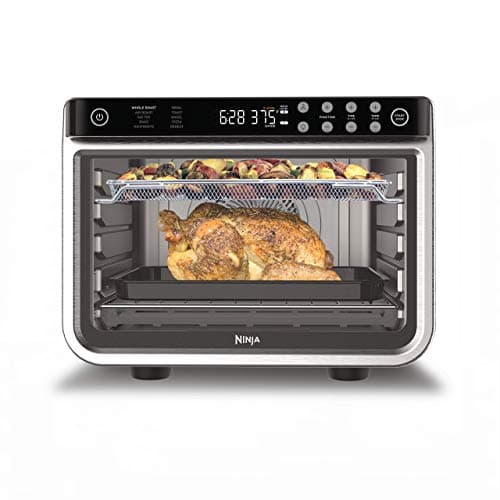
The Ninja Foodi 10-in-1 XL Pro (DT201) is first and it is not close. It is the only oven in the line that publishes a wattage and gives you two genuine cooking levels rather than one shelf and an optimistic second slot, and it is currently the least expensive Ninja here. Ninja states the capacity as two 12-inch pizzas, which is a claim you can measure against your own baking sheet rather than a vibe. The honest catch is size: this is one of the biggest boxes in the category, and at some point a countertop appliance becomes furniture. Our full review is here.
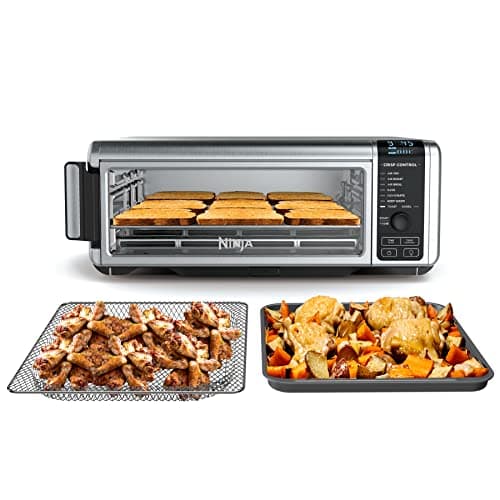
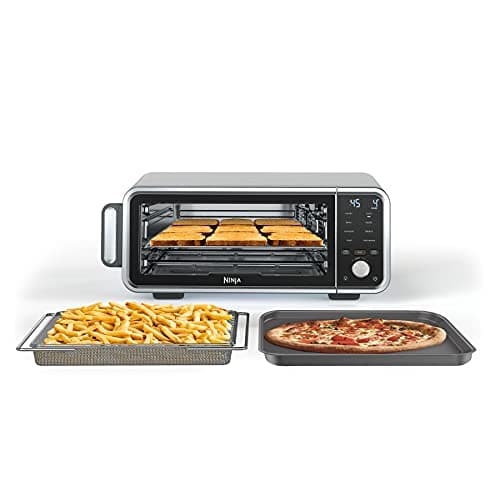
The Ninja Digital Air Fryer & Toaster Oven (SP101) is second, and it is first if your counter is the binding constraint. It is the other oven in the line with a published 1,800 W, and the flip-away hinge — it rotates vertically against the backsplash when you are done — is a real answer to the only problem this whole category reliably creates. What you give up for the fold is the second cooking level: this is a single-level oven, quoted at a 13-inch pizza or nine slices of toast. Its review is here, and it also wins our small-kitchen ranking.
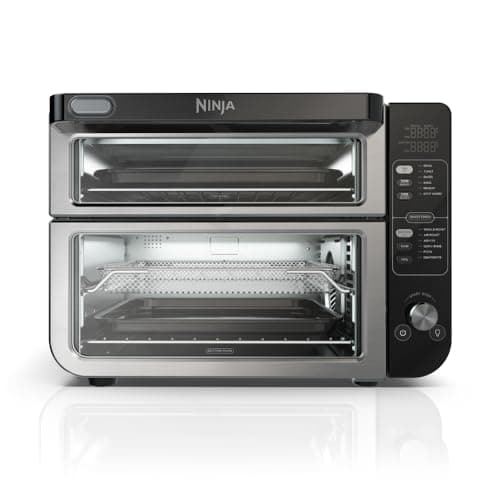
The Ninja Double Oven with FlexDoor (DCT401) is third and is the most interesting oven Ninja makes. Its door splits the box into two independently controlled ovens: the top toasts, bakes, broils, reheats and does bagels, the bottom air fries, convection bakes, roasts and dehydrates, and the two run at different temperatures at the same time. That is a mechanism, not a preset, which is a sentence we almost never get to write about a function count. Ninja quotes the capacity as six pounds of wings and a 12-inch pizza simultaneously. It publishes no wattage, publishes no interior volume for either cavity, and publishes a one-year warranty — half the term BLACK+DECKER states for its budget air-fry line.
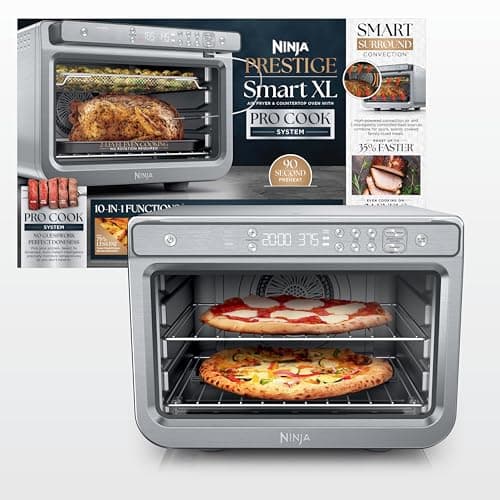
The Ninja Prestige Smart XL with Pro Cook System (DT551) is fourth, and it moved up this list in September 2026 when it replaced the discontinued DT251. Mechanically it is the DT201 with an integrated thermometer added — the same two genuine cooking levels, the same XL box — and that pairing is what earns the place: on the rubric above it is the only oven below the DCT401 that has two cooking levels anda premium you can point at rather than one made of labels. The DT251 sat last on this page because it sold for a large multiple of the DT201's price for that one sensor. The DT551 does not — it lists within about ten dollars of the probe-less DT201 — which is most of why the order changed. Ninja still publishes neither a wattage nor an interior volume for it, and it inherits the DT201's furniture-sized footprint. We settle that one head-to-head in full here.
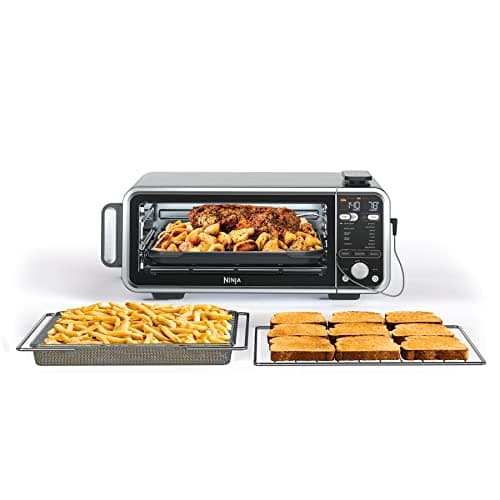
The Ninja Foodi 13-in-1 Dual Heat (SP351) is fifth: the flip-away chassis with an integrated probe and a dedicated high-heat top element added. It is the only oven anywhere on this site that combines vertical storage with a thermometer, and if both of those describe your kitchen it is the answer. It is also priced against ovens with considerably more room inside, and Ninja publishes neither a wattage nor an interior volume for it. Its review is here.
The Ninja Digital Air Fry Pro (SP201) is last. It is the SP101 made wider — wide enough for a genuine half-sheet pan rather than a quarter sheet — with the same fold and the same single cooking level. The width is real and it is useful. The problem is what it costs relative to the DT201, which gives you a second level for less, and the fact that the extra width buys you nothing at all if you were always going to leave the oven out.
The line, side by side
| Model | Published wattage | Cooking levels | What the extra functions are |
|---|
| DT201 XL Pro | 1,800 W | Two | Presets — 10 heat profiles |
|---|
| SP101 flip-away | 1,800 W | One | Presets — 8 heat profiles |
|---|
| DCT401 Double Oven | None published | Two, independently controlled | Hardware — a door that splits the cavity |
|---|
| DT551 Prestige Smart XL | None published | Two | Hardware — a probe |
|---|
| SP351 Dual Heat | None published | One | Hardware — probe and a high-heat top element |
|---|
| SP201 Air Fry Pro | None published | One, extended width | Presets — 8 heat profiles |
|---|
Wattage entries are what SharkNinja publishes in its own product page and support documentation. Capacity and function figures are as Ninja states them in its listing copy, which is the manufacturer's own words but is not a manual — every spec chip on the picks below says which of the two it came from.
What a Ninja function count is actually worth
Eight-in-one, ten-in-one, thirteen-in-one. A “function” on a countertop oven is a heat profile at a set point: which elements come on, how hard, and whether the fan runs. Air fry is convection bake with the fan at a higher speed and the tray raised. Bagel is toast with the bottom element held back. Neither of those is a lie, and neither is a capability you could not reach with a dial.
So the count is close to meaningless as a ranking key — except at two points in this line, which is why the table above has a column for it. The SP351's thermometer and the DCT401's dividing door are physical things the cheaper ovens cannot imitate at any setting. The DT551's probe is the same story. Everything else that separates a 10-in-1 from an 8-in-1 here is labeling. We take the air-fry-versus-convection version of this apart here.
Where Ninja sits against the rest of the category
Ninja's consistent advantage is interior room per dollar. The DT201 draws the same published 1,800 W as a Breville costing several times as much, which means the two cost the same to run per hour — the premium buys element control and documentation, not a cheaper hour. Breville versus Ninja, settled on that basis, is here.
Ninja's consistent weakness is paperwork. Cuisinart publishes a wattage for most of its line; Breville publishes wattage, interior volume and element layout in an instruction book you can download before you buy. Ninja publishes a wattage for two of the six ovens on this page and an interior volume for none of them, quoting capacity in pizzas and slices instead. Those claims are useful — more useful than an unqualified “XL,” certainly — but they are not a number you can compare across brands. Ninja versus Cuisinart runs the same test.
How to choose, in four lines
You want the most oven for the money: the DT201. Two levels, a published wattage, the lowest price in the line. Buy it unless a specific constraint below applies.
Your counter has to be clear between meals: the SP101, or the SP351 if you also want a probe. The fold is the entire point of these two, and if the oven never folds you have bought a mechanism instead of interior room.
You cook two things at two temperatures: the DCT401. Nothing else in the line does it, and no preset on any other model substitutes for a second cavity.
You roast to internal temperature: the DT551 or the SP351, depending on whether you need the fold. Otherwise skip the probe — most of what these ovens do has no internal temperature worth measuring.
And the fifth line, which the category does not like: if what you actually do is toast, reheat and roast a tray of vegetables twice a week, none of these is necessary and a budget toaster oven does those three jobs at the same speed for a fraction of the money.
The one pairing inside the line that is worth its own page is the top of it: the DCT401 Double Oven against the DT201 XL Pro, because it is the choice between a second temperature zone and the only Ninja here whose wattage is published — and that asymmetry decides more of it than the price does.
Buyer's guide: reading a Ninja before you buy it
Ninja is the hardest brand in this category to shop, not because the ovens are complicated but because the naming is. Three checks cut through it.
1. Find the model number, then ignore the name
Every Ninja oven carries a short alphanumeric code — DT201, SP101, DCT401 — and that code is the only stable identifier. The marketing name attached to it varies between retailers and between years: the same DT201 appears as “Foodi 10-in-1 XL Pro Air Fry Oven” and as “Digital Air Fry Countertop Oven, 10-in-1, XL.” Search the code, not the phrase, or you will end up comparing one oven to itself.
2. Count cooking levels, not functions
The single biggest practical difference across this line is whether the oven cooks on one level or two. Two levels means a tray of chicken and a tray of vegetables finish together; one level means two passes. The DT201 and DT551 have two, the DCT401 has two in separate cavities, and the three SP models have one each. No number of presets closes that gap.
3. Ask whether the premium is hardware
Moving up this line costs real money, and it is worth it only when the extra buys a physical thing: a probe, a second cavity, a dedicated high-heat element, a folding hinge. When the only difference is the function count, you are paying for labels. That test is the whole reason the picks above are ordered the way they are.
What to measure before it arrives
These are large objects. Measure counter depth to the backsplash, height to the underside of your wall cabinets, and the clear space in front of the door — a drop-down door needs ten to fourteen inches and becomes a hot shelf at reaching height while it is open. Our sizing page covers the four measurements that matter, and the under-cabinet ranking is here if the cabinets above are the constraint.
One circuit note
An 1,800-watt oven is a continuous load close to the limit of a 15-amp kitchen circuit. It will run on a normal outlet, but sharing that circuit with a kettle or a microwave will trip the breaker. We work through when that actually matters here.