The short answer
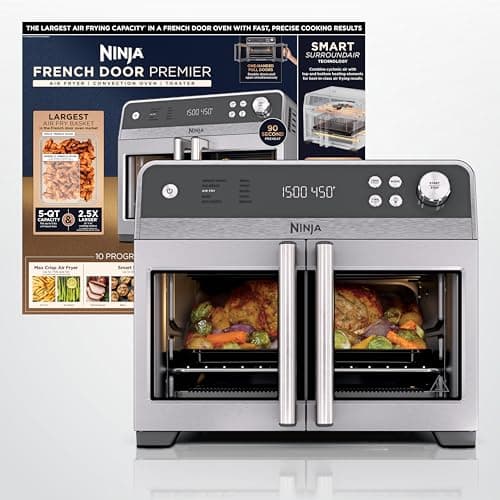
Buy it if you want the most capable French-door oven in the format and you are not buying on a specification. Ten functions, named individually by Ninja rather than counted — Air Fry, Air Roast, Whole Roast, Bake, Pizza, Broil, Reheat, Dehydrate, Toast, Bagel — a published 90-second preheat, which no other maker on this site publishes at all, and a door that opens with one hand on a sixteen-and-a-half-inch oven. Skip it if the electrical figure matters, because SharkNinja publishes no wattage for this model, and skip it if you are shopping on capacity, because SharkNinja publishes no cavity capacity either.
We have not cooked in this oven. There is no test kitchen behind this site and our rubric says so in those words. What follows is what Ninja publishes, what it conspicuously does not, and what the gap does to the numbers a buyer actually sees.
What Ninja publishes, which is unusual in both directions
Start with the good half, because it is genuinely good. SharkNinja's own product page names all ten functions instead of advertising a count, which is rarer in this category than it should be — a “13-in-1” badge with no list behind it tells you nothing, and the presets are mostly the same elements at different set points anyway. Having the names means you can tell in advance that there is a Dehydrate mode and a Bagel mode and no Proof mode.
Then the 90-second preheat, which is the only published preheat time for any oven on this site. Preheat is the specification that decides how a countertop oven feels day to day — it is the difference between using it for one piece of toast and walking to the full-size oven — and almost nobody publishes one, because almost nobody wants to be held to it. Our preheat guide covers when it matters and when it does not. Ninja also publishes that no rotating is required on Bake, Pizza and Whole Roast, which is a claim about the fan stated rather than implied.
And the figures from SharkNinja's own product-data sheet: 16.53 by 15.79 by 13.48 inches, 22.77 pounds. Two decimal places on both. Which makes what is missing from the same sheet all the stranger.
There is no published wattage, and Ninja has published one before
This is the hole, and it is not a small one on an 1,800-watt-class appliance. SharkNinja's product page publishes no wattage. SharkNinja's own syndicated product-data sheet — the vendor feed retailers render their spec tables from — publishes a dimension and a weight and leaves the wattage field unpopulated. And no FO101 owner's guide has been published that we could reach, which is normal for a release this new and is still the document that would settle it.
The reason to call this out rather than shrug at it is that SharkNinja has published rating-plate wattages. For the DT200-series Foodi XL Pro the figure sits in a technical-specifications table in the owner's guide — a regulatory artefact, reproduced. So this is not a brand that refuses on principle; it is a brand that has not got to it on this model. Worth adding, because it changes the stakes: that DT200-series oven was discontinued in November 2026, so this is now the only large Ninja oven on sale with any wattage attached to it at all, and the figure is a retailer's.
The 1,800 watts this page costs everything from comes from Target's specification table. That is below “the manufacturer's own listing copy” on the source hierarchy this site publishes: a retailer typed it from a vendor sheet nobody outside the trade can read, and it can change without a changelog. We use it because it is the only figure that exists and because every oven of this size and ambition in the catalog draws the same — but a buyer whose decision turns on amps should not make it on this number.
With the figure we have: 1,800 W at 120 V is 15 amps, the entire rating of a standard branch circuit. Our dedicated-circuit guide works through what that does at home; our office ranking is the version of the problem you cannot solve with an electrician, and this oven is disqualified there on a figure its own maker did not publish. At the US average residential rate of 18.34¢ per kWh, 1,800 watts is 33.0¢ an hour of oven-on time, or about $60 a year at half an hour a day — the sum is written out on our air-fryer-oven electricity page, and watts by model lists where every figure on the site came from.
The 20.3 quarts is a title, not a specification
Here is the one that will actually cost somebody money. The oven is sold as 20.3 quarts. That figure is in the Amazon listing title and in retail copy, and it is not in any SharkNinja specification we could read— not on the product page, not in the product-data sheet. The only capacity Ninja publishes for this oven is the five-quart air fry basket, which is an accessory, and which SharkNinja also sells separately.
So retailers put the basket in the capacity field. Target's specification table for this oven reads “Capacity (Volume): 5 Quart”. That is not Target being careless; it is the only capacity figure in the vendor feed. The consequence is that a shopper filtering a retailer's category page by size will see a twenty-quart oven described as a five-quart one, and a shopper comparing the Amazon title against the Target table will see two numbers four times apart with no way to reconcile them.
For what it is worth, 20.3 quarts is not implausible. It is 1,172 cubic inches; the published exterior is 3,518 cubic inches, so the claim describes a cavity at about a third of the box, which is ordinary for an insulated countertop oven. The problem is not that the number looks wrong. The problem is that there is nothing to check it against— no interior dimension, no cubic-foot figure, nothing. Compare the Cuisinart French-door oven published the same season, which states 0.6 cu ft and 18 quarts: multiply the first out and you get 17.95, so the pair confirms itself. One oven here publishes a claim you can test and the other publishes a claim you cannot.
This site has recorded the inflated-headline pattern three times — Nuwave's 30 QT against 24.9, the Our Place Large Wonder Oven, the Midea Flexify. Every one of those findings existed because the maker published enough to be caught. An unfalsifiable capacity claim is not a better one, and our Documentation score is weighted that way deliberately.
The superlative, and how to read a footnote
SharkNinja claims “the largest air frying capacity in a French door oven” and then does something most brands do not: it footnotes the claim. The footnote reads “vs. Emeril's FAFO-001 French Door Air Fry Oven”— one named comparator.
Read plainly, that is a comparison of air-frying capacity against a single rival, not a survey of the format. Two things follow. First, the claim is about the basket, which is the only capacity Ninja publishes, rather than the oven. Second, this site ranks French-door ovens with substantially larger published cavities — the Midea Flexify at 26.4 QT, the Emeril 26 QT and the Elite Gourmet at a stated 47.5 — so “largest” is doing narrow work.
Ninja deserves the credit anyway. A footnoted superlative is a checkable superlative, and the brands that write “largest capacity” with no asterisk are the ones you cannot argue with. The lesson generalizes: on any appliance claim with a star next to it, the star is the specification.
Dehydrate, with no published floor
Dehydrate is one of the ten named functions. No minimum temperature is published for this oven anywhere, which means there is no document that tells you whether the mode runs at a dehydrating temperature or just at the lowest the thermostat accepts.
That gap is specific and it is checkable against the makers who do publish a floor. The Our Place Wonder Oven Pro publishes 80°F. The Nuwave Bravo XL Pro publishes 50°F in 5°F steps. Midea publishes 100°F. Breville's BOV680 publishes 120°F in its manual. A long list of cheaper ovens stop at 200°F, and a 200°F floor is not a dehydrator whatever the button says. Our dehydrator ranking is built entirely on the published floor for exactly that reason, and the how-to explains what the temperature has to do. The FO101 has a Dehydrate mode we cannot place on that scale.
Footprint, and what the French door costs
16.53 inches on its longest horizontal figure, 15.79 on the other, 13.48 high, 22.77 pounds. Narrower than a Breville BOV900's 21.4 inches, which is the width that defeats most under-cabinet gaps, and lighter than the 25-pound Cuisinart. The 13.48-inch height plus the clearance a manual would ask for is most of a standard upper-cabinet gap, and there is no published clearance requirement for this model to plan against — the makers who publish one ask for two to four inches.
One number worth noticing: Target's table gives the depth as 15.75 inches where SharkNinja's data sheet gives 15.79. Four hundredths of an inch is nothing, and it tells you the retailer table and the vendor sheet are the same source rounded differently — which is also the reason the missing wattage is missing in both places.
What the format buys is reach: both doors clear the opening, so you load from in front of the cavity instead of over a hot drop-down door, and nothing needs clear counter space in front of the oven. What it costs is width and moving parts. Our French-door roundup ranks the whole field on those trade-offs.
One year of warranty, in a format with two hinge sets
One (1) Year Limited Warranty, published by SharkNinja on its own page. That is the bottom of the published range in this category and it is the weakest thing on this oven after the missing wattage. Our brand-by-brand warranty audit found that a published term is the exception rather than the rule here — thirteen of the forty products in this catalog carry one — that the longest anyone publishes is three years, and that price and term are close to unrelated.
It lands harder here than it would on a single-door oven. A French-door oven carries two doors, two hinge sets and a linkage that keeps them synchronized, which is more moving metal than the format it replaces — and the hinge is what fails. The Cuisinart French-door oven published the same season carries three years at a lower price. If the mechanism is the product, the cover on the mechanism is part of the spec sheet.
Who should buy it, and who should not
Buy itif you want ten real functions in a French-door body, if a 90-second published preheat is the thing that will make you reach for it, or if you have had good service out of Ninja ovens before — the brand has more models in this catalog than any other and we rank the whole line separately. At two hundred dollars it is priced where the format is competitive.
Skip itif you are buying on numbers. No wattage, no cavity capacity, no temperature floor, no clearance figure: four of the things this site exists to check, and none of them available. On a shared circuit — an office, a camper, a kitchen with one spare outlet — that first gap is disqualifying on its own, and the ovens that can share a circuit are the ones whose makers published a figure.
Also skip it if the 20.3 quarts is why you are here, not because the figure is wrong but because nothing supports it. If you want a French-door oven whose capacity claim you can test with a calculator, the Cuisinart TOA-FD70 publishes two figures that agree and three years of warranty, for forty dollars less.
Why the basket ends up in the capacity field
Retail specification tables are not written by retailers. They are rendered from a vendor data feed — the same syndicated sheet SharkNinja publishes for this model — and each field in the table maps to a field in the feed. If the brand fills in a basket volume and leaves the cavity volume empty, the table shows the basket. Nobody lies; the schema simply has one “capacity” slot and the oven has two capacities.
The practical defense is to stop treating a single capacity number as comparable at all. Ask for an interior dimension in inches, which is the figure that decides whether your dish fits and the only one that cannot be quietly redefined. Our pan-fit guide lists the small number of makers who publish one — and on this oven, as on most, that list does not include this one.
How much a preheat figure is worth
More than most specifications and less than it sounds. A 90-second preheat is a claim about a small cavity and a fast fan, and it is the difference between an oven you use for a single piece of toast and one you walk past. It is also a figure measured under conditions nobody publishes: to what temperature, from what starting point, with what in the cavity.
Treat it as a statement of intent that the brand has put its name to, which no other maker here has done, and not as a time you can plan a recipe around. The honest comparison with a full-size oven is mostly about preheat rather than cook time, and that is the part this figure speaks to.
What to do about a missing wattage before you buy
Three options, in order of how much they cost you. One: buy a different oven. Two dozen products in this catalog carry a wattage figure and every one is listed with its source, most of them off a rating plate or a manufacturer's specification table — so if the circuit is the constraint, the constraint is solvable by shopping. Two: buy this one and read the rating plate on the back on delivery day, inside the return window, which settles it in ten seconds. Three: assume 1,800 W and plan the circuit for 15 amps, which is what we have done on this page and is the safe direction to be wrong in.
What not to do is assume it draws less because it is smaller. Rated power in this category tracks the element set, not the cavity: an 1,800-watt rating turns up on a 12-quart Breville compact and on a 30-quart Nuwave. The circuit arithmetic is the same for both.