HUB 06 · Guides & Answers
Is a Countertop Convection Oven Worth It?
Yes if you cook for one or two several times a week, if your kitchen has no full-size oven, or if you want to avoid heating the whole house in summer. No if you are buying it to save money on electricity, to replace a wall oven, or because the box says fifteen functions.
We earn a commission if you buy through our links. It does not change the price you pay, and it does not decide our picks — the scoring rubric is published in full, including what disqualifies an oven. How this works.
The answer, first
A countertop convection oven is worth it in three situations and not worth it in three others, and the dividing line is not price. It is worth it if you routinely cook small amounts — one tray, two portions, a reheat — because the whole efficiency argument for this category is heating less air. It is worth it if your kitchen has no full-size oven at all, where it is not a supplement but the oven. And it is worth it if running the big oven makes the house uncomfortable in summer.
It is not worth it as a replacement for a full-size oven, which it cannot match on volume or pan size. It is not worth it for the electricity saving alone — the numbers are below and they are small. And it is not worth it for a function count: most of the presets are the same elements at different set points.
Where the value genuinely comes from
Not the wattage. A countertop oven at 1,800 watts is the same order of draw as a wall oven's bake element, which is typically in the 2,000 to 3,500-watt range. The saving is time and volume: a wall oven has around five cubic feet of air and a great deal of metal to bring up to temperature, and a preheat can mean ten to fifteen minutes of near-continuous draw before you have cooked anything. A countertop oven with under a cubic foot of cavity is at temperature in a fraction of that.
Put the sum at the US average residential rate this site uses throughout — 18.34¢ per kWh, EIA Table 5.3, June 2026:
Sixty dollars a year of total electricity, at the heaviest end of normal domestic use. If the countertop oven replaces half your full-oven sessions you might save fifteen or twenty dollars a year — real, and not a reason to buy an appliance. The full countertop-versus-wall-oven comparison, with the sums written out.
The real returns are the ones that do not appear on a bill: not waiting twelve minutes to heat a tray of vegetables, not turning the kitchen into a sauna for one pizza, and having a second oven on the two days a year it saves a dinner. Those are worth more than the electricity and they are what people actually keep these for.
The four things you give up, with the published figures
1. Height, and nobody will tell you how much.The constraint in a countertop oven is vertical: a filled cake pan, a covered casserole or a tall roast runs out of room long before the footprint does. Exactly three ovens in our thirty-four-strong catalog publish an interior height at all — Nuwave at 7.625 inches, Our Place at 7.6 and 7.75. Every Breville, every Ninja and the Cuisinart flagship publish none, and BLACK+DECKER's own manual adds a requirement on top of whatever the height is: “Be sure food or baking dish does not come within 1½ inches of the top heating elements.” Where that becomes the whole decision.
2. Pan size. The pan most kitchens own is a 9 x 13; the pan most bakers want is an 18 x 13 half-sheet. Not one oven in this catalog publishes a figure that admits a half-sheet, and only two publish a 9 x 13 claim at all — the Cuisinart TOB-260N1 and the BLACK+DECKER TO3250XSB, the latter being the only one anywhere here that states the fit with the pan handles included. The pan geometry worked through in full.
3. Thermostat accuracy that nobody publishes. Not one of the thirty-four publishes a temperature tolerance. The only accuracy disclosure in the whole category is BLACK+DECKER stating in its own manual that its oven temperatures read below the set point by design. For roasting, shrug. For bread and cakes, buy a separate oven thermometer and treat it as part of the purchase.
4. Longevity, and the warranty as the only proxy.Nobody publishes a duty cycle or an element life, so the warranty term is the only number a maker puts its own money behind — and it does not track price. In our catalog it runs from one year (most brands, including Breville on several models) through two (BLACK+DECKER's budget line, Breville's BOV950) to three (Proctor Silex, on a $50 oven). What that evidence does and does not support.
What “worth it” costs, by band
The useful framing is not cheap-versus-expensive but what each additional hundred dollars actually buys, and in this category the answer changes direction twice.
- Under $70. You get a working thermostat, three knobs, four slices and — from two brands — a published wattage and a two or three-year warranty. What you do not get is a fan worth the name, published interior figures, or evenness. The budget field ranked.
- $70 to $200.This is where the marginal dollar buys the most: a real convection fan, a genuinely larger cavity, published pan-fit claims, and in a couple of cases a rating line printed in a manual. Most people asking “is it worth it” should be shopping here. The under-$200 field.
- $200 to $400. You are buying documentation, element control and build. Breville publishes rating plates and temperature floors most of the category will not print; that is a real thing to want, and it is also the point at which a buyer should ask honestly how many hours a week the oven will run. The premium field.
- Above $400.In our catalog the extra almost always buys connectivity or a second control board rather than heat. Breville's own published figures for the BOV900 and BOV950 are identical on every mechanical row — same 1,800 W, same cubic foot, same dimensions, same band — and the premium is an app. The side-by-side.
Is the convection part worth it, specifically?
The fan is usually worth having and almost never the expensive part. In hardware terms it is a motor drawing a few tens of watts inside an appliance rated at 1,100 to 1,800, so it is not where the electricity goes, and an oven that finishes sooner can use less energy for the same dish than a radiant one that takes longer. What it buys is evenness and speed on anything larger than a slice.
Two caveats worth knowing before you treat the fan as a pure upgrade. Recipes are written for still air, so the standard adjustment is to drop the set point about 25°F — the chart is here. And not one function list in this catalog states whether the fan can be switched off independently of the cooking mode, which matters for delicate baking. If you want radiant heat with nothing to defeat, three ovens we cover have no fan at all. Whether to pay for the fan, settled.
Who should not buy one
Anyone expecting to retire a wall oven. The volume is not there, the pan sizes are not there, and two of these cannot take a half-sheet between them. The honest version of that question.
Anyone counting on the electricity saving to justify it. Sixty dollars a year is the total bill at heavy use, not the saving. Buy it for the time and the heat, or do not buy it.
Anyone whose counter is already full. This is the most common regret in the category and it is entirely predictable: these are large objects, published clearance requirements vary by a factor of six, and one brand bans operating its oven under a wall cabinet outright. Measure first, with the published figures.
Anyone buying on function count.Fifteen functions is nine more than most households use, and the presets are overwhelmingly the same elements at different set points. The one genuine exception in our catalog is a mechanism rather than a label — Ninja's FlexDoor splits the box into two independently controlled cavities — and even there, Ninja publishes no wattage for it. Sorting the function list by what the hardware is actually doing.
A three-question test before you buy
How many times a week will this run? Under two, and almost nothing in this category pays for itself in convenience, let alone money. Four or more and the time saving becomes the real return — and the case for spending into the $70–$200 band rather than the bottom of the market gets strong.
What is the biggest thing it has to take? Measure it loaded, on a rack, and add the inch and a half of top-element clearance BLACK+DECKER publishes. Then look for a published interior figure — and if the brand does not print one, treat the fit as unverified rather than assuming.
Where will it live, and what is above it? Published clearance requirements in this catalog range from one inch on every side to a flat prohibition on operating under a wall cabinet. This is the question that decides whether an oven gets used or gets put away, and it costs nothing to answer with a tape measure.
What we would buy, if the answer is yes
On published figures rather than on feel: the Cuisinart Chef's Convection (TOB-260N1) if you want the biggest honestly documented cavity — the only oven in our catalog publishing a wattage and an interior volume in cubic feet in the same place. The BLACK+DECKER TO3250XSB for value, because it prints the rating line in its own manual, publishes the only handles-included pan claim here, and carries two years. The Breville Smart Oven Pro (BOV845) if you bake seriously and want a published 120°F floor. And the Nuwave Bravo XL Pro if you want published interior dimensions and a 5°F set-point step, which nobody else in the category offers. The full ranking is here.
The hardware
The ovens this page is about
The ovens referred to above, with prices pulled live from Amazon and dated on every card. Full rankings live in the roundups linked from this page.
1,800 W
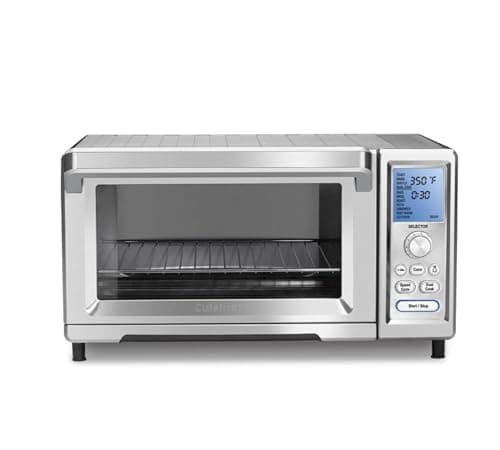
Cuisinart Chef's Convection Toaster Oven (TOB-260N1)
The only oven here whose manufacturer publishes both a wattage and an interior volume in cubic feet on the same page. 0.95 cubic feet at 1,800 W, with a stated list of what fits — a 13-inch pizza, a 9x13 pan, nine slices.
1,800 W
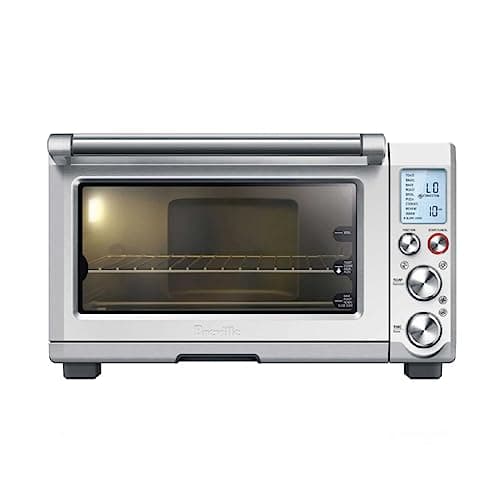
Breville Smart Oven Pro (BOV845BSS)
No air fry function, which is the point. This is the convection oven from the range with the marketing layer removed — ten functions, 1,800 W, and a published 120°F floor on Bake and Roast: no Proof preset, but a stated low end most ovens in the category never print.
1,500 W
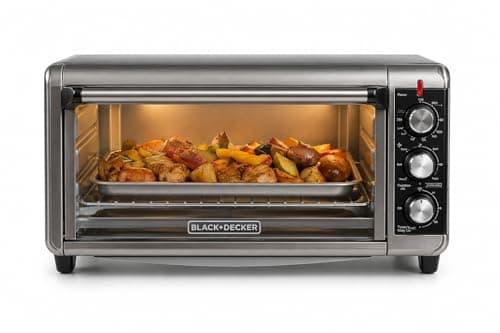
BLACK+DECKER 8-Slice Extra Wide Convection Toaster Oven (TO3250XSB)
A dial-controlled convection toaster oven whose maker publishes the wattage, the dimensions, the weight and a two-year warranty on its own page, and prints the rating line in the manual — 1500 W, 120 V, 60 Hz. Eight slices, a 12-inch pizza and a 9 x 13 pan with handles, for under a hundred dollars. It is a convection baker, not an air fryer: there is no basket and no air-fry setting.
1,800 W
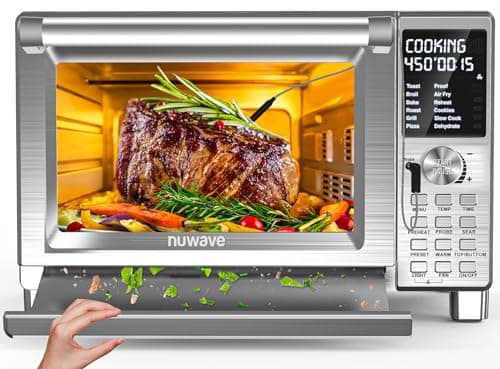
Nuwave Bravo XL Pro Air Fryer Toaster Oven (30 Qt, with probe)
A 30-quart, four-rack-level convection oven with an integrated temperature probe that stops the cook at a set internal temperature, and a maker that publishes its interior and exterior dimensions, weight, capacity, temperature range and warranty term — most of which the Ninja probe ovens do not. The 1,800-watt figure comes from a Nuwave support answer on its own product page rather than the manual's rating line, and we say so.
#ad · As an Amazon Associate we earn from qualifying purchases.
Questions
Frequently asked
Is a countertop convection oven worth buying?
Does a countertop convection oven save money on electricity?
Can a countertop convection oven replace a full-size oven?
How much should you spend on one?
Is the convection fan worth paying for?
What is the biggest regret people have with these?
Keep reading
Related
- Best countertop convection ovensThe full ranking, if the answer to this page turns out to be yes.
- Countertop oven vs full oven costThe arithmetic behind the saving, with the usage assumption stated.
- Can one replace your oven?The harder version of the same question, answered on published capacity.
- Convection vs conventional ovenWhat the fan changes, and what the 25°F conversion is actually correcting for.
- Best under $200The band where the marginal dollar buys the most in this category.
Receipts
Sources
- Cuisinart — Chef's Convection Toaster Oven TOB-260N1 product page (1800 watts, 0.95 cubic feet, stated fit list, fifteen functions)
- Breville — Smart Oven Pro (BOV845) product page (1800 W, ten functions, published 120°F floor on Bake and Roast, no air-fry function)
- BLACK+DECKER — Extra-Wide 8-Slice Toaster Oven (TO3250XSB) product page: specifications block, published function list (bake, broil, toast, keep warm; convection fan) and stated pan fit
- BLACK+DECKER — TO3250XSB / TO3260XSBD / TO3240XSBD use and care manual [PDF]: “During first few minutes of use you may notice smoke and a slight odor. This is normal and should cause no concern.”; “Temperatures in the oven will be lower than your set point.”; the 1½-inch top-element clearance rule; the timer rule; the short-power-supply-cord note
- Nuwave — Bravo XL Pro Smart Oven & Air Fryer product page (specifications table: 50°F to 500°F in 5°F increments, inner and outer dimensions, capacity, warranty)
- Proctor Silex — 4 Slice Toaster Oven Broiler (31260G) product page (temperature range, timer, 3-year limited warranty)
- US EIA, Electric Power Monthly Table 5.3 — average residential price, US total, June 2026
We have not cooked in these ovens and we do not pretend to have. Specifications come from the manufacturer's own published documents; electricity rates come from the US Energy Information Administration; prices come from the live Amazon API. Where a figure is not published, the page says “not published” rather than guessing. Read the full method.