HUB 06 · Guides & Answers
Why Does My Toaster Oven Smell Like Burning Plastic?
If the oven is new, almost certainly the factory coating on the elements and cavity burning off — one maker in our catalog says so in exactly those words, and another publishes a procedure for getting it over with. If the oven is not new, a plastic smell is not normal, and the causes are worth knowing in order.
We earn a commission if you buy through our links. It does not change the price you pay, and it does not decide our picks — the scoring rubric is published in full, including what disqualifies an oven. How this works.
The answer, first
If the oven is new, it is almost certainly the factory coating on the heating elements and the inside of the cavity burning off, and it is expected. Nuwave's own owner's manual says it in exactly these words: “It is perfectly normal for your new unit to produce a heated plastic smell when used for the first time. This will go away after the first few uses.” BLACK+DECKER's manual is nearly as direct: “During first few minutes of use you may notice smoke and a slight odor. This is normal and should cause no concern.”
If the oven is not new, a plastic smell is not normal and should not be waited out. Work down the list in the second half of this page; the fourth item on it — a plug or cord getting hot — is the one worth acting on immediately.
Why there is anything to burn off at all
A countertop oven arrives from a factory with manufacturing residue on the parts that get hottest: light protective oils on the elements and the stamped steel, binder from the insulation, and — surprisingly often — adhesive and labels that are supposed to be removed before first use. The first time the cavity goes past about 300°F, all of it volatilises at once. What you smell is organic residue breaking down, and the plastic character comes mostly from the adhesives and coatings rather than from anything structural melting.
Nuwave puts label removal in its Before First Use list as its own numbered step — “remove the glue and labels on the appliance” — which is a good indication of how commonly it gets skipped. It is worth going over the whole exterior and the door frame before the first run, including the back, where a sticker on a vent will produce exactly the smell this page is about.
The one published burn-off procedure in this category
Three manufacturers in our catalog address the smell. Only one publishes an actual procedure with a temperature and a duration attached, and it is Our Place, in the Before Your First Use section of its Wonder Oven manual:
That is a specification you can follow on any oven in this category, and we would: no food, 400°F, ten minutes, a window open and the extractor on. It is the whole fix for the new-oven case, and it is better done deliberately than discovered halfway through cooking dinner.
Our Place's same list asks you to wash the air fry basket, wire rack, bake pan and crumb tray in warm soapy water first — and specifies notin the dishwasher, because finishes may degrade. Nuwave's equivalent list permits the dishwasher, top rack only, and excludes the probe. Those are the kinds of instruction worth reading once rather than guessing at, and they differ by brand.
How long should the smell take to go? Nuwave commits to “after the first few uses” and BLACK+DECKER to “the first few minutes”. Nobody publishes a number of cycles. If a brand-new oven still smells of hot plastic after three or four proper heat cycles with nothing in it, stop treating it as burn-off and treat it as the next section.
When it is not burn-off: five causes, in the order to check them
1. Packaging left inside. Foam blocks, a cardboard insert under the crumb tray, a desiccant sachet, or plastic film on a stainless panel. Every manual in this category opens with a remove-all-packaging instruction and this is why. Unplug, let the oven cool fully, pull the crumb tray right out and look under and behind it with a torch.
2. Food residue carbonising.Grease on the element, a dripped cheese, or crumbs in the tray. Our Place's manual is unusually blunt about the consequence: “Be sure to clean the appliance after use. Failure to do so may cause food residue left inside the appliance to carbonize, causing fire and smoke.” Nuwave's troubleshooting guide attributes white smoke to greasy foods or greasy residue on the cooking rack. This usually smells acrid rather than plastic, but a burnt plastic container or a melted silicone mat smells exactly like plastic, because it is. The smoke question in full, with the grease-management detail.
3. The wrong cookware. Plastic-handled cookware, a plastic lid, melamine, a takeaway container, or glass with a plastic seal. This is the most common non-burn-off cause and the most avoidable one — and it is why the published guidance on materials is worth knowing before improvising: glass and foil both have real published answers that are not the obvious ones.
4. The plug, cord or outlet getting hot.This is the serious one. Overheating at a connection smells of hot plastic because it is the insulation and the socket body heating, and it is an electrical fault rather than a cooking smell. The relevant published facts: these ovens draw 1,100 to 1,800 watts, which is roughly 9 to 15 amps at 120 V, and BLACK+DECKER's manual notes that “a short power-supply cord is provided to reduce the risks resulting from becoming entangled in or tripping” with extension cords permitted only “if care is exercised”. Our Place goes further and instructs you to clean the plug regularly, because dust on it can cause condensation and damage the cable.
If the smell is at the wall rather than at the oven, or the plug is hot to the touch, or the cord is warm along its length: unplug it, stop using that outlet, and do not solve it with an extension lead or a power strip. The circuit arithmetic, and why a 15-amp kitchen circuit is tighter than it looks.
5. The oven cooling itself down.Worth knowing because it reads like a fault and is not. Nuwave's manual explains that the Bravo XL Pro “is engineered with an automatic shut-off feature to prevent overheating during use. If the Bravo XL Pro shuts off to cool itself down, an odor may be detected.” The instruction is to unplug it and let it cool completely, and to avoid cooking at higher temperatures or for longer than recommended. An oven that shuts off and smells is behaving as designed; the other reasons one of these appears to stop working are mostly as undramatic.
When to stop using it
Three situations where the answer is to unplug it and not wait and see. If the smell is coming from the plug, the cord or the outlet rather than from inside the cavity. If anything inside has visibly melted, deformed or discoloured around a joint. And if the smell appears for the first time on an oven that has been working fine for months — the burn-off explanation does not apply to an appliance that has already been through dozens of heat cycles.
One safety instruction from Our Place's manual that is worth reading before you ever need it, because the instinct it contradicts is strong: “If smoke or fire appears during cooking, do not open the door until the flames go out and do not attempt to extinguish with water. Doing so may cause the glass to shatter or the fire to spread.” Opening the door feeds it air. The published instruction is to turn the appliance off and keep the door shut.
And if the unit is under warranty, a persistent plastic smell on a new oven is a legitimate warranty conversation rather than something to tolerate. Published terms in our catalog run from one year (most brands, including Breville on several models, Our Place and Nuwave) to two (BLACK+DECKER, Breville's BOV950) and three (Proctor Silex) — the full warranty picture is here, and it does not track price.
The first-run routine, from the published instructions
Pulled from the three manuals we read for this page, in the order they put it: remove all packaging and remove the glue and labels from the appliance itself; wash the removable accessories by hand in warm soapy water (check whether your brand permits the dishwasher — Our Place forbids it, Nuwave allows the top rack and excludes the probe); wipe the cavity with a damp cloth and dry it; set the oven at least an inch from the wall and any other object; then run it empty at 400°F for ten minutes on Bake with the kitchen ventilated.
That last step is the one most people skip and the one that turns an alarming first dinner into an uneventful ten minutes. It is also free.
What this tells you about choosing a brand
Three of the thirty-four ovens we cover have manufacturers that address this smell in their own documentation, and exactly one publishes a procedure for it. That is a documentation story rather than a quality story — the ovens whose makers say nothing are not smellier, they just leave you to work it out — but it is the kind of difference that shows up when something actually goes wrong. Why Documentation is one of the five metrics we score.
The hardware
The ovens this page is about
The ovens referred to above, with prices pulled live from Amazon and dated on every card. Full rankings live in the roundups linked from this page.
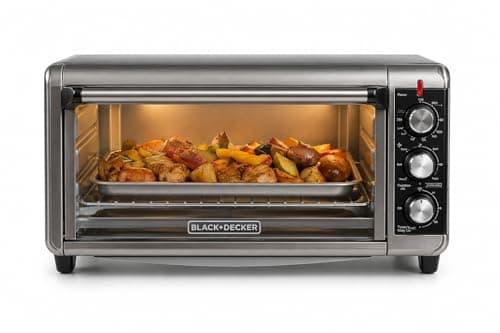
1,500 W
BLACK+DECKER 8-Slice Extra Wide Convection Toaster Oven (TO3250XSB)
A dial-controlled convection toaster oven whose maker publishes the wattage, the dimensions, the weight and a two-year warranty on its own page, and prints the rating line in the manual — 1500 W, 120 V, 60 Hz. Eight slices, a 12-inch pizza and a 9 x 13 pan with handles, for under a hundred dollars. It is a convection baker, not an air fryer: there is no basket and no air-fry setting.
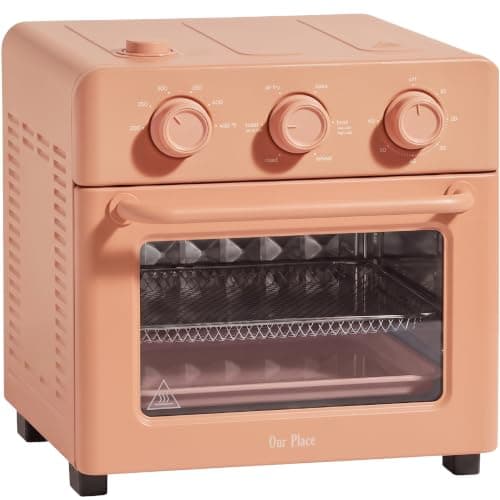
1,400 W
Our Place Wonder Oven (6-in-1, 13 Qt)
The most completely documented small oven we have covered, from a brand better known for pans. Our Place publishes the rating-plate wattage, the temperature range, the interior dimensions and the warranty term — all four things we score documentation on. At 1,400 W it costs less per hour than the 1,800 W field; at four slices and a 9-inch pizza it is genuinely small; and the limits are published too — a 200°F floor and a 60-minute timer.
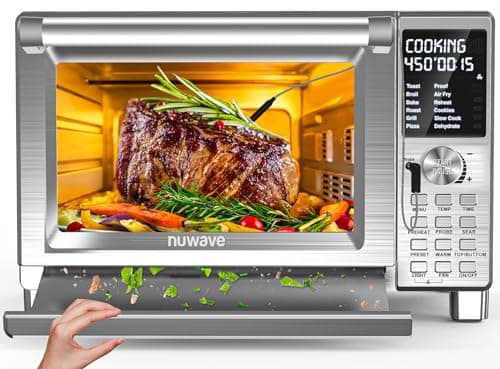
1,800 W
Nuwave Bravo XL Pro Air Fryer Toaster Oven (30 Qt, with probe)
A 30-quart, four-rack-level convection oven with an integrated temperature probe that stops the cook at a set internal temperature, and a maker that publishes its interior and exterior dimensions, weight, capacity, temperature range and warranty term — most of which the Ninja probe ovens do not. The 1,800-watt figure comes from a Nuwave support answer on its own product page rather than the manual's rating line, and we say so.
#ad · As an Amazon Associate we earn from qualifying purchases.
Questions
Frequently asked
Is a burning plastic smell from a new toaster oven normal?
How do you burn off a new toaster oven?
How long should the smell last?
My toaster oven is not new and smells like burning plastic. What is wrong?
Is the smell dangerous to breathe?
What if there is smoke or fire?
Keep reading
Related
- Why does my air fryer oven smoke?The grease-and-residue version of this question, with the published guidance.
- Why is my toaster oven not heating up?The other troubleshooting page, where the first published cause is not a fault at all.
- Does one need a dedicated circuit?The amperage arithmetic behind a plug or outlet that gets hot.
- Toaster oven recalls and safetyWhat has actually gone wrong with these appliances, from the recall record.
- How long do toaster ovens last?Every published warranty term, which is the only number any maker puts money behind.
Receipts
Sources
- Nuwave — Bravo XL Pro owner's manual, model 20813 [PDF]: Before First Use (remove glue and labels; “it is perfectly normal for your new unit to produce a heated plastic smell when used for the first time”), automatic shut-off odor note, white-smoke troubleshooting entry, probe target range
- BLACK+DECKER — TO3250XSB / TO3260XSBD / TO3240XSBD use and care manual [PDF]: “During first few minutes of use you may notice smoke and a slight odor. This is normal and should cause no concern.”; “Temperatures in the oven will be lower than your set point.”; the 1½-inch top-element clearance rule; the timer rule; the short-power-supply-cord note
- Our Place — Wonder Oven user manual, model APL.WDO.ESN [PDF, retailer-hosted copy]: rating line 120V 60Hz 1400W, Before Your First Use steps 5–7 (1 inch clearance; trial run without food at 400°F for 10 minutes on Bake; “conduct the trial run in a well-ventilated area as a small amount of smoke and odor may be detected”), carbonised-residue warning, smoke-or-fire instruction
- Our Place — Wonder Oven product page (200–450°F range, 13 qt / 12 L capacity, interior and exterior dimensions, steam infusion)
- BLACK+DECKER — Extra-Wide 8-Slice Toaster Oven (TO3250XSB) product page: specifications block, published function list (bake, broil, toast, keep warm; convection fan) and stated pan fit
We have not cooked in these ovens and we do not pretend to have. Specifications come from the manufacturer's own published documents; electricity rates come from the US Energy Information Administration; prices come from the live Amazon API. Where a figure is not published, the page says “not published” rather than guessing. Read the full method.