Small is a category, not a compromise
For one or two people, a compact toaster oven is not a downgrade — it is the right size. It heats less air, so it costs less to run and comes up to temperature faster, and it leaves counter for everything else. The trade is capacity: four slices and a small pizza is the honest ceiling of this tier, and no amount of preset labeling stretches it. This page ranks on the smallest published footprint that still does the three jobs — toast, bake, broil — properly, with the dimensions cited rather than guessed.
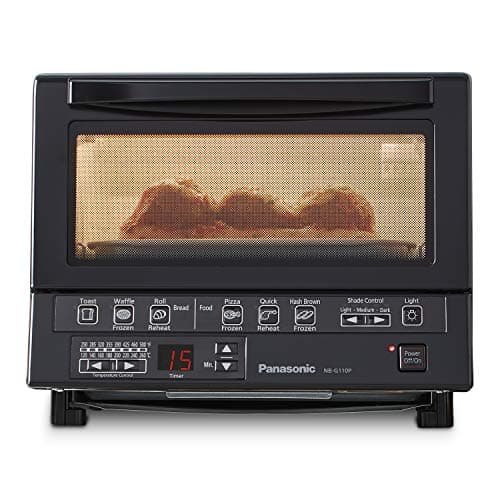
The Panasonic FlashXpress (NB-G110P) wins because it is the most completely documented small oven on the whole site: 1,300 watts, 120 volts, a 7.2-quart cavity, a 250–500°F range and exact millimeter dimensions, all published by Panasonic. It is 330 mm wide — genuinely compact — and its infrared elements mean no preheat in the usual sense. You pay for the engineering, but you can check every number. Our full review is here.
Reading the order
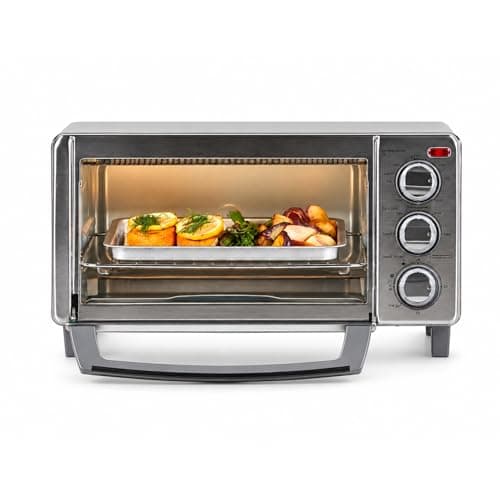
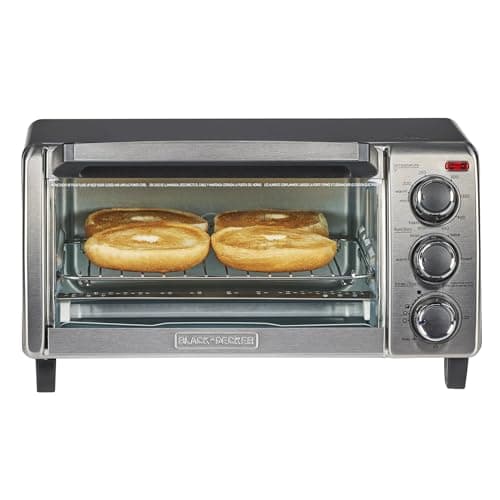
The BLACK+DECKER TO1785SG is second and the value pick: a four-slice oven at about eleven inches wide that publishes its full specification — 1,150 watts, 120 volts, dimensions and a two-year warranty — for sixty-five dollars, which is a more complete spec sheet than ovens costing five times as much. Its review is here. The BLACK+DECKER TO1313SBD is third and the floor: about sixty dollars, four slices, three knobs, small enough for a dorm room, an office or an RV, and cheap enough that its eventual failure is an inconvenience rather than a loss.
The one measurement that matters
Depth, not width. A small oven still has to clear whatever is behind it and let its door open in front, and the most common small-kitchen failure is an oven whose drop-down door fouls the backsplash or overhangs a shallow counter. The FlashXpress is 260 mm deep and the BLACK+DECKER ovens are around eleven inches — shallow enough for most counters, but measure from the wall to the front edge before you buy. Our sizing guide walks through exactly what to measure, and if a wall cabinet is the constraint, the under-cabinet picks handle the vertical gap.
How to choose
If you want the best-specified small oven and will keep it a long time, the Panasonic is the buy — it is small, fast and fully documented. If you want compact and cheap, the two BLACK+DECKER ovens do the same three jobs for a third of the price, with the TO1785SG adding a published wattage and warranty and the TO1313 costing less still. None of these has a convection fan, so if you want air fry in a small body, that is a different category. Every pick is judged from published specs, not our own testing.
One case where small is the wrong axis to sort on: if the oven is going into a workplace break room, the binding constraint is not the counter but the circuit, because you cannot read the panel and cannot add a line. Our office ranking sorts the same shortlist on published amps instead of inches — and the published shut-off behavior, which matters when you are at your desk rather than in the room.
One thing this ranking deliberately does not require is a fan, so it includes radiant ovens where the air only moves because it is hot. If a real convection fan is non-negotiable in a small box, the compact convection ranking applies that filter and sorts on published exterior width plus a published interior — and it also marks the price below which, in this category, the fan simply disappears.
How we picked
Ovens we claim to have cooked in: 0
Everyone in this category tells you they roasted forty chickens. We have roasted none, and we say so. Here is what we do instead: read the manufacturer's manual and spec sheet, record the published wattage, interior volume, temperature range and warranty term, work out what the oven costs to run for an hour and for a year, show the arithmetic so you can redo it with your own electricity rate, and cite all of it. Where a brand publishes no wattage, we print no running cost rather than borrowing a number from a similar model. Prices come live from Amazon's API and disappear rather than go stale.
The scores above are judgments from that documented research — not test results. One of the five metrics is Documentation: whether the manufacturer will tell you what its oven draws at all. The full rubric, including what disqualifies an oven, is published in full.