The short answer
Buy the Our Place Wonder Oven. It is for the cook who has measured the gap on the counter and wants to know the oven will fit before it arrives: Our Place publishes an exterior of 11.5 x 10.6 x 11.6 inches, an interior of 10 x 10.3 x 7.6 inches, a 1,400-watt rating line off the manual cover and a one-inch clearance requirement — and the interior dimension is the figure that almost nobody in this category prints at all. If you want the full 1,800 watts in a small box, the Breville Smart Oven Air Fryer Compact is 15.7 inches wide with a published 120–445°F range. The budget pick is the Hamilton Beach Sure-Crisp 31403 — the cheapest oven on this site that has both a real fan and a wattage its maker publishes.
We have not cooked in any of these. Our rubric says so in those words — there is no test kitchen behind this site. What follows is what each manufacturer publishes, the arithmetic those figures support, and the places where the published numbers run out.
Why “compact” is a measurement problem, not a marketing one
This hub already ranks the full-size end, where the question is how much cavity you can buy. At the compact end the question inverts, and it is harder, because the number you need is the one brands withhold. Of the forty ovens in this catalog, exactly three publish an interior dimension in inches: the Our Place Wonder Oven, the Our Place Pro and Large, and the Nuwave Bravo XL Pro. Everybody else publishes a capacity in quarts or liters, which tells you the volume of a box but not its shape — and shape is what decides whether your pan goes in.
So this page ranks on four published figures, in this order: a stated exterior footprint, a stated interior or a stated fit in objects, a rating-plate wattage, and a real fan. The fourth one matters more at this size than anywhere else on the site, because the budget compact shelf is full of ovens marketed as “natural convection”. That phrase means the air moves because it is hot. There is no fan. The difference between the three things called convection is worth two minutes before you spend anything.
The published numbers, side by side
| Oven | Published exterior | Published interior or fit | Rated power | Per hour |
|---|
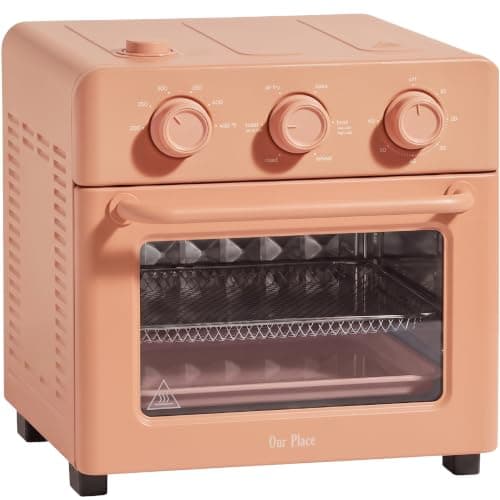
| Our Place Wonder Oven | W11.5" x D10.6" x H11.6" | W10" x D10.3" x H7.6" (13 qt / 12 L) | 1400 W (rating plate) | 25.7¢ |
|---|
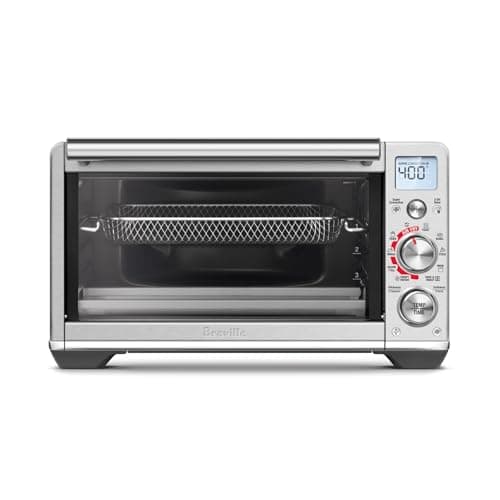
| Breville Smart Oven Air Fryer Compact | 15.7" wide | 1–4 slices; 11" pizza pan | 1800 W (rating plate) | 33.0¢ |
|---|
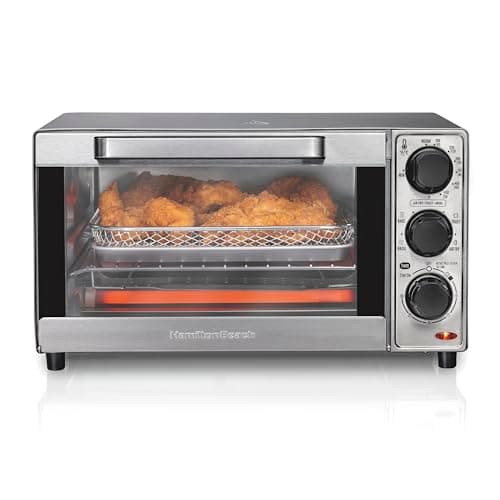
| Hamilton Beach Sure-Crisp 31403 | W14.9" x D11.5" x H8.7" | 4 slices; 9" pizza; 8 x 8 pan | 1120 W (product page) | 20.5¢ |
|---|
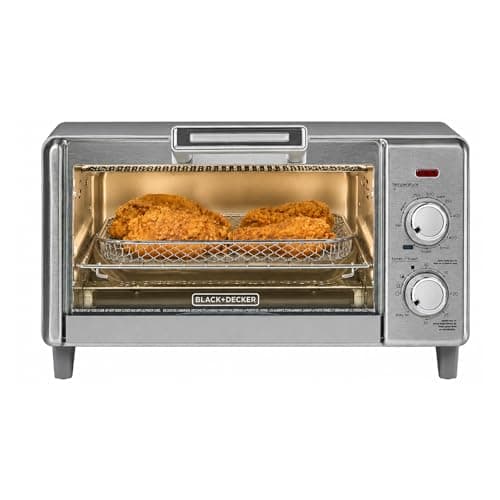
| BLACK+DECKER Crisp 'N Bake Air Fry | Not published for this SKU | 4 slices / 9" pizza (line figure) | 1150 W (line figure, TO1785SG) | 21.1¢ |
|---|
Per-hour figures are ours, at 18.34¢ per kWh— the US average residential rate for June 2026, cited below. They are the published wattage times the rate and nothing else, so you can redo them with the number on your own bill. The full arithmetic, written out.
1. Our Place Wonder Oven — for the cook who measured the gap
Who it is for: someone buying for a specific space, who would rather read an interior dimension than a quart figure. It is the smallest oven here by published width at 11.5 inches, and the only one whose maker tells you the cavity is 10 x 10.3 x 7.6 inches, so the question “will my pan fit” has an answer before you pay.
Our Place publishes all four things we score documentation on — a rating-plate wattage on the manual cover, a temperature range, interior dimensions and a warranty term — and 1,400 watts is about 11.7 amps, which is a fifth less draw than the 1,800-watt norm and costs 25.7¢ an hour rather than 33.0¢.
The cons. The published floor is 200°F and the timer stops at 60 minutes, so there is no proofing, no dehydrating and no slow cook — and those are exactly the modes the Pro adds. Four slices of toast and a 9-inch pizza is the honest ceiling. None of the accessories is dishwasher safe; Our Place says so itself. The full review is here.
2. Breville Smart Oven Air Fryer Compact — for full power in a small box
Who it is for: the cook who will not trade watts for width. Breville prints “120V ~ 60Hz 1800W” in the BOV680 instruction book — the rating line, not a marketing headline — in a chassis it measures at 15.7 inches wide, and publishes a 120–445°F Bake and Roast range. That 120°F floor is unusually low for any oven at any size, and holding a low set point is harder than getting hot.
The cons, and Breville states them itself. No interior volume is published for this model, so you compare it by pizza pan rather than by number: the manual's own note is an 11-inch pan, with a 12-inch pan going in only with the rack in the upward orientation. The published ceiling is 445°F, below the 500°F two cheaper ovens on this site reach. And 1,800 watts in a small cavity is 15.0amps — the whole of a 15-amp circuit. Our full review.
3. Hamilton Beach Sure-Crisp 31403 — the budget pick
Who it is for: anyone who wants a fan and a checkable wattage for about the price of a nice pan. This is the cheapest oven in the whole catalog with both: Hamilton Beach publishes 1,120 watts, the 200–450°F range and the exact 14.9 x 11.5 x 8.7 inch exterior for model 31403, which is the model Amazon's listing data names for this listing. 9.3 amps leaves real headroom on a kitchen circuit shared with a kettle.
The cons. Four slices, a 9-inch pizza and an 8 x 8 pan is the published ceiling — this is a small oven. Hamilton Beach sells a 31403J variant at 1,500 watts under a near-identical name, so check the rating plate on delivery. And 1,120 watts preheats and cooks more slowly than 1,800: cheaper per hour is not automatically cheaper per meal.
4. BLACK+DECKER Crisp 'N Bake Air Fry — the floor of the category
Who it is for: a second oven, a short-term kitchen, or anyone for whom sixty dollars is the decision. BLACK+DECKER publishes 1,150 W at 120 V, a 4-slice / 9-inch-pizza capacity and a two-year limited warranty for the Crisp 'N Bake air-fry line, which is a longer term than several ovens three times the price carry.
The cons, and the first is a sourcing con. The published wattage and warranty we cite belong to the TO1785SG in the same line; BLACK+DECKER publishes no separate figures for this exact SKU and we have not assumed they are identical. No exterior dimensions are published for it either, which on a page about fitting an oven into a measured gap is the reason it ranks fourth rather than second on price. Four slices is genuinely small.
The honest summary
The compact convection shelf has a hard floor and it is not a price: it is the fan. Below roughly the Hamilton Beach's price the ovens stop having one, whatever the box says, and the sub-$50 band we rank separately is 650 to 800 watts of radiant heat — a toaster rather than a small oven. Above that floor the trade is simple and every figure in it is published: Our Place gives you the measurements, Breville gives you the watts, Hamilton Beach gives you the price, and nobody at this size gives you all three.
Measure the gap, then add the clearance nobody mentions
The published exterior is not the space the oven needs. Our Place asks for an inch above, behind and on each side in its own manual; Breville asks for clearance in the BOV680 book too. So an 11.5-inch-wide oven wants about 13.5 inches of counter, and a 15.7-inch one wants about 17.7. Depth is the dimension people forget: measure from the backsplash to the front edge, and then check that a dropped door has somewhere to go. The published clearance requirements, brand by brand.
A quart figure is not a shape
Thirteen quarts sounds like a number you can compare, and it is not one: a tall narrow cavity and a wide shallow one of identical volume take completely different pans. That is the whole reason the Our Place interior figure is load-bearing on this page. Where a brand publishes only a capacity, the useful substitute is a fit stated in objects — slices of toast, inches of pizza, a named pan size — which is why we quote those for the other three. Which pans fit which published interiors.
What you give up going small, stated plainly
Two racks become one or two shallow levels. A half-sheet pan becomes a quarter sheet. The temperature ceiling tends to fall — 445°F on the Breville Compact, 450°F on the other three — which is real for thin-crust pizza. What you do not give up, at this size, is power: the Breville Compact draws the same 1,800 watts as the widest oven in our catalog. Small does not mean slow unless the wattage says so.