The short version
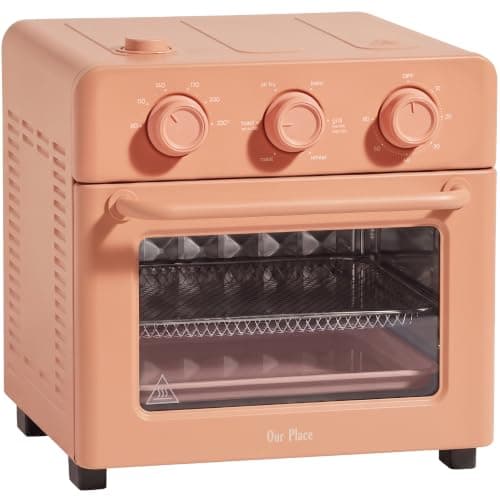
For most two-person households the right oven is the Our Place Wonder Oven, for one unglamorous reason: it is the only oven on this page whose maker publishes the inside dimensions — 10 by 10.3 by 7.6 inches, 13 quarts, in a box 11.5 inches wide — so it is the only one you can check two dinner plates against before paying. It draws a rating-plate 1,400 watts rather than 1,800, which is about 10.7 cents a meal against 13.8, and it publishes a steam function nothing else here offers.
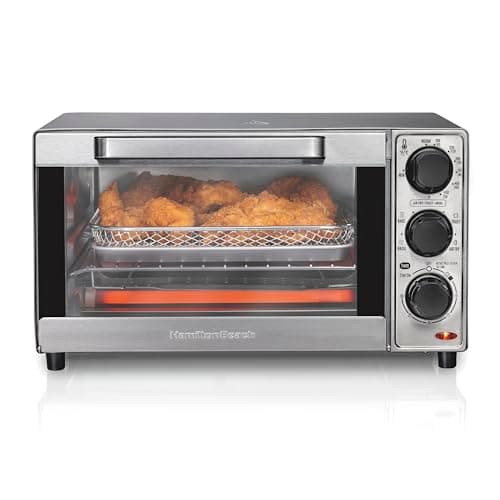
Spend as little as possible and buy the Hamilton Beach Sure-Crisp 31403. It is the cheapest oven on the page and also the cheapest to run — 1,120 published watts is the lowest figure in this whole catalog, about 8.6 cents for a 25-minute meal — and it is the only oven here that publishes three separate pan-fit claims at that size: a 9-inch pizza, an 8 by 8-inch pan and a 9 by 5-inch loaf pan. For two people that is an unusually complete answer for under fifty dollars.
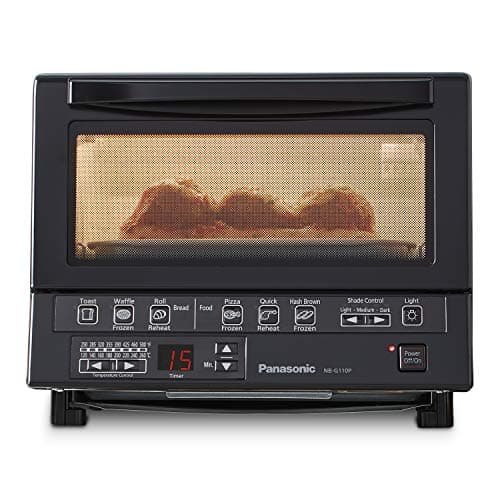
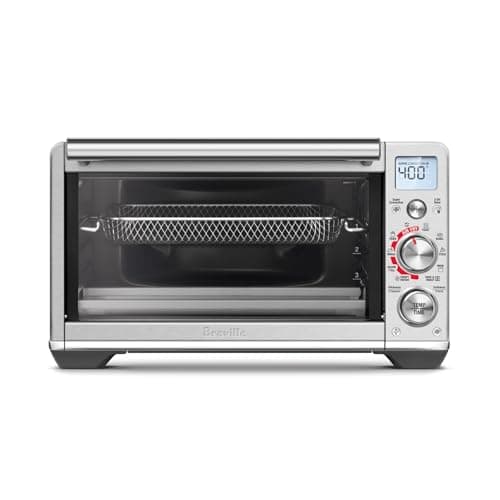
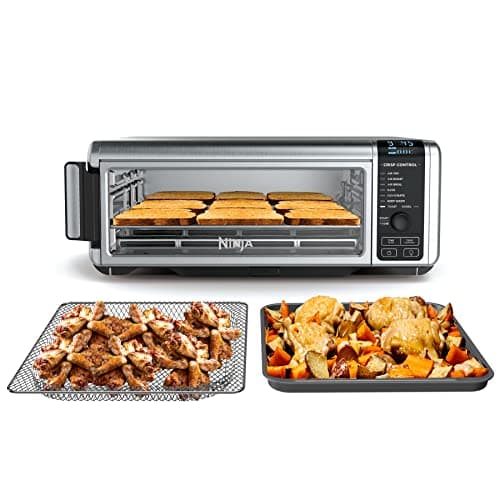
The Panasonic FlashXpress is the pick if speed matters more than versatility: 1,300 watts, a published 7.2-quart interior and the highest published ceiling on this site at 500°F, offset by a 250°F floor that rules out anything slow. The Breville BOV680 Compact is the one to buy if you need the oven to go cold — it publishes a 120°F floor that nothing else on this page approaches. And the Ninja SP101 is for the kitchen with a foot of counter and nowhere to put a box, because it flips up and stores vertically.
We have cooked in none of these. There is no test kitchen behind this site and every figure below came off a manufacturer document.
Why cooking for two is actually a different question
Most size advice in this category is about whether the food fits. For two people it almost always does — two portions of chicken and a tray of vegetables fit in the smallest oven here. The thing that changes at two servings is the arithmetic underneath.
A countertop oven draws its rated power whether it is cooking one portion or six. Fill a large oven for a family and the energy is spread across six dinners; cook for two in the same oven and the same energy buys two. So the figure that decides a two-person purchase is not capacity and not footprint — it is published watts per serving, and it is the one axis on which the budget end of this category genuinely beats the premium end.
At the EIA's published US average residential rate of 18.34¢ per kWh, for a typical 25-minute cook:
| Oven | Published power | Per hour | Per 25-minute meal | Per serving, for two | A meal a day, a year |
|---|
| Hamilton Beach Sure-Crisp 31403 | 1120 watts | 20.5¢ | 8.6¢ | 4.3¢ | about $31 |
|---|
| Panasonic FlashXpress | 1300 W | 23.8¢ | 9.9¢ | 5.0¢ | about $36 |
|---|
| Our Place Wonder Oven | 1400 W (rating plate) | 25.7¢ | 10.7¢ | 5.4¢ | about $39 |
|---|
| Breville BOV680 Compact | 1800 W (manual) | 33.0¢ | 13.8¢ | 6.9¢ | about $50 |
|---|
| Ninja SP101 | 1800 W | 33.0¢ | 13.8¢ | 6.9¢ | about $50 |
|---|
The honest conclusion is that the spread is nineteen dollars a year, which is not a reason to buy a worse oven. It is a reason to stop treating 1,800 watts as a feature. Multiply the same figures by a family of five and the ranking inverts, which is why the large-capacity ranking is a separate page with a separate winner. Do the arithmetic with your own rate using the full workings here.
What “fits two” looks like in published figures
Capacity claims in this category are nearly useless for two people because they are stated in four different units — quarts, litres, cubic feet and slices of bread — and because a quart figure says nothing about shape. Two dinner plates are a width problem, not a volume problem.
Only two ovens here publish something you can measure against a plate. Our Place publishes a 10 by 10.3-inch interior, which takes two 9-inch plates side by side only if you are lucky and comfortably takes them stacked on two levels. Hamilton Beach does not publish dimensions but publishes something better for this purpose — three explicit pan fits, which is a manufacturer telling you the exact objects that go in. The other three publish slice counts and volumes: Breville states a 1 to 4-slice toast capacity and an 11-inch pizza pan in its manual, Panasonic states 7.2 quarts, Ninja states a capacity claim rather than a figure.
For two, the practical floor is a published four-slice toast capacity or a published 9-inch pizza fit. Everything on this page clears it. That is why the ranking turns on cost and documentation rather than on size, and why the sizing method is its own guide rather than a section here.
The trade nobody mentions: a small oven has a high floor
Small ovens tend to publish higherminimum temperatures, not lower, and for a two-person household that eats this way daily it is the limitation most likely to bite. Panasonic's published floor is 250°F. Our Place's is 200°F with a 60-minute timer. Both of those exclude proofing dough, holding a plate warm while the second one cooks, and drying anything at all.
The Breville BOV680 is the exception and the reason it is on this page at all despite costing the most to run: Breville publishes a 120 to 445°F band on Bake and Roast. If your two-person cooking includes bread, that one figure outweighs the nineteen dollars a year — the subject of our bread ranking.
Two checks before you buy
Measure the depth with the door open. Our Place publishes a 10.6-inch depth and Hamilton Beach an 11.5-inch depth — both unusually shallow — while the Breville is 16.9 inches deep and its door drops down and out. Depth is the dimension people forget until the door will not clear a backsplash, and it is covered properly in the clearance guide.
Decide whether the oven shares a circuit. At 1,120 watts you are drawing about 9.3 amps and can run a kettle beside it; at 1,800 watts you are at roughly 15 amps, which is a full household circuit on its own and the reason Breville recommends a dedicated one in its own manual. The amperage arithmetic is here. In a small two-person kitchen this is often the deciding constraint rather than the budget.