The short version
The pick is the Midea Flexify (MET26C3AST), and it wins on documentation rather than on cooking. It is the only French-door oven in this catalog whose maker publishes a temperature range — 100–450°F, in five-degree increments, with a one-minute timer step — alongside a capacity, an exterior measurement, a weight, ten individually named presets and a stated fit of one 12-inch pizza, six slices of toast or fourteen wings. It is also the cheapest of the four. Being the best-documented oven in this particular field is a lower bar than it sounds, which is the next paragraph.
Not one of the four French-door ovens on this page publishes a rated wattage. Not Midea, not Oster, not Emeril Lagasse, not Elite Gourmet. That is not an oversight on our side — it is the defining fact about this category. Every other hub on this site is built on a published watt figure, because watts times hours times your electricity rate is the only running-cost calculation anyone can actually check. For French-door ovens that calculation is unavailable, from every brand that makes one, at every price we found. If you want a countertop oven whose cost per hour you can work out before you buy it, you want a drop-down door and you want a different page of this site.
We have cooked in none of these ovens. There is no test kitchen behind this site and the rubric says so in those words. What is checkable is what each manufacturer publishes, and in this category that turns out to be the whole story.
First decide the size class, because there is no middle
The four ovens publish their capacities in three different units — liters, US quarts and “extra large” — so the figures a shopper lines up next to each other are not comparable as printed. One quart is about 0.946 liters, so converting everything to liters:
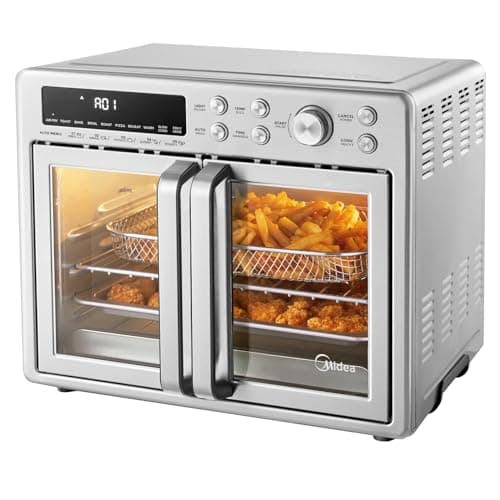
- Midea Flexify — 26.4 US qt, which is about 25 L
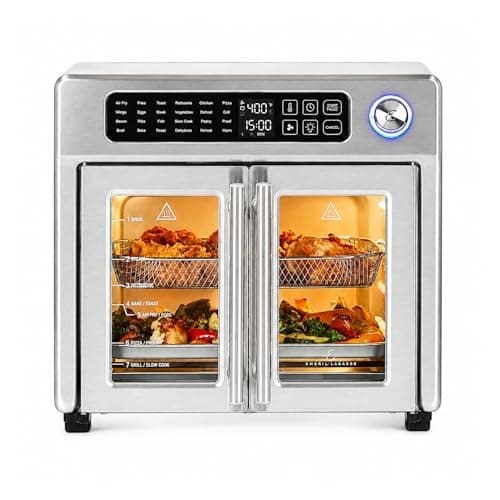
- Emeril Lagasse 26 QT — 26 US qt, about 24.6 L
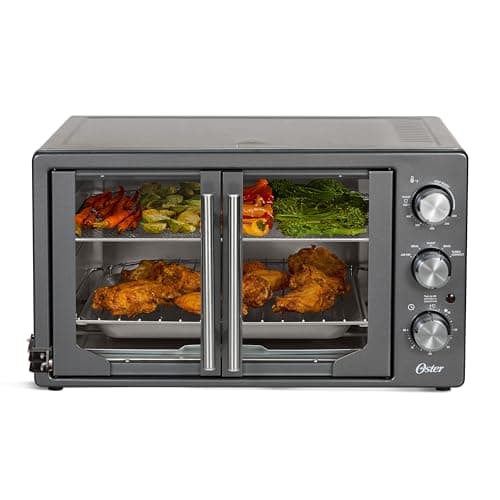
- Oster Extra Large — published directly as 42 L, which is about 44.4 US qt
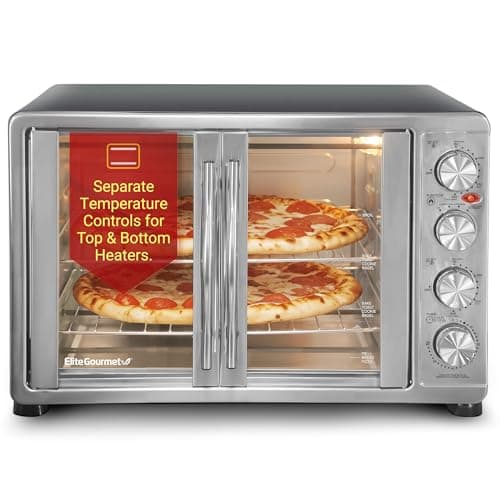
- Elite Gourmet ETO4510B — 47.5 US qt, about 45 L
So the field is two tight clusters with a gap between them and nothing in it: a ~25-liter class and a ~45-liter class, the larger being very nearly double the smaller. Note also that Oster's 42 L and Elite Gourmet's 47.5 qt are within about half a liter of each other despite looking like 42 against 47.5 — a shopper comparing the printed numbers would conclude the Elite Gourmet is thirteen percent bigger, and it is closer to one percent.
That makes the first decision a volume decision, not a brand decision. Twenty-five liters takes a 12-inch pizza and six slices of toast and will sit under most wall cabinets. Forty-five liters is a second oven: it will take a rotisserie chicken and an 18-slice toast load, it is the better buy if you are cooking for four or more, and it is a great deal of air to heat for two pieces of salmon. Our general argument for countertop ovens is that they heat less air than a range does; a 45-liter cavity gives a good part of that advantage back.
What the French door actually buys you
Clearance in front, and nothing else. A conventional drop-down door hinges at the bottom and sweeps out and downward, so it needs empty counter in front of the oven for its full depth, and when it is open it is a hot shelf between you and the food. French doors hinge at the sides and swing outward from the middle, which means the space they need is to the left and right — usually air — rather than in front.
That is a real ergonomic gain and it is why these ovens exist. What it is not is a performance feature. No maker on this page publishes any claim that two doors heat, seal, brown or crisp better than one, and we are not going to invent one for them. Two doors also means two hinges, two latches and two seals, which is more to go wrong on an appliance that gets slammed shut several times a day — and three of the four brands here publish no warranty term at all, so there is nothing to check that against either.
One mechanism claim is published and worth knowing: Emeril states that its doors open with a single pull, so both move together. Midea calls its doors “anti-scald” without defining the term. Neither claim is testable from a document, and both are recorded here as claims rather than facts.
How we ranked them
Six criteria, applied in this order, and the third one is the one that matters most and eliminates everybody:
- Is it genuinely a French-door oven?Two doors, hinged at the sides, opening outward from the middle. All four qualify. Several ovens marketed as “double door” are a single glass door with a decorative split, and those are not on this page.
- Is the capacity published as a figure? All four publish one. Three of the four publish it in a unit that disagrees with at least one competitor.
- Is there a rated wattage? No. Zero of four. This is the criterion the rest of the site is built on and the entire category fails it.
- Is there a published temperature range?One of four — Midea, at 100–450°F. The other three publish no temperature figure of any kind, which means a buyer cannot confirm that an oven sold with a Dehydrate or Proof function can reach the temperature those functions need.
- Published fit, in objects. Midea names a 12-inch pizza, six slices and fourteen wings. Elite Gourmet names 18 slices. Oster and Emeril publish capacity only.
- Warranty term. None of the four publishes one for these models. On a box containing a fan motor, two hinges and in two cases a rotisserie motor, that is a real gap rather than a formality.
1. Midea Flexify (MET26C3AST) — the best-documented French door
Midea publishes a specification block, which in this category makes it an outlier. The capacity is 26.4 quarts; the exterior is 16.92 inches wide, 15.93 deep and 13.74 high; the accessories are itemized as a baking tray, two baking racks, an air fry basket and a crumb tray. Its own listing copy adds the thing nobody else in the field publishes at all: a temperature range of 100 to 450°F, adjustable in five-degree steps, with the timer moving in one-minute steps.
That 100°F floor is the most useful published number on this page. Midea names Dehydrate and Slow Cook among its ten presets, and a 100°F floor is low enough to make the dehydrate claim credible — dehydrating runs roughly 100–160°F depending on the food. The other three ovens here also advertise functions in that territory and publish no temperature range whatsoever, so on those three the claim is unverifiable. Ten presets, named individually rather than summed into a marketing total: Air Fry, Roast, Bake, Broil, Toast, Pizza, Reheat, Slow Cook, Dehydrate and Warm.
The honest objections. There is no rated wattage, so there is no running cost for it on this site. Midea publishes no interior dimensions, so the 12-inch-pizza claim is the only proxy for pan fit. There is no warranty term on the US product page. And Midea's own specification block contradicts itself on weight: it gives a product weight of 25.57 lb and a shipping weight of 20.94 lb, which cannot both be true of a boxed appliance, since the box cannot weigh less than its contents. Amazon's item data for the same model says 20.9 lb, which matches the smaller of Midea's two figures. We quote both rather than quietly picking one. Capacity is not stable across Midea's own regions either — the Canadian listing for the same model family is sold as 25 qt.
Our full Midea Flexify review is here, including what the ten presets do and do not commit Midea to.
2. Oster Extra Large 42 L — the most liters per dollar
Oster publishes the interior as 42 liters, which is the only capacity figure in this field given in liters and the easiest one to reason about: roughly 1.5 cubic feet, larger than any Breville we cover, in the ~45-liter class alongside the Elite Gourmet. It is a 6-in-1 with air fry included, and it sits at the bottom of the price band for its size class.
The objections are the same ones that keep it at number two. No published wattage, which on a 42-liter cavity matters more than on a 25-liter one — a big cavity takes longer to come up to temperature whatever the element rating is, so the unknown number is being multiplied by a longer time. No published temperature range. No warranty term. Two doors, two hinges, two latches, and an interior you will be reaching to the back of. Our Oster French Door review covers it in full.
3. Emeril Lagasse 26 QT — twenty-four functions, almost nothing published
This is the most feature-dense listing on the page and the least documented product on it. Emeril publishes twenty-four cooking functions, a dual-speed fan with 360° circulation, a rotisserie, an interior light and French doors that open with a single pull. It publishes no wattage, no temperature range, no timer range, no interior dimension and no warranty term. The model field on its own listing reads 4-00675-02X-VN, which is a vendor SKU rather than a model number a buyer can take to a manual, and we could not reach a manufacturer spec sheet or manual for it at all.
It is third rather than fourth because of one genuinely distinctive published mechanism: it is the only oven on this entire site whose maker publishes an automatic toast shut-off with a stated indicator behavior — the light is red while toasting and turns blue when the timer ends and the oven switches itself off. That is a specific, falsifiable, useful claim about how the machine behaves, and it is more than the Elite Gourmet publishes about anything. It also costs about fifty dollars more than the Midea while publishing far less, which is why it is not higher.
Our full Emeril Lagasse 26 QT French Door review is here — including why twenty-four functions on an oven with no published temperature range is a number to discount rather than to weigh.
4. Elite Gourmet ETO4510B — maximum interior, minimum documentation
Forty-seven and a half quarts — about 45 liters, the largest cavity on this page — with French doors, a rotisserie and four manual control knobs, for well under two hundred dollars. Per liter it is the cheapest countertop oven we cover, and that is a real achievement rather than a backhanded compliment.
It is last because essentially no published electrical or thermal specification stands behind any of it: no wattage, no temperature range, no tolerance, no warranty term. Analog knob thermostats in this price band typically hold temperature loosely, and with no published tolerance there is nothing to check that against — which matters more for baking than volume does. It is also a very large footprint for a counter. The full Elite Gourmet review is here.
The model that would reorder this page
Cuisinart has announced a French-door oven, the TOA-FD70 Artisan, and its listing publishes the things this entire page is missing: a 0.6 cubic foot interior, a 450°F ceiling, a 60-minute timer, a stated fit of six slices, a 12-inch pizza, three pounds of wings or a 4.5-pound chicken, a PFAS-free material claim and a three-year limited warranty — the only warranty term published by anyone in this category.
It is not ranked above and carries no buy link here for one reason: when we checked it through the Amazon Creators API for this page it returned a future ship date rather than “In Stock”, and this site does not rank products it cannot confirm you can actually buy today. If it ships and holds those published figures, it becomes the pick on documentation alone, and we will say so here. We are telling you it exists rather than waiting, because a buyer about to spend two hundred dollars on an oven with no published wattage should know that a better-documented one is weeks away.
So which one
If 25 liters is enough, buy the Midea Flexify. It is the cheapest oven on the page and the only one whose maker tells you what temperatures it reaches, and in a category this poorly documented that is worth more than four extra functions. If you need the big class, buy the Oster 42 L for the published figure and the lower price, or the Elite Gourmet if you want the absolute maximum cavity and accept knob controls. Buy the Emeril if the rotisserie and the twenty-four-function spread are specifically what you want and you are willing to find out what it draws by reading the plate when it arrives.
And if the running cost is what you actually care about, do not buy a French-door oven at all this year. Our electricity-use page works from published wattages, and every oven it can do arithmetic for has one door.
Why no French-door maker publishes a wattage
We cannot tell you why, only that none of them does, and that the pattern is consistent enough to be worth naming. The brands that build French-door countertop ovens — Oster, Elite Gourmet, Emeril Lagasse, Midea — are value- and mid-market brands whose product pages are built around function counts and capacity claims rather than specification blocks. The brands that publish rating-plate wattages, instruction books and per-function temperature tables on this site are Breville, Cuisinart, Panasonic, BLACK+DECKER and Our Place, and until the Cuisinart TOA-FD70 ships, none of them has sold a French-door model we could buy.
The practical consequence: assume a full-size French-door oven draws somewhere in the 1,500 to 1,800 watt range, because essentially every countertop oven of that size does, and understand that this is an assumption and not a published figure. We do not print it as a spec anywhere on this site, and we do not run cost arithmetic on it. If you want the real number, it is on the rating plate on the back or underside of the oven, and you can read it the day it arrives — within the return window.
What two doors cost you in counter depth
French doors reduce the clearance you need in front, not the space the oven occupies. Every oven on this page is between 13.7 and 16.9 inches deep, which is deeper than a standard 12-inch upper cabinet is, so all four will overhang the front edge of a standard 25-inch counter slightly less than a drop-down-door oven needs in total swing but will still sit proud of the cabinets above. Measure the height to your cabinets too: the Emeril is 14.8 inches tall and the Oster and Elite Gourmet are taller still.
The three-unit problem, and how to not be fooled by it
This category publishes capacity in US quarts and in liters more or less at random, and the numbers look similar enough to be confused. Multiply quarts by 0.946 to get liters, or liters by 1.057 to get quarts, before you compare anything. The clearest illustration is on this page: Oster's “42” and Elite Gourmet's “47.5” describe cavities within about half a liter of each other, and Midea's “26.4” and Emeril's “26” are likewise effectively the same size. There are two sizes of French-door oven on the market, not four.
Where the fan and the air-fry basket come in
Three of the four publish a convection fan and an air-fry mode with a basket; Emeril publishes a dual-speed fan specifically. None publishes a fan wattage, a fan speed in RPM or an air-flow figure, so the differences between them are not checkable. If you want the mechanism explained properly, our convection-versus-air-fry page covers what the two settings actually do differently, which is less than the labels suggest.