Skip to content
CC

HUB 04 · Comparisons

Our Place Wonder Oven vs Wonder Oven Pro (and the Large)

The word Pro makes this look like a size decision. On Our Place's own published figures it is not: the Large and the Pro are dimensionally the same oven, and the Pro's extra money buys a temperature floor, a timer and a digital panel. Here is which of the three limits actually matters to you.

By Stephen V.Updated How we rank
#ad

We earn a commission if you buy through our links. It does not change the price you pay, and it does not decide our picks — the scoring rubric is published in full, including what disqualifies an oven. How this works.

The short answer

Quick picks

#OvenBest forScorePrice
01
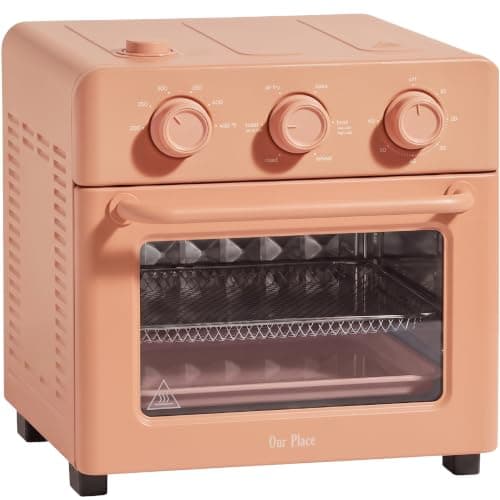
Our Place Our Place Wonder Oven (6-in-1, 13 Qt)
Our Place Wonder Oven (6-in-1, 13 Qt)

A small air fryer oven whose maker publishes everything

1,400 W
7.7
$149.00Amazon
02
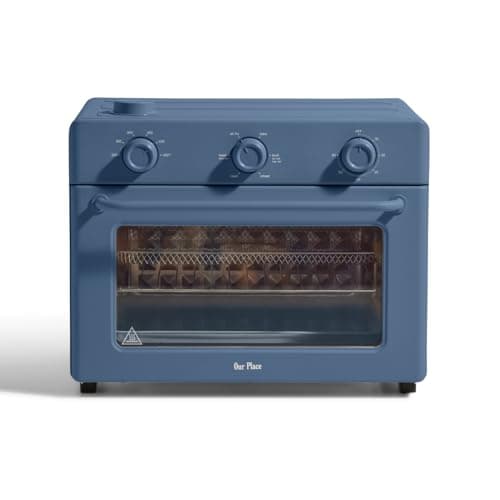
Our Place Our Place Large Wonder Oven (6-in-1, 28 L)
Our Place Large Wonder Oven (6-in-1, 28 L)

The Pro's cavity at the standard oven's controls

1,700 W
8.2
$179.00Amazon
03
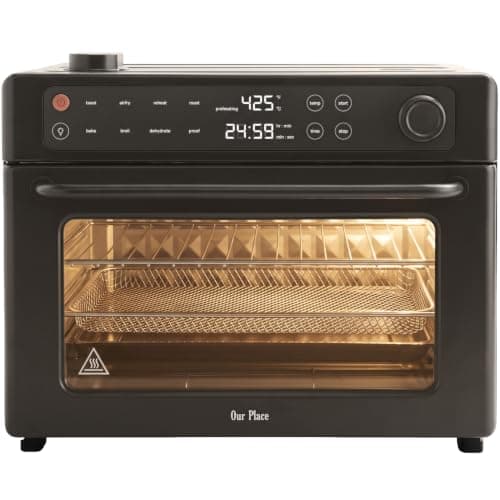
Our Place Our Place Wonder Oven Pro (8-in-1, 28 L)
Our Place Wonder Oven Pro (8-in-1, 28 L)

A published 80°F floor and a 24-hour timer

1,700 W
7.9
$275.00Amazon

#ad · Prices pulled live from the Amazon Product API, last checked October 10, 2026. Where we have no verified live price we show none — we would rather leave a gap than print a number that has gone stale. The wattage column is what the manufacturer publishes; “not published” means exactly that, and we have not estimated one. Scores are ours, compiled from published specifications, and are not test results.

The short answer

Buy the standard Wonder Oven if you cook for one or two. It is the cheapest of the three to buy and to run — 1,400 watts against 1,700 — and it is the only one in the line whose stated capacity and printed interior dimensions actually agree. Buy the Large Wonder Oven if you cook for four to six and you will never need a low oven: it is the cheapest route into the big cavity, and nothing above it in the line is physically bigger. Buy the Wonder Oven Pro only if you will proof dough, dehydrate, or run the oven for more than an hour — because that, and a digital panel, is genuinely all the extra money buys.

That last sentence is the whole point of this page, and it is not our characterization. Our Place publishes the Large and the Pro with the same interior dimensions, the sameexterior dimensions, the same 28-liter stated capacity, the same three rack levels and the same 1,700-watt rating. Its own FAQ says the Pro “shares the larger size and adds a digital control panel… plus two additional functions”. If you are choosing between the Large and the Pro on the assumption that Pro means bigger, you are choosing on a fact that is not true.

Every published figure, side by side

All three columns come from Our Place's own product pages. There is one sourcing difference worth stating up front rather than hiding: for the standard model we have read the rating line off the manual cover — 120V 60Hz 1400W, model APL.WDO.ESN — and for the other two we have not, because Our Place links no manual PDF for them. Those two wattages are product-page figures.

Published figureWonder OvenLarge Wonder OvenWonder Oven Pro
Rated power1400W (rating plate)1700w (product page)1700W (product page)
Temperature range200–450°F200–450°F80–450°F
Timer0–60 minutes0–60 minutes30 seconds to 24 hours
Stated capacity13 qt / 12 L28 L28 L
Interior (W×D×H)10 × 10.3 × 7.6 in13.75 × 13 × 7.75 in13.75 × 13 × 7.75 in
Exterior (W×D×H)11.5 × 10.6 × 11.6 in16.75 × 13.25 × 13 in16.75 × 13.25 × 13 in
Weight (no inserts)11.6 lb17.5 lb18 lb
Rack levels233
Modes668 (adds Proof, Dehydrate)
Controls3 knobs3 knobsDigital display
Published toast4 slices6 slices per wire rackNot published
Published pizza9 in12 in12 in
Warranty1 year1 year1 year

Read it as two decisions, not three options

The table collapses into two independent questions, and answering them in order gets you to the right oven without any reference to the model names.

Question one: how much cavity? The standard oven is 10 inches wide inside and takes four slices of toast and a 9-inch pizza across two levels. The other two are 13.75 inches wide inside and take six slices per rack and a 12-inch pizza across three levels. There is no middle option and no larger option. If two or three rack levels is the difference between one trip and two, pay the step up; if you cook for one or two, the standard oven is 6 pounds lighter, 5 inches narrower on the counter and cheaper every time you turn it on.

Question two: do you need below 200°F or beyond 60 minutes? This is the only thing the Pro premium buys. Proofing bread wants roughly 80–100°F; dehydrating runs eight hours or more; a low braise wants to sit for two or three. The standard oven and the Large both publish a 200°F floor and a 60-minute timer, which rules out all three, and no mode on either dial changes it. The Pro publishes an 80°F floor and a timer Our Place states runs from 30 seconds to 24 hours, plus named Proof and Dehydrate modes — making it the only oven in our whole catalog whose own spec sheet permits proofing, drying and an all-day cook. Why a low floor and a long timer are both necessary is worked through here.

Nothing else on the table should move your decision. The wattages are identical between the Large and the Pro, the warranty is one year on all three, and the extra half-pound on the Pro is a control board.

The digital panel, honestly weighed

It is easy to treat three knobs as the cheap option and a display as the upgrade, and for the two functions above it genuinely is: you cannot dial 95°F on a knob whose printed scale starts at 200. But the knobs have a real argument too, and this site has made it on other pages. There is no control board to fail while the elements are fine, nothing to reset after a power cut, and no capacitive panel to stop responding — and a failed control board is the most common reason a working oven gets thrown away. What actually retires a countertop oven, and what the warranty terms imply about it.

Our Place gives all three models the same one-year warranty, which is short for an oven and notably short for one with a digital board. By comparison Breville publishes two years on the BOV950 and BLACK+DECKER publishes two on the TO3250XSB — a real difference rather than a formality, and the clearest thing the Pro's price does not buy.

What each costs to run

At the US average residential rate this site uses throughout, full rated draw works out at roughly 25.7 cents an hourfor the standard Wonder Oven's 1,400 watts and 31.2 centsfor both 1,700-watt models. On the site's standing assumption of half an hour a day that is about $47 and $57 a year. Both are ceilings and we label them as such everywhere: an oven draws its rated wattage only while the elements are energized, and the thermostat cycles them off once the cavity is up to temperature.

Two consequences. First, the saving that makes the standard Wonder Oven interesting against the 1,800-watt field — most full-size countertop ovens run about 33.0 cents an hour — mostly disappears when you step up to either big model. Second, 1,700 watts at 120 volts is about 14.2 amps, which is most of a 15-amp kitchen circuit, so expect to run the kettle and the big Wonder Oven one at a time. When a countertop oven needs its own circuit, and every published wattage we hold.

The one figure none of them reconciles

Both big models state 28 L and print an interior of 13.75 × 13 × 7.75 inches directly beside it. Multiply: about 1,385 cubic inches, which at 61.02 cubic inches to the liter is roughly 22.7 liters— some five liters under the stated figure, and Amazon rounds the claim further still to “30 Qt”. Run the same sum on the standard model's published 10 × 10.3 × 7.6 inches and you get about 783 cubic inches, or 12.8 liters, against a stated 12 L. Those agree.

There is a mundane explanation available — a stated volume usually includes space around the elements and above the top rack that no pan can occupy, while an interior measurement may be taken between the rack rails — and Our Place does not say which it has done. That is the criticism. The practical instruction is the same whichever it is: buy on the inches, not the liters, and check the 7.75-inch interior heightagainst your own cookware first. It is within two tenths of an inch of the standard model's 7.6, so both big Wonder Ovens grew sideways and not upward — if a lidded casserole or a tall loaf tin is what does not fit today, none of the three fixes it. The pan-fit arithmetic in full.

Where the line sits against the rest of the category

Worth knowing before you spend Pro money inside one brand. At the Pro's price the Breville Smart Oven Air Fryer Pro (BOV900) publishes an 80–480°F band out of its own instruction book with a rating line, a stated 1 cubic foot interior, nine slices of toast, a 13-inch pizza, thirteen functions and two years of warranty — it wins on documentation outright, and it reaches a lower floor than any Wonder Oven except the Pro. What it does not have is Our Place's materials position: a stainless interior and accessories Our Place states are made without PFAS, which is the reason most people are reading about these ovens in the first place. The full non-toxic ranking is here, and what each coating actually is.

Below the line, a 1,500-watt BLACK+DECKER TO3250XSB publishes a 13 x 9 pan with the handles counted, a 12-inch pizza and eight slices for a fraction of the Large's price — more published fit per dollar than anything in this line — with none of the materials claims and a plainer cavity. Our full air fryer oven ranking puts all of them in order.

So which one

Cooking for one or two, and 200°F is low enough: the standard Wonder Oven. Cooking for four to six, and 200°F is low enough: the Large — same cavity as the Pro, less money, and the knobs are arguably the more durable interface. Proofing, dehydrating or cooking past the hour at any household size: the Pro, which is the only one that publishes the numbers to do it. And if you were about to buy the Pro purely because it sounded like the big one, buy the Large and spend the difference on a pan that fits it.
In detail

The picks, in full

01
Our Place Our Place Wonder Oven (6-in-1, 13 Qt)

A small air fryer oven whose maker publishes everything

Our Place Wonder Oven (6-in-1, 13 Qt)

Wattage published in the manualInterior dimensions published200°F floor, 60-minute timer
7.7/10

The most completely documented small oven we have covered, from a brand better known for pans. Our Place publishes the rating-plate wattage, the temperature range, the interior dimensions and the warranty term — all four things we score documentation on. At 1,400 W it costs less per hour than the 1,800 W field; at four slices and a 9-inch pizza it is genuinely small; and the limits are published too — a 200°F floor and a 60-minute timer.

Power
7.5
Usable space
5
Footprint
9.5
Documentation
10
Value
6.5

What it gets right

  • Our Place publishes all four things we score documentation on — a rating-plate wattage in the manual, a temperature range, interior dimensions and a warranty term — and interior dimensions are the one almost nobody prints
  • 1,400 W draws about a fifth less per hour than the 1,800 W most full-power countertop ovens are rated at, and puts a lighter load on a kitchen circuit shared with a kettle or a coffee maker
  • A published 7.6-inch interior height in a box 11.5 inches wide, and the manual asks for only an inch of clearance above, behind and on each side

What it doesn't

  • The published floor is 200°F and the timer stops at 60 minutes, so there is no proofing, no dehydrating and no slow cook — the modes the Wonder Oven Pro adds are exactly the ones this one cannot reach
  • Small, and Our Place says so: four slices of toast, a 9-inch pizza, a pound of fries and two rack positions
  • None of the accessories is dishwasher safe — the manual says finishes may degrade — and the bake pan's non-stick is ceramic, which tends to lose its release faster with use than PTFE does

What it costs to run

About 25.7¢ an hour at full draw, or $46.86 a year at 30 minutes a day, 365 days a year and 18.34¢ per kWh.

1,400 W ÷ 1000 × 182.5 h × 18.34¢ = $46.86

120V 60Hz 1400W is the rating line printed on the cover of Our Place's own Wonder Oven user manual (model APL.WDO.ESN), which repeats 1400 W as the appliance rating an outlet must meet. This is an upper bound: the elements cycle off once the cavity is at temperature, and no manufacturer publishes a duty cycle, so we compute at full rated draw rather than invent a correction factor. The full method is published.

Skip this if…

…you want to proof dough, dehydrate, or cook anything for longer than an hour. The dial starts at 200°F and the timer stops at 60 minutes, and no mode on the knob changes either.

$149.00on Amazon

$185.0019% off

Price last checked October 10, 2026. Prices move constantly — Amazon's at checkout is the one that counts.

#ad · we may earn a commission from this link to Our Place Wonder Oven (6-in-1, 13 Qt)

02
Our Place Our Place Large Wonder Oven (6-in-1, 28 L)

The Pro's cavity at the standard oven's controls

Our Place Large Wonder Oven (6-in-1, 28 L)

Interior and exterior dimensions publishedThree rack levels and a 12-inch pizza published1,700 W with a 200°F floor and a 60-minute timer
8.2/10

Dimension for dimension this is the Wonder Oven Pro: Our Place publishes the same 13.75 x 13 x 7.75 in. interior, the same 16.75 x 13.25 x 13 in. exterior, the same 28 L and the same three rack levels for both. What it does not get is the Pro's control board — the floor stays at 200°F and the timer still stops at 60 minutes — and it draws the Pro's 1,700 W to do it. Cheapest route to the big Wonder Oven cavity, and the wrong one if a published low temperature is why you are shopping.

Power
9
Usable space
8.5
Footprint
7.5
Documentation
8
Value
8

What it gets right

  • The Wonder Oven Pro's published cavity for substantially less money: Our Place prints an identical 13.75 x 13 x 7.75 in. interior, an identical 16.75 x 13.25 x 13 in. exterior, 28 L and three rack levels for both models, and says so itself in its own comparison table
  • More than doubles the standard Wonder Oven's published fit — six slices of toast per wire rack against four, a 12-inch pizza against nine, and three levels against two — in a box 16.75 inches wide
  • Our Place publishes a wattage, a voltage, a temperature range, a timer range, a capacity, interior and exterior dimensions, a weight, a rack count, the modes, the materials and a per-accessory dimension and weight, which is more of the spec sheet than most brands print at any price

What it doesn't

  • It draws the Pro's 1,700 W to deliver the standard oven's 200°F floor and 60-minute timer, so there is no proofing, no dehydrating and no long cook — the electricity bill of the capable model without the capability
  • The stated 28 L does not follow from the interior Our Place prints beside it: 13.75 x 13 x 7.75 in. is about 1,385 cubic inches, or roughly 22.7 L, and Amazon rounds the stated figure further still to “30 Qt”
  • The same product page gives three figures two different ways — 16.75 in. and 16.7 in. of exterior width, a 4.5 lb and a 5.5 lb chicken, 4–6 and 1–2 teaspoons of steam water — and no manual is published to settle any of them
  • Hand wash only: Our Place's own care instructions say to avoid the dishwasher for the accessories, and the bake pan's release coating is ceramic rather than PTFE

What it costs to run

About 31.2¢ an hour at full draw, or $56.90 a year at 30 minutes a day, 365 days a year and 18.34¢ per kWh.

1,700 W ÷ 1000 × 182.5 h × 18.34¢ = $56.90

1700w at 120V, published by Our Place in the “Wattage & Voltage” row of the Getting Technical block on its own Large Wonder Oven product page. As with the Wonder Oven Pro, Our Place links no manual PDF for this model, so this is a product-page figure and not a rating-plate one — the standard Wonder Oven is the only model in the line whose rating line we have read. This is an upper bound: the elements cycle off once the cavity is at temperature, and no manufacturer publishes a duty cycle, so we compute at full rated draw rather than invent a correction factor. The full method is published.

Skip this if…

…you are buying a bigger Wonder Oven in order to proof dough, dehydrate or run anything past the hour mark. This model's published floor is 200°F and its timer stops at 60 minutes, exactly like the standard oven, and no mode on the dial changes either — only the Pro publishes the 80°F floor and the 24-hour timer.

$179.00on Amazon

$245.0027% off

Price last checked October 10, 2026. Prices move constantly — Amazon's at checkout is the one that counts.

#ad · we may earn a commission from this link to Our Place Large Wonder Oven (6-in-1, 28 L)

03
Our Place Our Place Wonder Oven Pro (8-in-1, 28 L)

A published 80°F floor and a 24-hour timer

Our Place Wonder Oven Pro (8-in-1, 28 L)

80°F floor and a 24-hour timer publishedInterior dimensions publishedStated volume disagrees with its own interior
7.9/10

The standard Wonder Oven with both of its published limits removed. Our Place prints 1700W / 120V, an 80–450°F range and a 30-second-to-24-hour timer, which makes it the only oven here whose own spec sheet permits proofing, dehydrating and an all-day cook. The catch is that its stated 28-liter capacity does not agree with the interior dimensions printed beside it.

Power
9
Usable space
8.5
Footprint
7.5
Documentation
8.5
Value
6

What it gets right

  • A published 80°F floor with named Proof and Dehydrate modes, and a timer Our Place states runs from 30 seconds to 24 hours — the only oven in our catalog whose own spec sheet allows proofing, drying and an all-day cook
  • Our Place publishes interior AND exterior dimensions, a weight, a rack count, a timer range and a temperature range, which is more of the spec sheet than almost any brand at any price prints
  • A 12-inch pizza or a whole chicken across three rack levels, in a box 16.75 inches wide — more usable room than the standard Wonder Oven in a footprint that is still under 17 inches

What it doesn't

  • The stated 28 liters does not follow from the interior Our Place prints next to it: 13.75 x 13 x 7.75 inches multiplies out to about 1,385 cubic inches, or roughly 22.7 liters
  • 1,700 W draws about 14.2 amps at 120 V, so it uses nearly the whole of a 15-amp kitchen circuit and costs only marginally less per hour than an 1,800 W oven
  • Our Place publishes no toast-slice count for it, and no rating-plate wattage we could read in a manual — the standard Wonder Oven's review could cite both

What it costs to run

About 31.2¢ an hour at full draw, or $56.90 a year at 30 minutes a day, 365 days a year and 18.34¢ per kWh.

1,700 W ÷ 1000 × 182.5 h × 18.34¢ = $56.90

1700W at 120V, published by Our Place in the specifications block of its own Wonder Oven Pro product page. Unlike the standard Wonder Oven we could not read a rating line off the manual cover — Our Place hosts no PDF and the third-party copies refuse automated requests — so this is a product-page figure rather than a rating-plate one. This is an upper bound: the elements cycle off once the cavity is at temperature, and no manufacturer publishes a duty cycle, so we compute at full rated draw rather than invent a correction factor. The full method is published.

Skip this if…

…you want the lowest running cost in a small oven, or you want a figure you can reconcile. The standard Wonder Oven draws 1,400 W and its published interior dimensions multiply out to the volume it claims; this one draws 1,700 W and its do not.

$275.00on Amazon

$325.0015% off

Price last checked October 10, 2026. Prices move constantly — Amazon's at checkout is the one that counts.

#ad · we may earn a commission from this link to Our Place Wonder Oven Pro (8-in-1, 28 L)

How we picked

Ovens we claim to have cooked in: 0

Everyone in this category tells you they roasted forty chickens. We have roasted none, and we say so. Here is what we do instead: read the manufacturer's manual and spec sheet, record the published wattage, interior volume, temperature range and warranty term, work out what the oven costs to run for an hour and for a year, show the arithmetic so you can redo it with your own electricity rate, and cite all of it. Where a brand publishes no wattage, we print no running cost rather than borrowing a number from a similar model. Prices come live from Amazon's API and disappear rather than go stale.

The scores above are judgments from that documented research — not test results. One of the five metrics is Documentation: whether the manufacturer will tell you what its oven draws at all. The full rubric, including what disqualifies an oven, is published in full.

Questions

Frequently asked

What is the difference between the Our Place Wonder Oven and the Wonder Oven Pro?
Three things, and size is not one of them against the Large. Against the standard model the Pro is bigger: 13.75 × 13 × 7.75 in inside versus 10 × 10.3 × 7.6, three rack levels versus two, a 12-inch pizza versus nine. Against the Large Wonder Oven the Pro is dimensionally identical, and what it adds in both cases is a digital panel instead of three knobs, a temperature floor of 80°F instead of 200°F, a timer running to 24 hours instead of 60 minutes, and two extra modes — Proof and Dehydrate. The Pro's full review is here.
Is the Wonder Oven Pro bigger than the Large Wonder Oven?
No. Our Place publishes both with a 13.75 × 13 × 7.75 inch interior, a 16.75 × 13.25 × 13 inch exterior, a stated 28 L capacity and three rack levels, and its own FAQ says the Pro “shares the larger size”. The published difference between the two is the control panel, the 80°F floor, the 24-hour timer and the two extra modes — plus half a pound of shipping weight. The Large's review is here.
Which Wonder Oven can proof dough?
Only the Wonder Oven Pro, on published specifications. Proofing wants roughly 80 to 100°F, and Our Place publishes a 200°F temperature floor for both the standard Wonder Oven and the Large Wonder Oven -- there is no setting on either dial that goes lower. The Pro publishes an 80°F floor, a named Proof mode and a timer that runs from 30 seconds to 24 hours. We have not proofed bread in any of them; what we can tell you is which spec sheet permits it.
Do all three Wonder Ovens use the same amount of electricity?
No. Our Place publishes 1400W for the standard Wonder Oven — read off the rating line on its manual cover — and 1700W for both the Large and the Pro. At the US average residential rate that is about 25.7 cents an hour at full rated draw for the standard model against 31.2 for either big one, or roughly $47 and $57 a year on half an hour of use a day. Both are ceilings, because a thermostat cycles the elements off once the cavity is hot. The full arithmetic is here.
Is the Wonder Oven Pro worth the extra money?
It depends entirely on whether you will use the two things it adds. If you proof bread, dehydrate fruit or jerky, or cook anything for more than an hour, the Pro is the only model in the line that publishes a temperature floor and a timer that allow it, and nothing else in the range will do the job at any price. If you do not, you are paying a premium for a digital display on a cavity you can have for less, with the same one-year warranty and the same wattage.
How many liters is the big Wonder Oven really?
Our Place states 28 L for both the Large and the Pro and prints an interior of 13.75 × 13 × 7.75 inches beside it. That multiplies out to about 1,385 cubic inches, or roughly 22.7 liters — about five short of the stated figure, and Amazon rounds the claim further to “30 Qt”. The standard model's figures do reconcile: 10 × 10.3 × 7.6 inches is about 12.8 liters against a stated 12 L. Buy on the inches. How to size a countertop oven to a household.

Keep reading

Receipts

Sources

We have not cooked in these ovens and we do not pretend to have. Specifications come from the manufacturer's own published documents; electricity rates come from the US Energy Information Administration; prices come from the live Amazon API. Where a figure is not published, the page says “not published” rather than guessing. Read the full method.