The short answer
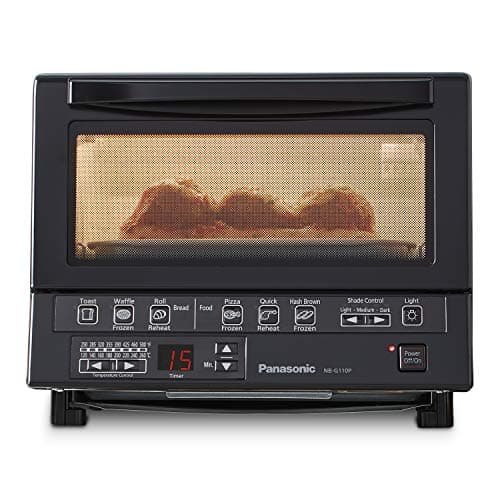
Buy the Panasonic FlashXpress (NB-G110P). It is the only 4-slice oven here whose maker publishes the complete electrical specification — 1,300 W at 120 V, 60 Hz — alongside a 7.2-quart capacity, a 250–500°F range and exterior dimensions in millimeters, and the 500°F ceiling is the highest on this page by fifty degrees. If that is more oven than the job needs, the Hamilton Beach Sure-Crisp 31403 is the cheapest oven anywhere on this site with both a convection fan and a wattage published by the manufacturer. The budget pick is the Elite Gourmet ETO449X, which publishes a wattage, a temperature range and a timer for about a third of the Hamilton Beach's price — and the wattage it publishes is 800, which is the whole catch.
We have not cooked in any of these. Our rubric says so in those words. Every figure below is the manufacturer's or the brand's own listing data, every one is cited at the foot of the page, and where a maker publishes nothing we publish nothing.
Nobody defines a slice
There is no standard behind “4-slice.” No agency specifies the bread, the thickness or the spacing, so the figure is a manufacturer's description of its own rack, and two ovens with the same claim can differ by inches of usable width. That makes slice count a useful shopping filter and a useless specification — which is why the entry requirement for this page was not the claim itself.
To qualify, a maker had to publish a figure you can check: a rated wattage, a temperature range, a stated pizza diameter or a stated pan. Five ovens cleared it. One live, in-stock 4-slice oven in this catalog did not: BLACK+DECKER's TO1313SBD is a perfectly real sixty-dollar oven with three knobs and nothing published about it at all — no wattage, no range, no stated fit — so it is the thing this page is ranking against rather than a pick on it. Our budget ranking covers that end on price instead.
One more 4-slice oven here qualified and did not make the five. Elite Gourmet's ETO490 publishes the same 800 watts, the same 200–450°F range and the same 30-minute timer as the ETO449X at number five, for slightly more money, in a noticeably shallower chassis — so it is the one to buy instead if your binding constraint is how far the oven sticks out from the wall, and it is the same oven on every other published figure.
And one 4-slice oven here is deliberately left without a buy button. BLACK+DECKER publishes more about its TO1785SG than most brands publish about ovens costing five times as much — 1,150 W at 120 V, a 9-inch pizza, a two-year limited warranty — and we still will not put a card on it, because the live Amazon listing's own model field reads TO1745SSG rather than the TO1785SG its copy describes. We confirmed that again from the listing title this run. Our review explains the mismatch in full. The figures above still describe the air-fry line, and the oven that sits at number three here is in it.
The number that actually separates them
Every oven on this page is sold as a 4-slice oven. Their rated power spans 800 watts to 1,300, a 62 percent difference, and that is what you are choosing between. Power does not change what fits; it changes how long the thing takes and how hard it leans on the circuit. At 18.34¢ per kWh the gap between the extremes is 14.7¢ an hour against 23.8¢ — about nine cents, which is not a reason to buy either one. The reason is time.
| Oven | Rated power | Amps at 120 V | Per hour | Published range | What backs the 4-slice claim | Warranty |
|---|
| Panasonic NB-G110P | 1300 W (with 120 V, 60 Hz) | 10.8 A | 23.8¢ | 250–500°F | 7.2 qt published; exterior in mm | Not published |
|---|
| Hamilton Beach 31403 | 1120 W | 9.3 A | 20.5¢ | 200–450°F | 4 slices, with the exterior published | 1 year |
|---|
| BLACK+DECKER Crisp 'N Bake | 1150 W (line figure) | 9.6 A | 21.1¢ | Not published | 4 slices / 9" pizza (line figure) | 2 years (line figure) |
|---|
| Proctor Silex 31260 | 1100 W (listing data) | 9.2 A | 20.2¢ | 200–450°F (listing data) | 4 slices, with the exterior published | 3 years |
|---|
| Elite Gourmet ETO449X | 800 W | 6.7 A | 14.7¢ | 200–450°F | 9.5 qt, 4 slices, 8" pizza | Not published |
|---|
Per-hour figures are the published wattage times 18.34¢ per kWh, the US average residential rate for June 2026. Amps are that wattage divided by 120 V — our arithmetic, not a published rating, and worth knowing because a shared circuit is the one place an 800-watt oven wins outright. Every published wattage on the site, with its source, is on one page.
1. Panasonic FlashXpress NB-G110P — the best-specified small oven here
Who it is for: the buyer who wants a small oven that behaves like a precise one. Panasonic publishes power consumption, supply voltage, frequency, capacity, temperature range, exterior dimensions and weight — the complete set, which no other brand on this page manages — and the range tops out at 500°F, fifty degrees above everything else here. Double infrared elements mean it reaches a working temperature without the preheat a sheathed element needs, which is the actual argument for a 7.2-quart cavity drawing 1,300 watts.
The cons. It is the most expensive oven on this page by a wide margin and you are partly paying for the engineering discipline rather than for capacity — 7.2 quarts is small, and a 9-inch pizza in it is optimistic. The infrared elements are not independently driveable the way a multi-element oven's are, so there is no element selection to speak of. There is no convection fan. And Panasonic publishes no warranty term on that product page, which is the one gap in an otherwise complete sheet. Our full review.
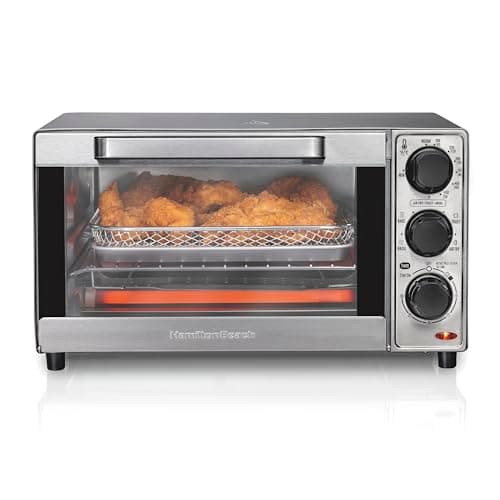
2. Hamilton Beach Sure-Crisp 31403 — a fan and a published wattage for about sixty dollars
Who it is for: anyone who wants air fry and real moving air without leaving the budget shelf. Hamilton Beach publishes 1,120 watts and the exact exterior dimensions on its own page for model 31403, which is the model number Amazon's listing data gives for this ASIN — and in this price band most SKUs publish neither. At 9.3 amps it leaves genuine headroom on an outlet shared with a kettle, which the 1,800-watt class does not.
The cons. Four slices, a 9-inch pizza and an 8 x 8 pan is the published ceiling and no preset on the dial moves it. Hamilton Beach sells a near-identically named 31403J variant rated at 1,500 watts, so check the rating plate when it arrives — if you have the J, the arithmetic above changes. And 1,120 watts preheats and cooks more slowly than the 1,800-watt norm: cheaper per hour is not automatically cheaper per meal. The cheap end of the air-fry category, ranked.
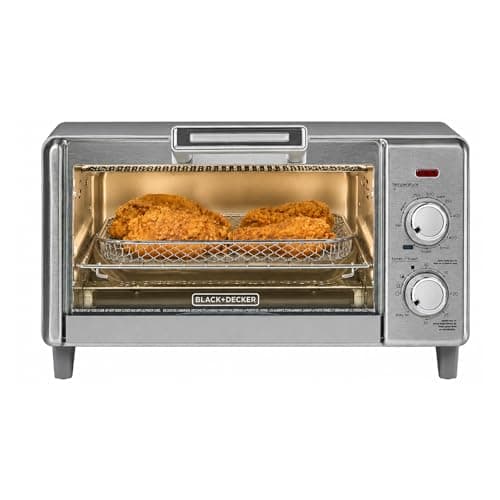
3. BLACK+DECKER Crisp 'N Bake Air Fry — air fry at the floor of the band
Who it is for: the household that wants an air-fry basket and a convection fan for the price of a plain radiant box. BLACK+DECKER publishes 1,150 W at 120 V and a two-year limited warranty for this Crisp 'N Bake air-fry line — a longer term than Hamilton Beach or Panasonic publish — and 1,150 watts is about 9.6 amps, which is still an easy load.
The cons, and the first one is a sourcing con. The 1,150 W and the two-year term are published for the TO1785SG in the same line, not for this exact SKU, and we have not assumed the two are identical — the card says so. BLACK+DECKER publishes no temperature range for it, which makes it the only pick here with no stated ceiling. Four-slice capacity is genuinely small. And the brand ships near-identical ovens under at least four model numbers, which is the single thing that makes this line hard to buy confidently. Our BLACK+DECKER line roundup works through which model is which.
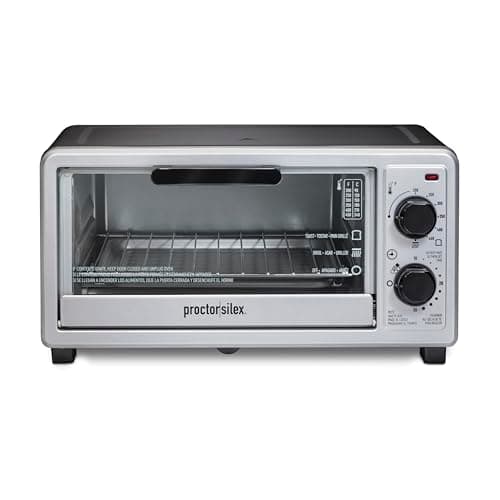
4. Proctor Silex 31260 — the longest warranty on the page
Who it is for: the second kitchen, the garage, the rental — somewhere an oven needs to toast, bake and broil and nothing else, for years. Proctor Silex publishes a three-year limited warranty, which is the longest term on this page and longer than several ovens here costing four times as much. The listing data gives 1,100 watts and a 200–450°F range, there is a 30-minute timer with a ready bell and an auto shutoff, and the controls are three knobs with nothing electronic behind them.
The cons. Proctor Silex publishes no wattage on its own product page — the 1,100 W figure is brand-supplied Amazon listing data, which is a rung below a spec sheet and labeled that way on the card. Worse, the brand's own page contradicts itself on temperature: the feature list says 200–450°F and the detail block says 150–450°F. There is no fan, no published interior volume, and four slices is the honest ceiling.
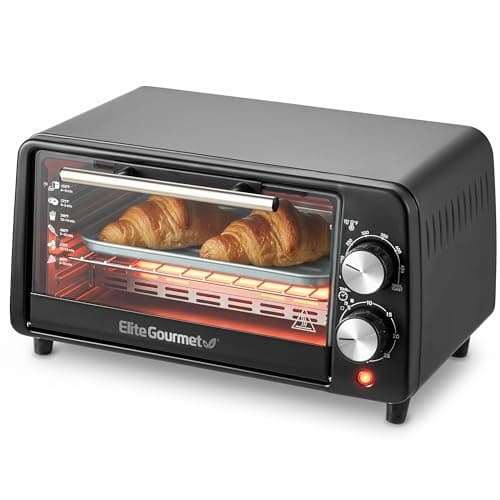
5. Elite Gourmet ETO449X — the budget pick, with one large asterisk
Who it is for: the dorm, the office, the RV — anywhere the oven is an accessory rather than the appliance. For about a third of the Hamilton Beach's price Elite Gourmet publishes a rated wattage, a 200–450°F range and a 30-minute timer in a Specifications list on its own storefront, it names the element technology (dual quartz, which almost nobody in this band does), and it states both a slice count and an 8-inch pizza fit. At 5.31 lb it is genuinely liftable, and it anchors our sub-$50 ranking for the same reasons.
The cons, and the first one is the whole decision. 800 watts is roughly two-thirds the power of the ovens above it and a little over 40 percent of an 1,800-watt oven's, so everything takes longer — Elite Gourmet's own page tells you to preheat at 450°F for about ten minutes before baking, which is an unusual amount of preheat for a brand to publish and a direct consequence of the rating. There is no convection fan. The 30-minute timer is also the auto shut-off, so anything longer needs restarting by hand. No interior dimension, no interior volume and no warranty term is published anywhere Elite Gourmet controls. And the product page carries a California Proposition 65 warning naming lead, which you are entitled to read before you buy rather than on the box.
The honest summary
If you came here because “4-slice” is the size that fits your counter, the useful news is that the claim is roughly honest across the band — these are all small ovens that take four slices and a 9-inch-ish pizza. The unhelpful news is that the claim tells you nothing else, and the thing it hides is power. An 800-watt oven and a 1,300-watt oven sold as the same size are not the same appliance: one is a competent toaster that can bake slowly, the other is a small oven that gets to 500°F. Decide which of those you are buying first, and the price takes care of itself.
Convert the slice claim into width, then stop trusting it
A standard sandwich loaf slice is roughly four inches across, so four slices side by side wants about sixteen to seventeen inches of rack — which no oven on this page has. Every 4-slice oven here is really a two-by-two arrangement, and that is why a 9-inch pizza is the other claim brands make: it is the diagonal the same rack supports. The usable pan rule on this site is the interior width minus about two inches for clearance, and a pan with handles eats more than that. The full pan-fit guide, against published interiors.
Wattage is the time axis, not the cost axis
At 18.34¢ per kWhthe spread across this whole page is about nine cents an hour, so nobody should choose a 4-slice oven to save electricity. What a low wattage costs you is minutes: the same food, the same temperature, a longer wait, and in a small cavity a less even result because the elements cycle for longer to hold the set point. The right way to read a cheap oven's published wattage is as an honest statement of how patient you will need to be. Cost per hour and per year, with the sum written out.
A fan is the one feature that changes the result at this size
In a cavity this small the air barely has anywhere to go, so moving it matters more here than it does in a full-size oven: two of these five have a fan and three do not, and that is a bigger difference than any preset list. If browning evenly is the job, buy the fan; if the job is toast and reheating, a radiant box with three knobs will outlive the oven with a control board. The convection toaster ovens, ranked separately.
Check the model number on the box against the listing
This band is where brands recycle a chassis under four or five model numbers, and the figures that make an oven buyable — the wattage, the warranty, the stated fit — are published per model. Two of the ovens discussed on this page are affected: Hamilton Beach sells 1,120 W and 1,500 W variants under near-identical names, and BLACK+DECKER's 4-slice air-fry listing carries a model field that disagrees with its own copy. Read the rating plate when the oven arrives; it is the only document that describes the unit you actually received.