The short answer
The closest alternative is the Nuwave Bravo XL Pro: it is the XL-plus-probe format two Ninja ovens are built around, and Nuwave publishes the things SharkNinja does not — the interior dimensions in inches, a 50–500°F range in 5°F increments, and the temperature band the probe will actually target. If what you wanted was documentation, the Breville Smart Oven Air Fryer Compact (BOV680) reproduces “120 V ~ 60 Hz 1800 W” on a rating line in its own instruction book. If it was the French-door format of the FO101, the Midea Flexify publishes a temperature floor, which no Ninja oven does. And if you simply wanted the SP101's 1,800 watts for less money, the Cuisinart TOA-70 has the same rating.
We have not cooked in any of these, Ninjas included. Our rubric says so in those words. This page compares published specifications and nothing on it is a performance claim.
What a Ninja air fry oven is actually known for
An alternatives page is only useful if it is honest about the original, so here is what SharkNinja publishes, from its own product pages and support documents. Six Ninja countertop ovens are in this catalog and the company is the reason several of these formats exist at all.
- More formats than anybody else. A flip-away chassis that stores vertically against a backsplash (the SP101 and SP351), a double oven with two independently controlled cavities behind a FlexDoor (the DCT401), a French-door premier oven (the FO101) and an XL flat oven with an integrated probe (the DT551). No other brand in this category ships four distinct mechanical answers.
- Function counts that are sometimes real hardware. Much of the category's “13-in-1” labeling is a temperature-and-fan recipe with a new name, but the probe thermometer in the DT551 and SP351 is physical, and so are the two separately controlled ovens in the DCT401. Those are published mechanical differences, which is more than most premium claims in this category amount to.
- Specific, checkable claims about speed and heat. SharkNinja publishes a 90-second preheat and “450°F cyclonic air” for the FO101, and names all ten of its functions rather than leaving a count to stand on its own.
- A footnoted superlative. The FO101's “largest air frying capacity in a French door oven” carries a footnote naming the single rival it is measured against. That is a narrower claim than it first reads, and SharkNinja publishing the footnote at all is to its credit.
- A published one-year limited warranty on the models that state a term.
And here is the gap, which is the reason this page exists. Of the six Ninja ovens here, one has a wattage in a SharkNinja document — the 1,800 W in the SP101 quick start guide. The FO101's 1,800 W comes from Target's specification table, not from SharkNinja; the other four publish no wattage anywhere we could reach. Not one publishes an interior volume in cubic feet or interior dimensions in inches, and not one publishes a temperature floor. The capacity claims are stated in objects instead — two 9x9 trays, nine slices, a twelve-pound turkey, six pounds of wings and a 12-inch pizza at once — which is useful, and is not a dimension. Our Ninja line roundup ranks the six against each other on exactly this.
Matched against the Ninja property you were buying
| If you wanted the Ninja's… | The alternative | What it publishes that Ninja does not | Rated power | Per hour |
|---|
| XL cavity plus a probe (DT551, SP351) | Nuwave Bravo XL Pro | Interior 14.50" x 13" x 7.625"; 50–500°F in 5° increments; a 50–212°F probe target band | 1800 W (brand Q&A answer) | 33.0¢ |
|---|
| Documentation and a rating plate | Breville BOV680 | “120 V ~ 60 Hz 1800 W” in its own manual; a 120–445°F band | 1800 W (rating line) | 33.0¢ |
|---|
| The French-door format (FO101) | Midea Flexify | A published 100°F floor; 26.4 qt; a stated fit of one 12" pizza, 6 slices and 14 wings | Not published | No figure — we publish none |
|---|
| 1,800 watts for less (SP101) | Cuisinart TOA-70 | Nothing — it matches the rating and publishes less than Ninja does | 1800 W (listing data) | 33.0¢ |
|---|
Per-hour figures are the published wattage times 18.34¢ per kWh, the US average residential rate for June 2026. Three of these four are rated at the same 1,800 watts as the Ninja ovens they replace, which is the first useful finding: switching brands in this class does not change what the oven costs to run. Every published wattage, with its source.
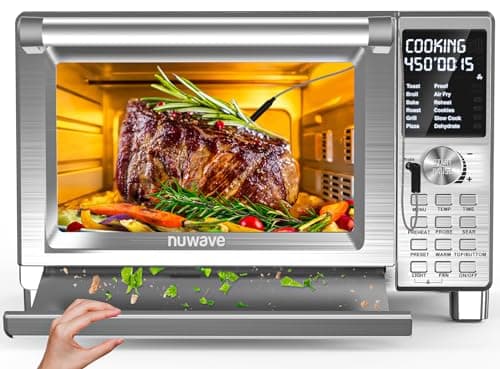
1. Nuwave Bravo XL Pro — the closest alternative, and better documented
Who it is for: anyone shopping a Ninja DT551 or SP351 for the XL cavity and the integrated probe. Nuwave publishes the specification Ninja does not: a 30-quart cavity with its interior stated as 14.50" x 13" x 7.625", a 19.875 x 14.75 x 11.125-inch exterior, a 25-pound weight, twelve menu functions, a 50–500°F range adjustable in 5-degree steps and a probe target range of 50–212°F with the oven stopping at target. A 500°F ceiling is fifty degrees above what SharkNinja publishes for the FO101, and a 50°F floor is lower than any Ninja oven states at all. There is also an owner's manual for model 20813 you can read before you buy.
The cons. The 1,800-watt figure comes from Nuwave's own dated answer to a customer question on its product page rather than from a rating plate in the manual — brand-published, but not a spec sheet, and the card says so. It is a large box: at nearly twenty inches across it wants more counter than the flip-away Ninjas, and it will not store vertically. Twelve menu functions in a cavity with one fan is the same labeling exercise the rest of the category runs. And the one-year limited warranty applies to the original purchaser only. Our full review, and the head-to-head against the best-documented oven on the site.
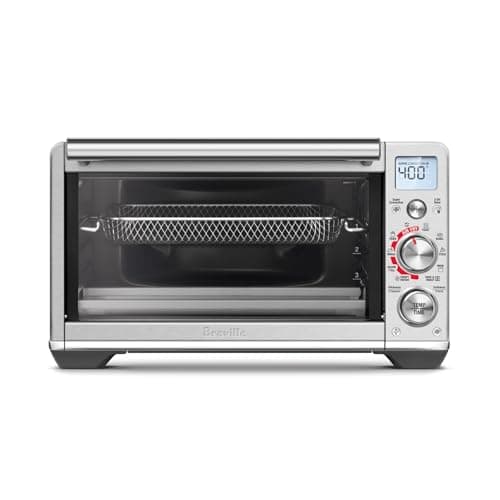
2. Breville Smart Oven Air Fryer Compact — if the paperwork was the point
Who it is for: the buyer who got as far as a Ninja and then could not find out what it draws. Breville reproduces the rating line “120 V ~ 60 Hz 1800 W” in the instruction book for this model, publishes a 120–445°F band for Bake and Roast — a published floor, which no Ninja oven here has — states a one-to-four-slice toast capacity, gives the exterior as W15.7" x D16.9" x H10" and publishes a one-year manufacturer warranty. Breville's elements are driven independently rather than switched in banks, which is a published mechanical difference rather than a marketing one.
The cons. It is the most expensive oven on this page and it is the compact Breville, so you are paying a documentation premium for a smaller cavity than the XL Ninjas offer — and Breville publishes no interior volume for it, which is the one figure Nuwave does. 445°F is an oddly specific ceiling and it is below the 450°F most of this category advertises. Ten functions, and the air-fry basket is small enough that a large batch is two loads. Our full review, and Breville against Ninja, brand to brand.
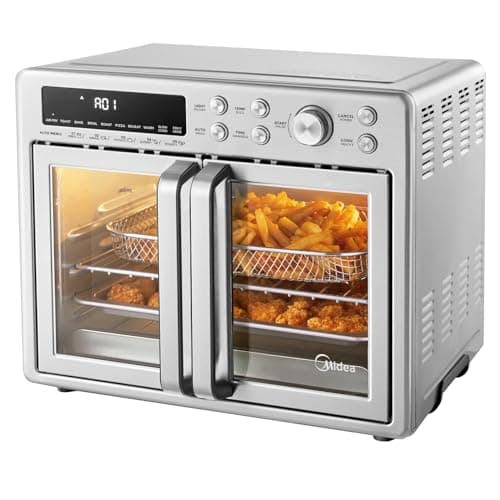
3. Midea Flexify — the French-door format with a published floor
Who it is for: anyone who was buying the FO101 for the French doors. Midea publishes a specifications block with a 26.4-quart capacity, a W16.92" x D15.93" x H13.74" exterior, a 25.57-pound weight, ten presets, 5°F temperature and one-minute timer increments, and a 100–450°F range. That floor is the thing to notice: SharkNinja publishes a 450°F ceiling for the FO101 and no minimum at all, so if you want to hold a low set point for proofing or for warming, Midea is the only one of the two that will tell you whether it can. The published fit is spelled out in objects too — one 12-inch pizza, six slices of toast, fourteen chicken wings.
The cons. Midea publishes no wattage, so this site shows no running cost for it and no amperage either — a real gap on an oven this size. No interior dimension and no interior volume in cubic feet. Ten presets with one fan is the usual labeling. And Midea is a far smaller presence in US countertop ovens than SharkNinja, which matters for parts and for resale in a way a spec sheet does not capture. Our full review, and the French-door ranking, where both ovens appear.
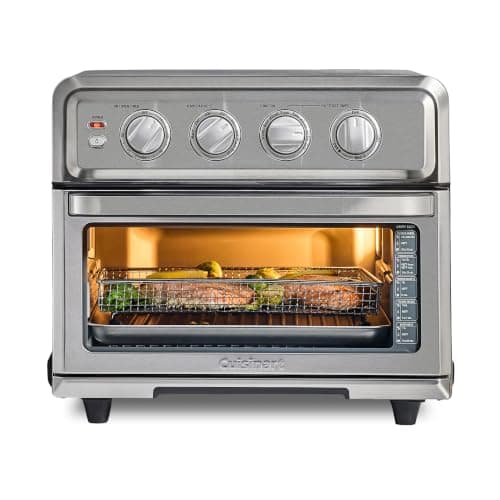
4. Cuisinart TOA-70 — the same 1,800 watts for less
Who it is for: the reader whose shortlist was the SP101 — the one Ninja oven with a wattage in a SharkNinja document — and whose actual requirement was a full-power air-fry oven. The TOA-70 is rated at the same 1,800 watts — 15.0 amps at 120 V, 33.0¢ an hour at 18.34¢ per kWh— across eight functions, and it generally sells for less than the Ninjas it replaces. It is the budget pick on this page for that reason and no other.
The cons, and they are the honest mirror of this page's own argument. Cuisinart publishes less about this oven than SharkNinja publishes about its ovens: the 1,800-watt figure is brand-supplied Amazon listing data rather than a spec sheet, we found no manufacturer specification page for the model, and cuisinart.com has returned a bot challenge to every automated request we have made. So if documentation is why you are leaving Ninja, this is not the oven to leave for — pick the Breville or the Nuwave. If the 1,800-watt rating is why, this is the cheapest way to keep it. Our full review.
The honest summary
Ninja is not a brand to avoid, and this page would be worthless if it pretended otherwise: it builds formats nobody else does, and the probe and the dual cavity are real hardware rather than labels. What it does not do is publish. If you can buy an oven on a stated fit and a function list, the Ninja line is a genuinely good shelf. If you want to know what the thing draws, how big the inside is and how low it will go before you pay for it, then the alternative is not a different Ninja — it is Nuwave for the interior, Breville for the rating plate, or Midea for the temperature floor. And if the only thing you wanted was eighteen hundred watts, three of the four ovens on this page have it and none of them costs more to run.
Decide which Ninja property you were actually paying for
Ninja's lineup is unusually differentiated, so “an alternative to a Ninja” is four different questions. Vertical storage is a chassis decision no one else has copied at this price. A probe is hardware. Two independently controlled cavities are hardware. A 10-in-1 function list mostly is not. Write down which of those sent you to the brand, and the substitution becomes obvious — and in one case (the flip-away chassis) the honest answer is that there is no substitute, so buy the Ninja.
A stated fit and a dimension are not the same claim
SharkNinja states capacity in objects: nine slices, a twelve-pound turkey, six pounds of wings. Those are checkable against what you cook and they are genuinely useful. What they cannot tell you is whether the dish in your cupboard goes in, because that needs a width and a height. Nuwave publishes both; Ninja publishes neither; Breville and Midea publish the exterior only. The usable-width rule and the published interiors.
A temperature floor matters more than a ceiling for most people
Everything in this class reaches 450°F; the interesting number is how low it will hold. Proofing dough wants roughly 80–100°F, dehydrating wants 120–160°F, and an oven with no published minimum is an oven nobody will commit to holding a low set point. Of the ovens discussed here, Nuwave publishes 50°F, Midea 100°F, Breville 120°F and Ninja none. What a published floor lets you actually do.
Switching brands does not change the running cost
The 1,800-watt rating is effectively the ceiling of a 15-amp household circuit, which is why so many ovens in this class land on the same figure. At 18.34¢ per kWh that is 33.0¢ an hour whoever made it, so no alternative here is cheaper to run than a Ninja — the savings are in the purchase price, and the gains are in what the maker will tell you. The comparison that does move money: countertop against full-size.