The short answer
Buy the toaster if toast is genuinely the whole job, you want it on a timer rather than a thermostat, and the counter has room for a 6-inch-wide appliance and nothing bigger. Buy the toaster oven if you want one machine that toasts and bakes, broils, reheats a slice of pizza and takes a pan. A toaster oven is not a better toaster; it is a small oven that can also toast, and the two sentences are not the same claim.
What should not decide it is electricity. A 2-slice toaster is rated at a published 750 watts and the ovens below run 1,100 to 1,800. Over the few minutes it takes to brown two slices, that is a difference of roughly a cent — 0.9¢ against 1.3¢ against 2.2¢ at four minutes. The arithmetic is below with every input shown, because “more efficient” is the most common argument in this comparison and it is the weakest one.
Slots versus a cavity
The hardware difference is not a feature list, it is a shape. A pop-up toaster is a pair of vertical slots with heating elements on both faces of each slot, a fixed distance from the bread, and no thermostat: you set a darkness and it runs a timed cycle. A toaster oven is a box with a thermostat, a rack, a door and a fixed distance from nothing — you set a temperature and the food sits wherever you put it.
That is why the two documents read so differently. Proctor Silex's toaster manual has a toasting chart with shade numbers per food and no temperature anywhere in it. The oven manuals in this catalog have temperature ranges, rack maps and per-function tables. Neither appliance is more sophisticated; they are answering different questions. Rack position matters in an oven precisely because the distance is not fixed, which is a problem a toaster does not have and a flexibility it does not offer.
One consequence is worth stating plainly: a toaster browns both faces of a slice at once, and a toaster oven does not. In an oven, toast is a broil job under one set of elements, and most manuals tell you to turn the bread over. We ranked toaster ovens on their published toast documentation — slice range, darkness steps, the rack position the manual names — and the ovens that do it best are the ones whose makers bothered to write that down.
What each side actually publishes
This site scores documentation as one of five metrics, so it is worth saying where these numbers come from. On the toaster side, neither Hamilton Beach nor Proctor Silex publishes a wattage on the product page.The figure exists in exactly one place: the electrical-ratings block on the last page of the use and care guide, in the Spanish-language section. Hamilton Beach's guide covers three models and prints both ratings together — 120 V ~ 60 Hz 750 W for the 2-slice types and 120 V ~ 60 Hz 1400 Wfor the 4-slice. Proctor Silex's guide for its 2-slice type prints 120 V ~ 60 Hz 750 W.
Breville prints nothing. The Bit More instruction book states the toaster needs a 110/120 volt outlet and never gives a wattage — from the same manufacturer whose oven books print a rating plate line reading 120 V ~ 60 Hz 1800 W. Same brand, same documentation department, two standards. That is the documentation pattern in this category in one sentence.
| Appliance | Published power | Where the figure lives |
|---|
| Hamilton Beach 2-slice toaster (22614 / 22623) | 750 W | Electrical ratings, last page of the use and care guide |
|---|
| Proctor Silex 2-slice toaster (type T105) | 750 W | Electrical ratings, last page of the use and care guide |
|---|
| Hamilton Beach 4-slice toaster (24614) | 1,400 W | Same guide, printed alongside the 2-slice figure |
|---|
| Breville Bit More toaster (BTA720XL) | Not published | The instruction book gives 110/120 V and no wattage |
|---|
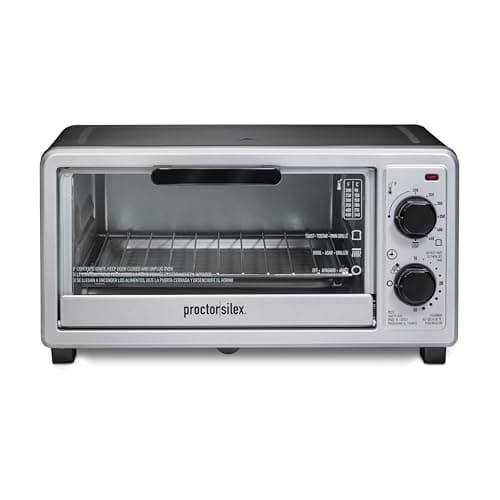
| Proctor Silex 4-slice toaster oven (31260) | 1,100 W | Amazon listing data — Proctor Silex's own page has no wattage |
|---|
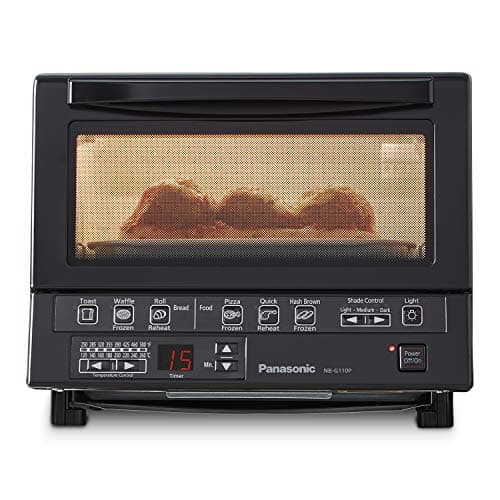
| Panasonic FlashXpress oven (NB-G110P) | 1,300 W at 120 V, 60 Hz | Panasonic's product page, with the supply conditions stated |
|---|
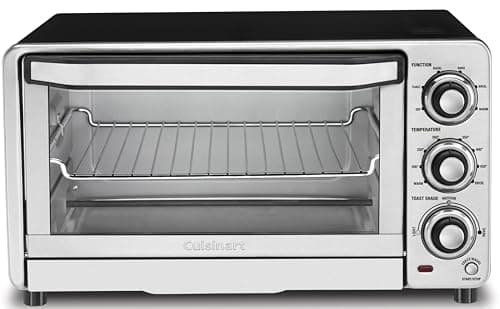
| Cuisinart Custom Classic oven (TOB-40N) | 1,800 W | Cuisinart's own listing title and copy — there is no separate spec sheet for this model |
|---|
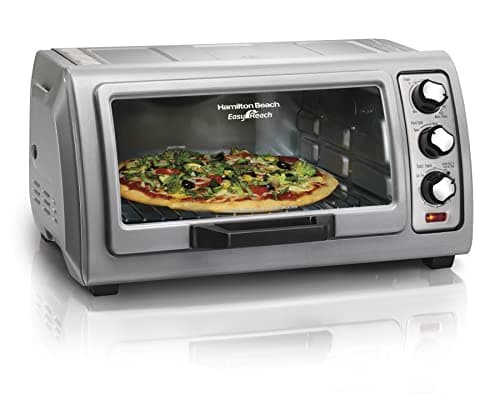
| Hamilton Beach Easy Reach oven (6 slice) | Not published | No figure for this SKU we could source anywhere |
|---|
The 750 W / 1,400 W pairing is how Hamilton Beach prints it: the models line reads 22614, 22623 then 24614, the types line reads T95 then T96, and the ratings line reads 750 W then 1400 W in the same order. We are reading the order, not a sentence that names each model against its figure. The 1,100 W for the Proctor Silex oven and the 1,800 W for the Cuisinart are both brand-supplied listing data rather than brand spec sheets, and both catalog entries say so. The only figure on this page that comes with its supply conditions attached is Panasonic's.
Notice what just happened across two brands. Proctor Silex publishes a wattage for its toaster in the manual and none on the page; it publishes none for its oven at all, so the only figure we have is the listing. Hamilton Beach publishes two toaster wattages in one manual and nothing for the Easy Reach oven. The full published-wattage table for every oven we cover is here — and the gaps in it are the point.
The electricity question, with the sums
Four autocomplete completions ask this — energy use, more efficient, uses more electricity, more power — so here is the whole calculation at the one rate this site uses everywhere: 18.34¢ per kWh.
750 W (2-slice toaster) ÷ 1,000 × 18.34¢ per kWh = 13.8¢ per hour
1,100 W (Proctor Silex oven) = 20.2¢ per hour
1,300 W (Panasonic oven) = 23.8¢ per hour
1,400 W (4-slice toaster) = 25.7¢ per hour
1,800 W (Cuisinart oven) = 33.0¢ per hour
Rate: US EIA, Electric Power Monthly Table 5.3 — average residential price, US total, June 2026. Upper bound in every row — elements cycle off once they are up to heat, and no manufacturer in either category publishes a duty cycle.
Those are hourly numbers, and nobody toasts for an hour. The honest grain is a minute, and here the arithmetic gets small enough to end the argument:
750 W = 0.23¢ per minute → 0.9¢ over four minutes
1,100 W = 0.34¢ per minute → 1.3¢ over four minutes
1,800 W = 0.55¢ per minute → 2.2¢ over four minutes
Four minutes is the reader's number, not a published one. No toaster manual and no oven manual in this catalog publishes a toast cycle time, so substitute your own — the per-minute figures are what make that possible.
So the toaster wins the energy comparison, and it wins it by about a cent per breakfast. Even scaled to a year of daily use at the site's standing assumption of 30 minutes a day, 365 days a year, 750 W costs about $25 against $37for the 1,100-watt oven — and that assumption is half an hour a day, which is a toaster oven's usage pattern rather than a toaster's. Anyone using a toaster for thirty minutes a day is doing something the manual does not describe. The full countertop-oven electricity calculation, with the assumptions spelled out, is here.
There is one place the wattage difference is genuinely useful, and it is not the bill. It is the circuit. A 750-watt appliance and a 1,800-watt appliance are very different loads to put on a 15-amp kitchen circuit that is also running a kettle or a coffee maker. Whether a countertop oven needs its own circuit is worked through here.
Toast quality: what the documents give you
A toaster's entire user interface is a darkness control, and the manufacturers are specific about it. Hamilton Beach and Proctor Silex both publish 7 toast shades on a dial. Breville publishes something stranger and more precise: the Bit More book states there are 12 browning settings ranging from ‘1’ (lightest) to ‘5’ (darkest), which is a five-point printed scale with twelve actual steps behind it, indicated by LEDs rather than a number.
Proctor Silex goes further than any oven manual in this catalog and publishes a toasting chart by food: regular bread on settings 1–7, English muffins 3–7, bagels 4–7, frozen bread or buns 3–7, and frozen waffles 1–3. It also publishes the two variables that ruin toast — bread temperature and moisture — noting that room-temperature bread reaches a medium color around 3–6 while the same bread from the refrigerator needs a darker setting, and that fresh local bagels may need two cycles because they hold more moisture than supermarket ones. The best line in the document is about geometry: English muffins cut with a knife toast more evenly than ones split with a fork.
Nothing in that paragraph is a test result and we are not presenting it as one — this site has no test kitchen and says so in the rubric on every page. It is Proctor Silex's own guidance, and it is the sort of thing an appliance that does one job can afford to write down.
Two more published behaviors are worth knowing because they are things a toaster oven genuinely cannot copy. Both Breville and the American brands run a bagel mode that changes which elements fire— Breville's book says it is normal for the outside elements to appear off or on lower power during the bagel setting, so the cut face browns while the crust does not. And Breville publishes a jam detection behavior: if bread lodges in the slots, every button and the progress indicator flash and the elements shut off. Element-level control at that granularity is possible in a slot because the distance is fixed. In a cavity it is not.
The line the toaster manuals draw themselves
This is the part of the comparison we did not expect to find, and it is the strongest single argument for the oven, because it is not our argument.
Both American-brand toaster manuals tell you to use a toaster oven.Hamilton Beach's warning page reads, in its own words: do not use with toaster pastries, always cook toaster pastries in a toaster oven. Proctor Silex's says the same thing and names the function — a toaster oven broiler — and its toasting chart repeats it in the row where a shade number would otherwise go. Both also rule out food spread with butter, jelly or frosting, and both rule out rice cakes, fried foods, frozen prepared foods and non-bread items entirely.
Read the list again as a shopping list. Anything with a topping, anything that drips, anything frozen that is not plain bread, and anything that is not bread-shaped is outside what a toaster's maker will sanction — and the manufacturer's own stated alternative is the appliance on the other side of this page. If more than one item on that list describes your breakfast, the comparison is already over.
Counter space, and a clearance surprise
A toaster is smaller, obviously. Hamilton Beach publishes 11.3 inches wide, 6.4 deep and 7 high for its 2-slice metal toaster; Proctor Silex publishes 6.6 wide, 10.7 deep and 7 high for its own — the same appliance rotated, which is a real choice if your counter is a narrow strip. Against that, the Proctor Silex 4-slice oven is 15.2 inches wide, 8.07 deep and 11.3 high, and the Panasonic is 330 × 304 × 260 mm.
What is not obvious is the clearance, and Breville is the one manufacturer that publishes it for both. The Bit More book asks for a minimum of 4 inches on the surrounding sides and 8 inches above. The Smart Oven Air Fryer Pro instruction book asks for 4 inches on both sides and 6 inches above. The toaster wants two more inches of overhead room than the oven does — which makes sense the moment you picture where the heat goes in an appliance that vents straight up out of an open slot, and which inverts the assumption that the smaller appliance is the one that fits under a cabinet. Every published clearance figure we hold is collected here, and the ovens we rank specifically for under-cabinet placement are here.
Speed, and the one oven that publishes it
A toaster has no preheat. It cannot have one: there is no cavity of air to bring up to temperature, so the elements go to work on the bread immediately. Most toaster ovens do preheat, and the good news is that several manufacturers publish exactly how much. BLACK+DECKER publishes ten minutes for baking and ten for broiling, and states that toasting needs none. Breville names which of its functions run a preheat cycle and which do not. And Panasonic publishes, for the FlashXpress, that its double infrared elements give instant heat that eliminates the need for preheating — which is the closest any oven in this catalog comes to a toaster's standing start, and it is the manufacturer's claim rather than a measurement of ours. The full per-brand preheat rundown is here.
The practical reading: for toast specifically, a toaster oven is not meaningfully slower, because toasting is a broil job that needs no preheat in the manuals that address it. For anything with a set temperature, it is slower by whatever that brand publishes, and a toaster cannot do the job at all.
Warranty, which is the only durability number either side publishes
Nobody publishes a service life for a toaster or a toaster oven, so the warranty is the only commitment on the table. The toasters do well here. Proctor Silex warrants its 2-slice toaster for three years in the US and five in Canada; Hamilton Beach warrants its toasters for one year in the US and five in Canada. On the oven side the Proctor Silex 31260 carries a three-year limited warranty, which matches its own toaster and is longer than most of the budget oven band offers. Why the warranty is the only honest lifespan figure in this category is worked through here.
There is a mechanical argument underneath it. A toaster is a timer, a carriage, a set of elements and a crumb tray. A toaster oven adds a thermostat, a door and a hinge, and a convection model adds a fan motor on top of that. Fewer parts is a real reliability advantage, and it is the same reasoning that makes an oven that has been sold essentially unchanged for over a decade a better bet than a cheap one with a screen.
The decision table
| If you mostly… | Buy | Why |
|---|
| Toast sliced bread and bagels, nothing else | Toaster | Both faces at once, no preheat, seven published shades, and a smaller footprint. |
|---|
| Eat toaster pastries, buttered things, frozen snacks | Toaster oven | The toaster manuals rule all three out by name and send you to an oven for them. |
|---|
| Want one appliance instead of two | Toaster oven | It toasts adequately and bakes, broils and reheats; a toaster does one job. |
|---|
| Care most about the electricity bill | Either — it is about a cent | 750 W vs 1,100–1,800 W over a few minutes. The difference is real and trivial. |
|---|
| Have a 15-amp circuit already carrying a kettle | Toaster, or check the oven's wattage | Load is the one place the wattage gap genuinely matters. |
|---|
| Are fitting it under a wall cabinet | Measure the overhead, not the width | Breville asks 8 inches above its toaster and 6 above its oven. The small appliance is not automatically the one that fits. |
|---|
| Want the fewest things that can fail | Toaster | A timer and a carriage, versus a thermostat, a door and sometimes a fan. |
|---|
The rule
Count the things you want to heat that are not a plain slice of bread. If the answer is zero, buy a toaster — it browns two faces at once, it starts cold, it draws half the power, the warranty is as good or better, and there is almost nothing in it to break. If the answer is one or more, buy a toaster oven, and do it because of capability rather than efficiency: the oven costs about a cent more per breakfast and does the jobs the toaster's own manual refuses.
What would change the answer: a toaster that publishes a temperature rather than a darkness step, or an oven that browns both faces of a slice simultaneously. Neither exists in anything we cover. Until one does, this is a question about what you eat, not about which appliance is better. The budget toaster ovens we rank start around toaster money, and whether to pay for a fan on top of that is a separate question with its own page.
On owning both
It is a defensible setup and a narrow one. The case for it is that a toaster does its one job better and faster, so an oven that is not being asked to make breakfast can be chosen purely on capacity and temperature — which is how you end up buying a bigger, better oven than you otherwise would. The case against it is two footprints, two clearances and two things to clean, to save a cent a day. Buy both only if you already know which of the two is going to do the toast, because the failure mode is a toaster oven you bought for toast sitting unused next to a toaster.