HUB 06 · Guides & Answers
Can You Put a Toaster Oven on Top of a Microwave?
It is the obvious way to buy back a foot of counter, and both appliances' own documentation rules it out — from opposite directions. The microwave publishes a required air gap above itself; the toaster oven publishes a warning about what sits beneath it.
We earn a commission if you buy through our links. It does not change the price you pay, and it does not decide our picks — the scoring rubric is published in full, including what disqualifies an oven. How this works.
The short answer
No. Not because it will certainly catch fire, but because both appliances publish requirements that the stack breaks, and they do it independently of each other — so you end up operating two appliances outside their stated installation conditions, which is also the configuration a warranty claim is assessed against.
The microwave publishes a clearance it needs aboveitself. LG's countertop microwave guidance is to “keep a minimum clearance distance of 20 centimeters from the top” and 10 centimetres from the left, right and back, and separately to “avoid placing heavy objects… on top of microwave oven” and “do not install in an enclosed cabinet.” A toaster oven on the lid occupies precisely the 20 centimetres the manufacturer reserved — and a countertop oven is a heavy object by any reading, at 12 pounds for the BLACK+DECKER TO3250XSB.
The toaster oven publishes the complementary rule from its side. BLACK+DECKER's manual warns against placing “any item on top of unit when in operation”, tells you to “select a location… allowing enough space from back of the unit and the wall to allow heat to flow without damage to cabinets and walls”, and states “do not place on or near a hot gas or electric burner, or in a heated oven.”
Why the microwave's clearance is not optional
A microwave's magnetron and transformer generate waste heat, and a countertop microwave sheds it through ventilation openings in its own cabinet — commonly on the top and sides. The published clearance is not about the food getting hot; it is the air path that keeps the electronics inside their rated temperature.
Block it and the failure is slow rather than dramatic: the components run hotter, for longer, every time the microwave is used, which shortens their life. Manufacturers across the category say some version of this — that restricting airflow leads to overheating and shorter component life — and the published figures vary considerably by brand and model, from a couple of inches on some to 20 centimetres on LG's. Read your own microwave's number; this is one of the cases where brands genuinely disagree.
Now add the second problem. A toaster oven is not an inert object sitting in that gap — it is a heat source. BLACK+DECKER rates its exterior as hot enough to require mitts on any outer surface, and extends its flammable-material warning to the oven “when in operation or after, when still hot”. So the appliance you have put in the microwave's cooling path is actively warming the air that was supposed to carry heat away. That is the stack's real flaw, and it is why “I left a two-inch gap” does not resolve it.
The toaster oven's own problem with the arrangement
Looked at from above, the stack is bad for the oven too, in three published respects.
It is not a flat, stable, heat-tolerant surface. A microwave lid is sheet metal or plastic over a cavity, often slightly flexible and rarely perfectly level. A countertop oven that rocks is a countertop oven whose door can swing and whose contents can slide — and whose feet, which exist to hold the hot base off the surface, may not all be in contact.
It raises the oven. Stacking typically puts the oven door at or above eye level, which means reaching up and over a hot cavity to take out a hot tray. That is the exact ergonomic hazard our seniors ranking is built around, and it applies to everyone with a heavy casserole.
It usually puts the oven under a cabinet.Two appliances stacked are roughly 20 inches tall, which on a standard kitchen wall brings the top of the oven close to the cupboards — directly against the manual's instruction to allow heat to flow “without damage to cabinets and walls”and against the fire warning about the oven touching “curtains, draperies, walls and the like”. What each maker requires around its own oven is here.
What about the other way round?
Putting the microwaveon top of the toaster oven is worse, not better. The oven is then venting its heat directly into the microwave's underside and the microwave's rear vents, the oven's door opens downward into your knees, and nearly every toaster oven manual we have read prohibits placing any item on top of the unit during operation. If one has to sit above the other, neither manufacturer sanctions it.
The adjacent question people ask next — whether a toaster oven can go in a cabinet, an appliance garage, or on a quartz or wood worktop — comes down to the same two published requirements: free airflow around the box, and a flat heat-tolerant surface under it. The enclosure cases are the hardest no of the group, because they remove the airflow entirely.
What to do instead
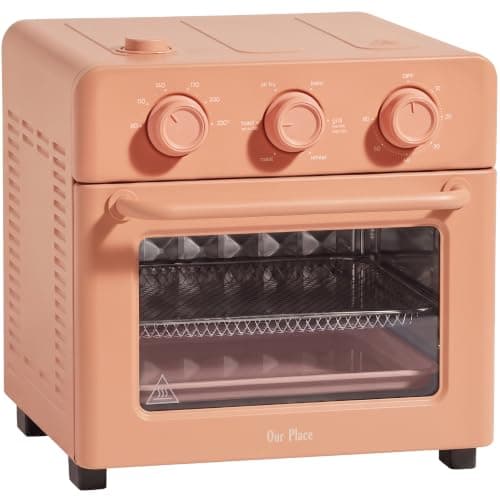
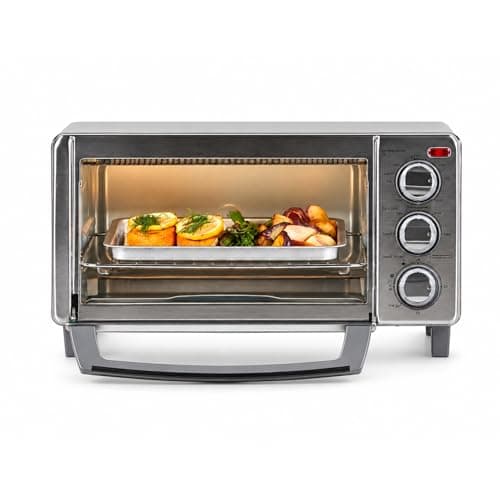
Go side by side and buy the depth back. This is the only arrangement both manuals sanction, and it is more achievable than it sounds because the small ovens in this catalog publish genuinely small footprints: the Our Place Wonder Oven at 11.5 inches wide by 10.6 deep, the BLACK+DECKER TO1785SG at 11.22 by 11.54. Either sits beside a microwave in the space a wide oven would have taken alone.
Or go vertical with the oven, not with the stack. The flip-away Ninja ovens publish vertical storage, so the oven leaves the counter between uses instead of occupying a permanent footprint.
Or use a shelf unit rated for appliances, with the published clearance for each appliance on its own shelf — which is a different thing from resting one on the other, because each keeps its own air path.
If you only have room for one, the honest comparison is worth reading before you buy a second appliance at all: toaster oven versus microwave goes through what each genuinely does better, and the small-footprint ranking covers the ovens that fit a counter that already has a microwave on it.
What to check if counter space is the constraint
When the stack is off the table, footprint becomes the whole purchase decision — and it is the one figure a surprising number of makers do publish.
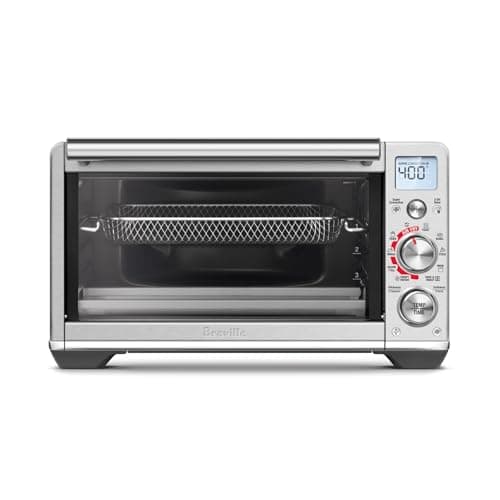
Measure depth with the door open, not just width. Width is what people measure and depth is what fails. Published depths here run from 10.6 inches (Our Place Wonder Oven) to 16.9 (Breville BOV680), and a down-and-out door adds its own swing in front.
Check the published exterior against the gap you actually have. Our Place publishes 11.5 by 10.6 by 11.6 inches; BLACK+DECKER publishes 11.22 wide by 11.54 deep by 8.31 high for the TO1785SG; Breville publishes 15.7 by 16.9 by 10 for the BOV680. Those are manufacturer figures you can tape out on the counter before ordering. The whole small-footprint field is ranked here.
Decide whether it needs to live on the counter at all. An oven at 11.6 pounds (the Our Place) is one a person can lift into a cupboard; one at 25 to 38 pounds is not, which quietly turns a storage decision into a permanent-footprint decision.
Confirm the circuit before the layout. A microwave and an 1,800-watt toaster oven on the same circuit is the other hidden constraint of a shared counter — about 15 amps for the oven alone. The amperage arithmetic is here.
The hardware
The ovens this page is about
The ovens referred to above, with prices pulled live from Amazon and dated on every card. Full rankings live in the roundups linked from this page.
1,400 W
Our Place Wonder Oven (6-in-1, 13 Qt)
The most completely documented small oven we have covered, from a brand better known for pans. Our Place publishes the rating-plate wattage, the temperature range, the interior dimensions and the warranty term — all four things we score documentation on. At 1,400 W it costs less per hour than the 1,800 W field; at four slices and a 9-inch pizza it is genuinely small; and the limits are published too — a 200°F floor and a 60-minute timer.
1,150 W
BLACK+DECKER 4-Slice Toaster Oven with Natural Convection (TO1785SG)
1,150 W, 120 V, four slices, a 9-inch pizza and a two-year warranty — all published by BLACK+DECKER on its own site. For sixty-five dollars that is a more complete specification than several ovens here costing three hundred.
1,800 W
Breville Smart Oven Air Fryer Compact (BOV680BSS)
The smallest oven on this site whose manufacturer publishes a rating-plate wattage, a temperature range and a stated toast and pizza-pan capacity — in an instruction book you can download before you spend anything. It is a genuinely small oven and Breville is unusually honest about how small, which is the whole reason it ranks where it does.
#ad · As an Amazon Associate we earn from qualifying purchases.
Questions
Frequently asked
Will a toaster oven damage a microwave if I stack them?
How much space does a toaster oven need around it?
Can I put a toaster oven in a cabinet or an appliance garage?
Is it safe to put a microwave on top of a toaster oven instead?
What is the smallest toaster oven that will fit beside a microwave?
Can I put a toaster oven on a quartz or wood countertop?
Keep reading
Related
- Toaster oven vs microwaveWhat each genuinely does better, if the counter only has room for one.
- How much clearance does an air fryer oven need?The air gap each maker requires around its own oven, quoted from the manuals.
- Best air fryer ovens for small spacesThe ovens that fit a counter which already has a microwave on it.
- Best under-cabinet ovensThe products actually designed to leave the countertop, rather than stacked onto it.
Receipts
Sources
- LG — countertop microwave oven installation guidance: “keep a minimum clearance distance of 20 centimeters from the top” and 10 centimetres from left, right and back; “Avoid placing heavy objects or lace-decorated cover on top of microwave oven”; “Do not install in an enclosed cabinet”
- BLACK+DECKER — TO3250XSB / TO3260XSBD / TO3240XSBD use and care manual [PDF]: “You must set the timer or select Stay On for the oven to function”, the end-of-cycle shut-off, the 60-minute Bake/Broil knob, the placement and on-top warnings, the 1½-inch top-element rule, the below-set-point disclosure and the warranty exclusions
- BLACK+DECKER — Crisp 'N Bake Air Fry 4-Slice Toaster Oven (TO1785SG) product page (1150 W, 120 V, 4 slices / 9" pizza, 8.31"H x 11.22"W x 11.54"D, two-year limited warranty)
- Our Place — Wonder Oven product page (1400 W rating line, 200–450°F, 13 qt / 12 L, interior and exterior dimensions, 11.6 lbs, 60-minute timer)
- Breville — the Smart Oven Air Fryer Compact (BOV680) instruction book [PDF]: the end-of-cook-timer behaviour, “the oven goes into standby mode if not used for 10 minutes”, the dedicated-circuit recommendation, the external-timer prohibition and Rating Information 120 V ~ 60 Hz 1800 W
We have not cooked in these ovens and we do not pretend to have. Specifications come from the manufacturer's own published documents; electricity rates come from the US Energy Information Administration; prices come from the live Amazon API. Where a figure is not published, the page says “not published” rather than guessing. Read the full method.