HUB 06 · Guides & Answers
Does an Air Fryer Cook Faster Than an Oven?
Yes, usually — by a margin that is mostly preheat and only partly cooking. The reason is not that an air fryer oven is more powerful; a full-size oven draws more. It is that there is a fifth as much air to heat, and something is pushing it.
We earn a commission if you buy through our links. It does not change the price you pay, and it does not decide our picks — the scoring rubric is published in full, including what disqualifies an oven. How this works.
The answer, first
Yes, for most of what people cook in one — and the saving comes from two places that have nothing to do with power. First, a countertop air fryer oven heats about one cubic foot of air where a full-size oven heats five, so it reaches temperature in three to five minutes instead of ten to fifteen. Second, the fan moves hot air across the food instead of letting it sit, which transfers heat faster at the same set temperature. Net effect on a tray of vegetables or a batch of fries: meaningfully quicker, most of it saved before the food goes in.
Where the time actually goes
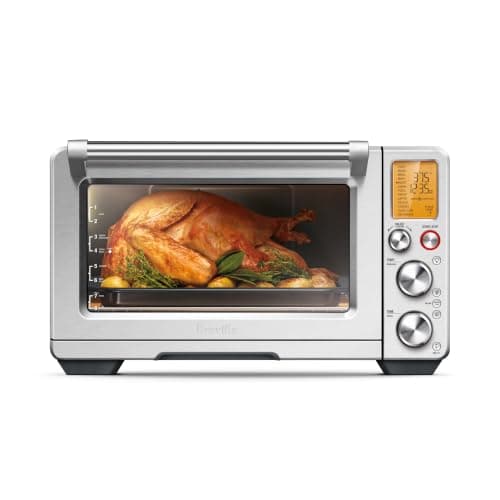
The preheat is the headline and it is worth separating out, because it is the part people forget when comparing. A full-size oven is a large insulated box with a lot of steel and air in it, and bringing all of that to 400°F takes real time. A countertop oven is a small box with its elements inches from the food. Breville publishes a one-cubic-foot interior for the Smart Oven Air Fryer Pro — that number is the entire explanation for why it is ready sooner, and it is checkable, which is why we lean on it rather than on a stopwatch we never started.
The cooking itself is a smaller saving, and it comes from the fan. Moving air strips the insulating boundary layer off the surface of food, so more heat crosses into it per minute at the same air temperature. That is the whole mechanism behind both convection and air frying — the physics is one paragraph long — and the conventional adjustment for it is to drop the temperature about 25°F or cut the time by roughly a fifth. Our conversion chart works that out.
It is not because it is more powerful
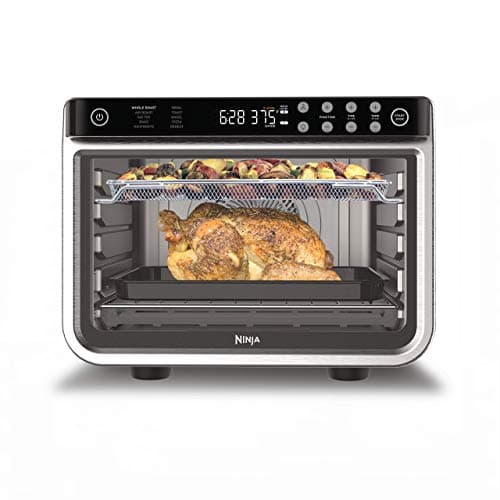
This is the part that surprises people. A full-size electric oven typically draws two to three times what a countertop oven does; the countertop unit is the weaker appliance by a wide margin. Nearly every full-size countertop oven on this site sits at 1,800 watts, because that is the ceiling of a standard 15-amp, 120-volt US kitchen circuit — 15 × 120 = 1,800 — and the ones that publish a figure all bunch there. The Ninja Foodi XL Pro DT201 publishes the same 1,800 watts as ovens costing more than twice as much. Speed here is a consequence of a small cavity and a fan, not of horsepower.
Which also means the difference between two 1,800-watt countertop ovens is not speed. It is interior, controls and door. If you are choosing between them on how fast they cook, you are choosing on a specification they share.
Where the advantage disappears
When you crowd it. The fan needs air to move. A tray packed edge to edge steams rather than crisps, and the cook takes longer than the same food in a single layer would in the big oven. Batch size is the most common reason someone concludes their air fryer oven is slow.
On anything large and dense. A big roast is limited by heat conducting inward through the meat, not by how fast air arrives at the surface. The fan browns the outside sooner; the middle takes as long as it takes. Thermal mass wins, and a countertop cavity usually cannot fit the joint anyway.
On anything that needs to rise slowly. Cakes and delicate bakes often do worse under a fan, which sets the crust before the crumb has finished expanding and can push the top around. This is why several ovens here let you turn convection off, and why our bread ranking cares more about a stable temperature floor than about speed.
When the oven is genuinely low-wattage. A 1,100 or 1,150-watt oven is cheaper per hour and slower per cook. Below the 1,800-watt tier, the preheat advantage over a full-size oven survives but the cooking advantage narrows.
Faster is not automatically cheaper
It usually is, but not for the reason people assume, and the arithmetic is worth seeing. Running cost is watts times hours. A countertop oven wins on both terms against a full-size oven — less power, less time — which is why not heating five cubic feet for one tray is the real saving, and we put numbers on that comparison. But between two countertop ovens, a lower wattage cuts the first term and raises the second. A cheaper hour is not the same as a cheaper meal, and this site says that on every page where the question comes up.
What to do with this
Preheat anyway — most of the saving is that the preheat is short, not that it is unnecessary — and check food at about two-thirds of the time the original recipe gives you. Cook in a single layer, in two batches if you have to; two uncrowded batches routinely beat one crowded tray on both time and result. And if you are buying rather than cooking, do not shop for speed: buy for interior, published wattage and controls, because among 1,800-watt ovens the speed is already decided. Our ranking sorts on exactly that.
On the preheat itself, your oven has probably already decided for you. Breville publishes exactly which functions run a preheat cycle and which do not, BLACK+DECKER publishes a figure in minutes, and Panasonic publishes that its infrared oven does not need one at all.
The hardware
The ovens this page is about
The ovens referred to above, with prices pulled live from Amazon and dated on every card. Full rankings live in the roundups linked from this page.
1,800 W
Breville Smart Oven Air Fryer Pro (BOV900BSS)
The most completely documented oven in the category, and the only one at any price whose manufacturer publishes a rated wattage, an interior volume and a full element layout in the same place. You pay roughly four times the category floor for that, and about a third of the premium is the documentation itself.
1,800 W
Ninja Foodi 10-in-1 XL Pro Air Fry Oven (DT201)
The value pick, and it is not close. Same 1,800 W as ovens costing more than twice as much, two full cooking levels, and a published capacity claim — two 12-inch pizzas — that is specific enough to be checkable rather than a vibe.
#ad · As an Amazon Associate we earn from qualifying purchases.
Questions
Frequently asked
Does an air fryer cook faster than an oven?
Is an air fryer faster because it is more powerful?
How much should I reduce the time by?
Do you still need to preheat an air fryer oven?
Does cooking faster mean it costs less to run?
Keep reading
Related
Receipts
Sources
- Breville — Smart Oven Air Fryer Pro product page
- SharkNinja — Ninja Foodi 10-in-1 XL Pro Air Fry Oven (DT201) product page
We have not cooked in these ovens and we do not pretend to have. Specifications come from the manufacturer's own published documents; electricity rates come from the US Energy Information Administration; prices come from the live Amazon API. Where a figure is not published, the page says “not published” rather than guessing. Read the full method.