The short answer
Buy the Cuisinart Chef's Convection Toaster Oven (TOB-260N1). It is for the cook who wants a big cavity they can plan around: Cuisinart publishes 0.95 cubic feet in the same place as the 1,800-watt rating and then states what fits — a 13-inch pizza, a 9x13 pan, nine slices — which makes it the easiest large oven in this category to compare on paper. If you want the biggest published cavity at any price here, the Oster Extra Large French Door states 42 liters, roughly 1.5 cubic feet. The budget pick is the BLACK+DECKER TO3250XSB, which costs a fraction of the Cuisinart and publishes the one measurement most households actually need: a 13 x 9 pan with handles goes in.
We have not cooked in any of these. Our rubric says so in those words. Every figure here is the manufacturer's, and every one is cited at the foot of the page.
The entry requirement: a number, not an adjective
“Extra large” is not a specification. Of the forty ovens in this catalog, the large majority publish no interior volume at all — they publish a slice count, or a quart figure that came from a marketing department, or nothing. So the qualifying test for this page was simple: the manufacturer publishes an interior volume, or states a named pan size that fits. Four ovens cleared it, and they are the four ranked here.
That test also disqualifies a familiar failure. A quart or liter figure describes volume, not shape, and a tall narrow cavity takes completely different pans from a wide shallow one of the same capacity. It is why the stated-fit claims matter as much as the cubic feet: the clearance rule is that your usable pan width is the interior width minus about two inches, and a pan with handles eats more than that.
How this differs from our other two size pages. The large-capacity ranking on the air-fryer hub covers the air-fry XL class — 26 to 47 quart French-door machines sold on basket capacity. The sizes explainer is about choosing a size at all. This page is the ovens that toast and bake, ranked on published cavity. Three of the four picks here appear on neither.
Published interiors, side by side
| Oven | Published interior | Stated fit | Rated power | Per hour | Warranty |
|---|
| Cuisinart TOB-260N1 | 0.95 cubic feet | 13" pizza; 9x13 pan; 9 slices | 1800 W | 33.0¢ | Not published |
|---|
| Oster Extra Large French Door | 42 L (about 1.5 cu ft) | Not stated in objects | Not published | No figure — we publish none | Not published |
|---|
| Cuisinart TOA-FD70 | 0.6 cu ft / 18 qt | 6 slices; 12" pizza; 4.5 lb chicken | 1800 W (retailer table) | 33.0¢ | 3 years |
|---|
| BLACK+DECKER TO3250XSB | Not published | 13" x 9" pan with handles; 12" pizza; 8 slices | 1500 W | 27.5¢ | 2 years |
|---|
Per-hour figures are the published wattage times 18.34¢ per kWh, the US average residential rate for June 2026. Where a maker publishes no wattage we publish no running cost rather than borrowing a number from a similar oven — which is why the Oster row is blank. Every published wattage, with its source.
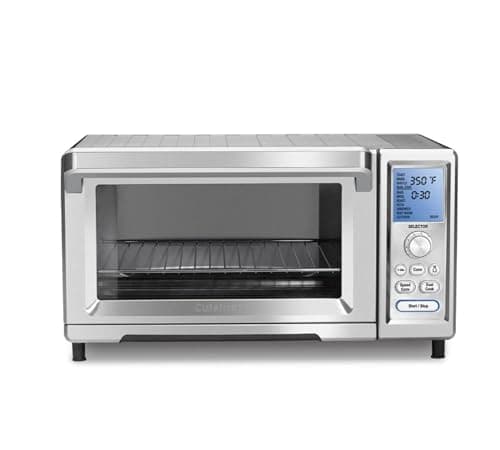
1. Cuisinart TOB-260N1 — for the cook who plans around the cavity
Who it is for: a household that bakes in real pans and wants the figure in writing. 0.95 cubic feet is within five percent of the biggest Breville's published cubic foot for a good deal less money, there are fifteen functions including a dual-cook mode that runs two temperatures in sequence, and the 1,800-watt rating sits on the same page as the volume.
The cons. At 530 mm deep it is the deepest oven on this list, and depth is the dimension people forget until the door will not clear the backsplash. Fifteen functions on a backlit panel is a lot of interface between you and heat. And Cuisinart lists this model as discontinued on its own site, so availability moves around — check the live price above before counting on it. Our full review.
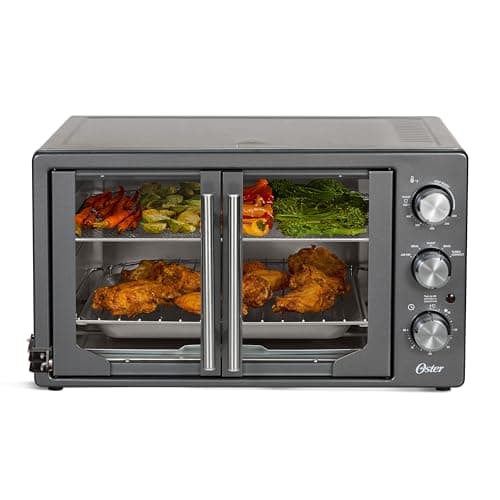
2. Oster Extra Large French Door — for the biggest published number
Who it is for: anyone whose constraint is volume and nothing else. 42 liters is stated as a figure rather than an adjective, which is roughly 1.5 cubic feet — larger than any Breville here — and the French doors clear far less counter in front than a single drop-down door.
The cons. Oster publishes no wattage, so this site shows no running cost for it at all; the 42-liter figure is manufacturer-supplied listing copy rather than a spec sheet; and a 42-liter cavity takes longer to come up to temperature than a 25-liter one whatever the element does. Two doors means two hinges and two latches. Our full review.
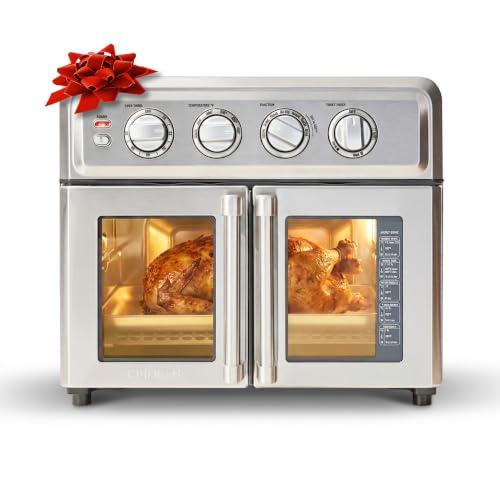
3. Cuisinart TOA-FD70 — for the longest warranty on a big cavity
Who it is for: the buyer who wants French doors and air fry at the price of a mid-range single-door oven. Its two published capacity figures agree, which fails more often than it should: 0.6 cubic feet is 1,036.8 cubic inches, a US quart is 57.75 cubic inches, and that is 17.95 quarts against a stated 18. It also carries a three-year limited warranty — the joint longest published term in our catalog — and the shallowest published depth of any French-door oven here at 12.25 inches.
The cons, and the first is why it is third. No instruction booklet has been published for this model anywhere we could reach, so the 1,800-watt figure comes from Target's specification table rather than from Cuisinart — the weakest sourcing on any watt figure we publish. There is no interior dimension, no clearance requirement and no published minimum temperature. The ceiling is 450°F where a step up publishes 500. Our full review.
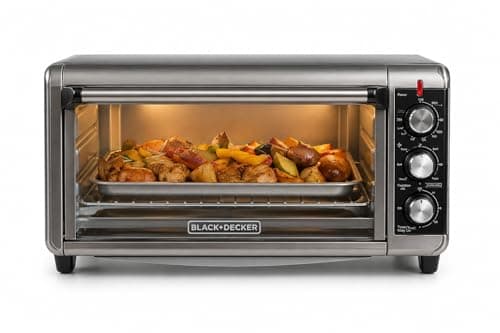
4. BLACK+DECKER TO3250XSB — the budget pick
Who it is for: the household that owns one 9x13 pan and wants it to fit, for under a hundred dollars. BLACK+DECKER prints “1500 W 120 V~ 60 Hz” in its own manual, publishes the exterior, the weight and a two-year warranty, and states the fit in objects: eight slices, a 12-inch pizza and that 13 x 9 pan with handles. Dials and a mechanical timer mean no control board to retire the oven while the elements are fine.
The cons. 22 inches wide is the widest oven in its price band and will not slide under most upper cabinets. No interior volume is published, so the stated fit is all you have. There is no air-fry basket or air-fry mode — the fan is for convection baking. And BLACK+DECKER's own copy warns the oven runs below the set point by design. Our full review.
The honest summary
Big is the easiest claim to make and the hardest to check, and this page exists because of the gap between those two facts. If you want a number you can compare, there are two in this whole catalog with a wattage printed beside them, and the Cuisinart TOB-260N1 is the larger. If you want the biggest cavity outright, the Oster is it and you will never know what it draws. If you want the pan you own to fit and the price to stay under a hundred dollars, the BLACK+DECKER tells you precisely that and nothing else.
Convert the units once, then compare like for like
A cubic foot is 1,728 cubic inches, 28.3 liters and about 29.9 US quarts. So 0.95 cubic feet is roughly 27 liters; 42 liters is roughly 1.48 cubic feet; 18 quarts is roughly 0.6 cubic feet. Doing that conversion first is the only way to shop this category, because brands deliberately publish in whichever unit flatters the box. The number is still only a volume — ask for the stated fit as well.
Depth and door swing beat width
A large oven fails on a counter for two reasons that are not its width: it is deeper than the counter once the backsplash is accounted for, or its drop-down door needs space the counter does not have. French doors solve the second problem and not the first. Measure backsplash-to-edge before you shop, and add the clearance the manual asks for. The published clearance requirements.
A big cavity costs more to heat, and the arithmetic is small
A larger oven holds more air to bring up to temperature, so the honest expectation is a longer preheat rather than a higher wattage — three of these four are rated 1,500 to 1,800 watts, the same as ovens half the size. At 18.34¢ per kWh an 1,800-watt oven costs 33.0¢ an hour, so the preheat penalty is measured in cents. The real comparison is against the full-size oven you are trying not to switch on: that sum is on the running-costs hub.