The short answer
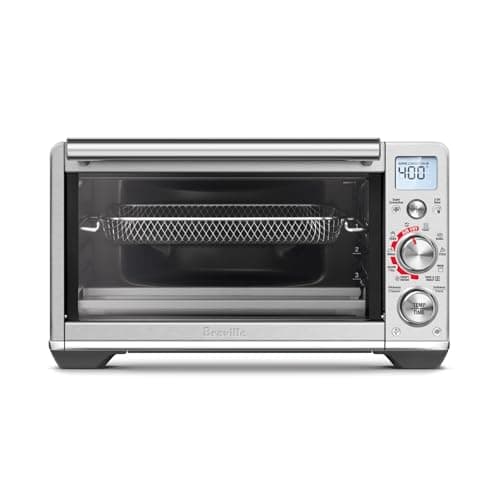
Buy it if your counter is small, you cook for one or two, and you want to be able to check what you bought against a document. The BOV680 draws a full 1,800 watts — the same as the Breville Pro that costs considerably more and the same as a full-size Cuisinart — from a chassis Breville measures at 15.7 inches wide. Breville prints the rating plate in the instruction book, publishes a temperature table function by function, and states in as many words that the oven fits an 11-inch pizza pan and toasts one to four slices. Almost nothing else this size tells you any of that.
Do not buy it if you cook for three or more, or if you were hoping a compact oven would be a cheap oven to run. It is neither big nor cheap per hour, and the second of those is true of the entire category.
What Breville publishes, and why that decides the ranking
This site has no test kitchen and says so on every page of the rubric. What we can do is read what a manufacturer is willing to put in writing, and Breville is the brand that puts the most in writing. For the BOV680 the instruction book carries a line headed Rating Information reading 120 V ~ 60 Hz 1800 W, which is a rating plate figure rather than a marketing headline, and the settings tables give a temperature band for each function rather than one headline maximum.
That is worth stating plainly because most of this size class publishes nothing at all. Four of the six ovens in Ninja's countertop line carry no published wattage, and several compact toaster ovens from other brands publish neither a wattage nor an interior figure. Our wattage table is shorter than our catalog for exactly that reason — and the BOV680 goes straight into it.
The one number Breville does not publish for this model is interior volume. The BOV900 gets a stated cubic foot; the compact gets no equivalent figure, so cross-model comparison here has to be done by pizza pan and slice count rather than by a number you can divide. That is the single documentation gap on an otherwise unusually complete sheet, and it costs the oven a little on the Documentation score rather than being waved through.
The 120°F floor is the number worth paying for
Every oven quotes a maximum. The interesting figure is almost always the minimum, because holding a low set point is harder than getting hot: the thermostat has to cycle a 1,800-watt element gently enough to sit at a temperature the element would blow past in seconds. Breville's own settings table puts Bake & Roast on this oven at 120°F to 445°F, with Toast running 160°F to 445°F and the air-fry functions working from 300°F up.
A published 120°F floor is genuinely low for a countertop oven and it is what makes the slow end of cooking possible in a cavity this size — holding dough somewhere warm, keeping a plate at temperature without drying it, a long low finish on something braised. There is no dedicated proof or dehydrate button on the dial, so this is a floor you drive yourself rather than a preset that does it for you. If a dedicated low-temperature program matters, the ovens that publish one are ranked here. That floor is also the whole of the case against the other fully specified small oven: Panasonic's published range starts at 250°F and ends at 500, so neither band contains the other.
The other end is the honest catch. 445°F is the published ceiling, and several ovens costing far less reach 500°F. For thin-crust pizza and for a hard finish on roast vegetables that fifty-five degrees is a real difference, not a rounding error — our pizza ranking is built on exactly that number.
How small is “compact”, measured
Breville publishes the exterior as 15.7 × 16.9 × 10 inches, and the manual is specific about what goes inside it: one to four slices of toast, and an 11-inch pizza pan — with a note that a 12-inch pan will also go in on the oven rack in the upward orientation. The pan is not included. The enamel roasting pan that is included measures 10.55 × 10.55 inches, which is a useful proxy for the usable floor area, and there is an air fry basket, a broiling rack, an oven rack and a crumb tray in the box.
Read those numbers as a household size rather than as a spec sheet. Four slices and an 11-inch pan is dinner for two, comfortably, and dinner for three at a stretch if one tray does it. It is not a half-sheet pan and it is not a chicken plus sides in one pass. If that is what you need, the compact is the wrong Breville and the full-size band starts here.
The depth is the figure people miss. At 16.9 inches deep before you add door clearance, this still wants most of a standard counter, and a drop-down door needs room in front of it while it is open. The four measurements to take before anything arrives are here, and the pan-fit question is worked through separately.
Element IQ and Super Convection, without the marketing
Element IQ is Breville's name for steering power to individual elements rather than switching them in banks — the same principle as the six independently driven elements in the Pro, at a smaller scale. It is the actual mechanical difference behind Breville's price across the whole range, and it is the one thing a cheaper oven cannot imitate at any setting. Breville does not publish an element count for this model, so we are not going to quote one.
Super Convection is a dedicated button, and on this oven it is not optional everywhere: the settings table shows the air fry and fries functions running with Super Convection on only, which is a fair description of what air frying is — a convection fan turned up. We take that equivalence apart in full here. Breville's own claim for the air fry modes is that they can reduce cooking time by up to 30 percent; that is the manufacturer's figure, we have not measured it, and it is a ceiling rather than a typical result.
The dial splits ten functions evenly: five on the air-fry side — Air Fry, Fries, Wings, Bacon and Crispy Reheat — and five conventional ones, Toast, Bagel, Pizza, Broil and Bake & Roast. A function in this category is a heat profile at a set point, so a count is not a capability ranking, and the difference between the convection and air fry settings is smaller than the panel suggests. Ten is a restrained number by current standards, which on the whole reads as a good sign.
Running cost: identical to the ovens twice its price
The card above computes it from the published 1,800 watts with every step shown, and the answer is the point of this whole site: a compact oven does not cost less per hour than a big one. It costs less per meal, because a smaller cavity has less air to bring up to temperature, so it reaches the set point sooner and finishes the same tray in less time. The saving is in the clock, not the rate. The arithmetic, with every input shown, is here.
It is also why 1,800 watts in a small box is a feature rather than a mismatch. Compact ovens that drop to 1,100 or 1,300 watts trade time for a lower draw, and cheaper per hour is not the same as cheaper per dinner. This one keeps the full draw and gets the speed back.
Where it sits in the Breville line
Above it, the BOV860 is the same idea in a wider chassis with more functions, and the BOV900 Pro adds a published cubic foot of interior and the full element count. All three carry the same 1,800-watt rating, so none of them is cheaper to run than the others — the BOV860-versus-BOV900 comparison settles that pair, and the BOV950 Joule Oven at the top of the range publishes the identical specs to the BOV900 with an app added. Sideways, the BOV845 Smart Oven Pro is the same family with the air fry function removed and a published 120°F floor, which is the better buy if you bake more than you crisp.
The compact is the one to take when width is the constraint and you are not willing to give up documentation to get it. Against the flip-away Ninjas that dominate our small-kitchen ranking, it does not fold, and it does not try to; what it offers instead is a manual with numbers in it. Breville versus Ninja, settled on that trade, is here.
Who should skip it
Anyone cooking for three or more, every time. Four slices and an 11-inch pan is a published ceiling and no dial setting moves it. Anyone whose main job is high-heat pizza, because 445°F is the published maximum and cheaper ovens go higher. And anyone buying a small oven specifically to spend less on electricity — this one draws the same 1,800 watts as the ovens twice its size, and that is true of nearly every full-power countertop oven in the US, because 15 amps at 120 volts is 1,800 watts and that is where the category stops.
If the budget is the binding constraint rather than the counter, the small toaster ovens we rank on footprintstart at a fraction of this price and two of them publish a wattage as well. What they do not have is Element IQ, a 120°F floor, or Breville's build.