HUB 06 · Guides & Answers
Do Countertop Ovens Need a Vent Hood?
We read the installation and safety sections of three manuals rather than guessing. None asks for a hood. All three ask for clearance, one bans a specific location in as many words, and one tells you to ventilate the room for a different reason entirely.
We earn a commission if you buy through our links. It does not change the price you pay, and it does not decide our picks — the scoring rubric is published in full, including what disqualifies an oven. How this works.
The short answer
No. Not one of the manuals we have read for a plug-in countertop oven requires a vent hood, a duct, or any kind of mechanical extraction. What they require instead is clearance measured in inches— and one of them bans a specific location outright, which is a more practical problem for most kitchens than a hood would be. Our Place's manual states: Do not operate your appliance in an appliance garage or under a wall cabinet.
One scope note, because the query is ambiguous: this page is about plug-in countertop ovens — toaster ovens, air fryer ovens, countertop convection ovens on a 120 volt supply. If you are asking about a commercial or gas convection oven, the answer is your local mechanical code and your building inspector, not us, and nothing on this page applies.
What each manual actually says about placement
Our Place (Wonder Oven, model APL.WDO.ESN)
The most specific of the three, and the only one with a diagram. It requires at least 1 inch behind, at least 1 inch above, and at least 1 inch on each side, and adds a condition most people would not think of: if the wall is made of heat-sensitive material such as plastic, leave more space around the appliance. Heat and steam may build up, causing malfunction, fire, or discoloration/deformation of the surrounding walls.
Then comes the ban, which sits in the numbered safety list rather than the installation section, which is probably why nobody reads it: Do not operate your appliance in an appliance garage or under a wall cabinet. When storing in an appliance garage, always unplug the unit from the electrical outlet. Not doing so could create a risk of fire, especially if the appliance touches the walls of the garage or the door touches the unit as it closes.
The one place Our Place does ask for ventilation is the first run, and for a different reason: conduct the trial run in a well-ventilated area as a small amount of smoke and odor may be detected. This is normal and should be expected. That is burn-off from manufacturing residue, not a standing ventilation requirement.
BLACK+DECKER (TO3250XSB and variants)
Publishes a requirement in prose rather than inches: Select a location where this unit is to be used, allowing enough space from back of the unit and the wall to allow heat to flow without damage to cabinets and walls. No figure, no hood, and the concern named is damage to the cabinetry rather than air quality.
The same section covers the smoke question honestly: during first few minutes of use you may notice smoke and a slight odor. This is normal and should cause no concern.And it names the real source of operational smoke, which is not ventilation at all — food overhanging the bake pan so drippings fall onto the heating elements. That failure has its own page.
Nuwave (Bravo XL Pro, model 20813)
Frames placement as a fire-risk instruction rather than a clearance figure: A fire may occur if the toaster-oven is covered or touching flammable material, including curtains, draperies, walls, and the like, when in operation. DO NOT store any item on top of the appliance when in operation.
And then the instruction that has nothing to do with air and everything to do with electricity, which is the one most likely to actually bite you: The Bravo XL Pro should be operated on a separate electrical outlet from other operating appliances due to wattage limitations. A 1,800 watt oven is about fifteen amps on a 120 volt supply, and a kitchen circuit is usually fifteen or twenty. We worked that out in full here.
The published clearance figures differ by a factor of six
Across the manuals this site has read, the required clearance ranges from Our Place's 1 inch all round to Breville's 4 inches at the sides and 6 above, with Nuwave at 5 inches behind, beside and on top. That is a sixfold spread for appliances that do substantially the same thing at substantially the same wattage, and it means the only correct answer to “how much space does it need” is the number in your own manual. Every figure we have found is tabulated here.
So why does the question get asked?
Three reasons, and two of them are real.
Because these ovens do emit steam and smoke sometimes.They do, and the manuals say so. Our Place's troubleshooting table records both steam from the door and white smoke from fatty food as normal, with the fix being a clean cavity rather than extraction. A range hood over the counter is a nice thing to have and no manual requires it.
Because a cabinet above the counter is where the space is. This is the genuine problem, and the one with a published answer: at least one manufacturer bans it outright, and others publish clearances a standard cabinet gap will not satisfy. The ovens that actually fit under a cabinet are ranked here, on published height rather than on hope.
Because commercial convection ovens genuinely do need ventilation. They are a different class of equipment on a different supply, and the rules that govern them are codes rather than manuals. If that is the question you came with, this is not the page.
What to do instead of installing a hood
- Read your own manual's clearance figure and obey the largest number in it. It is free, it is specific to your oven, and it is the only authority that matters for a warranty claim.
- Pull the oven forward rather than sideways. The published constraints are almost always rear and top, which a few inches of counter solves.
- Do not run it in an appliance garage, and unplug it if you store it in one. That is Our Place's own instruction, and the reason given is a fire risk from the door closing against a hot appliance.
- Give it its own outlet. Nuwave asks for this in writing, and it is the instruction most likely to prevent an actual incident.
- Open a window for the first run. Both Our Place and BLACK+DECKER publish that the first few minutes produce smoke and odour, and both describe it as normal.
What to check before the oven arrives
The cabinet gap, in inches, measured. This is the specification that eliminates ovens from a shortlist, and it is the one buyers check last. A published 6-inch top clearance plus a 12-inch-tall oven needs 18 inches of gap, which most kitchens do not have.
Whether the manual is downloadable before you buy. Brands that publish an instruction book let you read the clearance requirement in advance; brands that do not leave you discovering it after delivery. That is part of what the Documentation score on this site measures.
The outlet, not just the counter. At 1,800 watts these ovens want a circuit to themselves, and one manufacturer says so explicitly.
Then shop on footprint. The small-footprint ranking is here and the under-cabinet ranking is here, both on published dimensions.
The hardware
The ovens this page is about
The ovens referred to above, with prices pulled live from Amazon and dated on every card. Full rankings live in the roundups linked from this page.
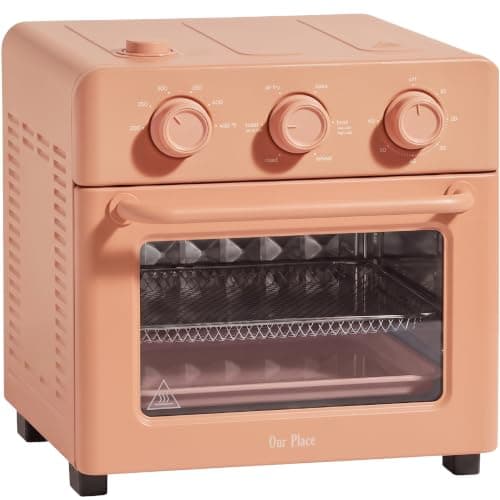
1,400 W
Our Place Wonder Oven (6-in-1, 13 Qt)
The most completely documented small oven we have covered, from a brand better known for pans. Our Place publishes the rating-plate wattage, the temperature range, the interior dimensions and the warranty term — all four things we score documentation on. At 1,400 W it costs less per hour than the 1,800 W field; at four slices and a 9-inch pizza it is genuinely small; and the limits are published too — a 200°F floor and a 60-minute timer.
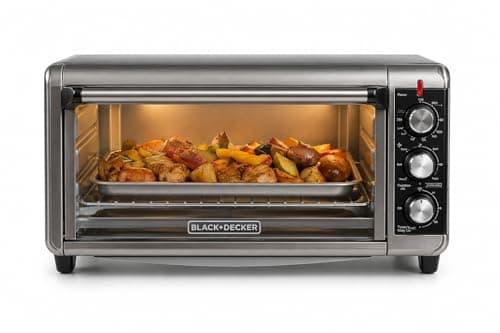
1,500 W
BLACK+DECKER 8-Slice Extra Wide Convection Toaster Oven (TO3250XSB)
A dial-controlled convection toaster oven whose maker publishes the wattage, the dimensions, the weight and a two-year warranty on its own page, and prints the rating line in the manual — 1500 W, 120 V, 60 Hz. Eight slices, a 12-inch pizza and a 9 x 13 pan with handles, for under a hundred dollars. It is a convection baker, not an air fryer: there is no basket and no air-fry setting.
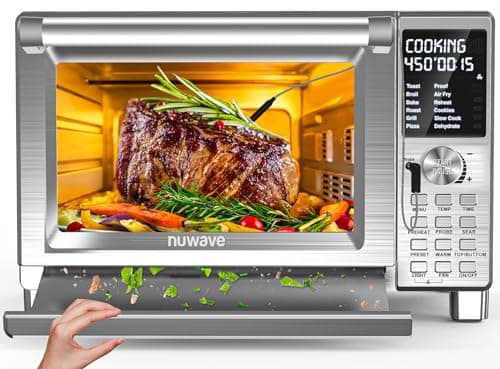
1,800 W
Nuwave Bravo XL Pro Air Fryer Toaster Oven (30 Qt, with probe)
A 30-quart, four-rack-level convection oven with an integrated temperature probe that stops the cook at a set internal temperature, and a maker that publishes its interior and exterior dimensions, weight, capacity, temperature range and warranty term — most of which the Ninja probe ovens do not. The 1,800-watt figure comes from a Nuwave support answer on its own product page rather than the manual's rating line, and we say so.
#ad · As an Amazon Associate we earn from qualifying purchases.
Questions
Frequently asked
Do countertop convection ovens need to be under a hood?
Can I put an air fryer oven in an appliance garage?
How much clearance does a countertop oven need?
Why does my countertop oven smoke, if it does not need venting?
Does a countertop oven need its own electrical circuit?
Keep reading
Related
- How much clearance does one need?Published figures that differ by a factor of six.
- Ovens that fit under a cabinetRanked on published height, which is what decides it.
- Do these ovens need their own circuit?The instruction one manufacturer puts in writing.
- Why does my air fryer oven smoke?The published causes, none of which is ventilation.
- Why is my toaster oven not heating up?The rest of what these manuals' troubleshooting sections say.
Receipts
Sources
- Our Place — Wonder Oven user manual, model APL.WDO.ESN [PDF, retailer-hosted copy]
- BLACK+DECKER — TO3250XSB / TO3260XSBD / TO3240XSBD use and care manual [PDF]
- Nuwave — Bravo XL Pro owner's manual, model 20813 [PDF]
- Our Place — Wonder Oven product page
We have not cooked in these ovens and we do not pretend to have. Specifications come from the manufacturer's own published documents; electricity rates come from the US Energy Information Administration; prices come from the live Amazon API. Where a figure is not published, the page says “not published” rather than guessing. Read the full method.