The short version
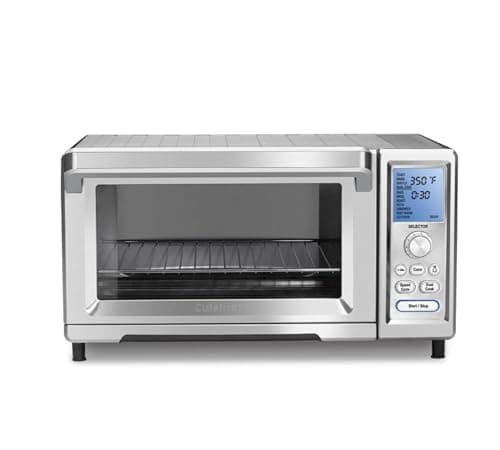
For a home bakery the pick is the Cuisinart Chef's Convection Toaster Oven (TOB-260N1), because it is the only oven in this catalog whose maker publishes a wattage, an interior volume and a list of what fits in the same place: 1,800 W, 0.95 cubic feet, a 13-inch pizza, a 9 x 13 pan and nine slices. When you are costing a batch and sizing a tray, a published figure is worth more than a feature. It is for the baker running quarter-sheet batches who needs the numbers to reconcile before they spend.
And here is the finding that should decide whether you buy a countertop oven for this at all: not one oven in this catalog publishes a figure that admits a half-sheet pan. A half-sheet is 18 by 13 inches. Every published pan claim across every brand here tops out at a 9 by 13 quarter-sheet. If your plan is half-sheet batches, the honest answer is that this category does not document itself as able to do it, and you are shopping for a different machine.
What a home bakery actually needs published
Four things, and they are not the four on the box.
The pan. Batch output is pans per hour, and a pan is a fixed rectangle. A quarter-sheet is 9 x 13, a half-sheet is 18 x 13, and the gap between them is the whole business plan. Ovens that publish a pan claim let you plan; ovens that publish only liters leave you measuring on delivery.
Whether the set point is real. Baked goods are sold on consistency. Exactly one manufacturer here publishes anything on the subject and it is a warning: BLACK+DECKER states in its own use and care manual that temperatures in the oven will be lower than your set point, because the dial is calibrated around the heating elements rather than a thermometer. No other brand in this catalog publishes a tolerance at all, which means for the rest you are buying an unspecified thermostat.
Element control. Browning the top of a tray without drying the base is an element problem, not a temperature problem. Breville drives six elements independently rather than switching them in banks, and publishes that it does; most ovens in this catalog publish an element count or nothing.
Warranty, as a duty-cycle proxy. Nobody publishes a duty cycle for a countertop oven, so the warranty term is the only number any maker will commit to about how long it expects the machine to run. The spread here is informative, and it does not track price.
The published numbers, side by side
| Oven | Published pan / fit claim | Published interior | Rated power | Published warranty |
|---|
| Cuisinart TOB-260N1 | 13 in pizza / 9 x 13 pan / 9 slices | 0.95 cubic ft | 1,800 W (product page) | None in the specs we carry |
| Breville BOV900 | 13 in pizza / 9 x 13 pan / 12-cup muffin tray | 1 cubic ft | 1,800 W (rating plate) | None in the specs we carry |
| BLACK+DECKER TO3250XSB | 13 x 9 pan with handles / 12 in pizza / 8 slices | None published | 1,500 W (rating plate) | 2 year limited |
| Breville BOV845 | None published | None published | 1,800 W (product page) | None in the specs we carry |
| Elite Gourmet ETO4510B | 18 slices | 47.5 Qt | None published | None in the specs we carry |
Reading the order
The Cuisinart TOB-260N1 is first because it is the easiest oven in the category to plan a batch around. Cuisinart publishes the 1,800 W draw and the 0.95 cubic foot interior on the same page as the fit list, so costing a bake and sizing a tray are both arithmetic rather than guesswork. Fifteen functions is more interface than a baker needs, and the real caution is depth: at 530 mm this is the deepest oven on this site, and depth is the dimension people forget until the door will not clear the backsplash.
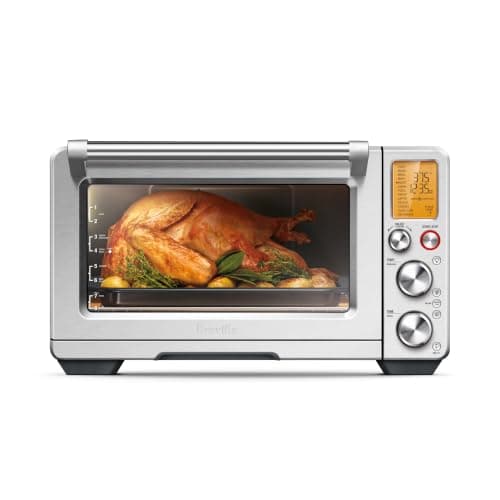
The Breville Smart Oven Air Fryer Pro (BOV900) is second and is the one to buy if the product you sell browns. Six independently driven elements and a published rating plate, with the same 9 x 13 pan ceiling as the Cuisinart and a cubic foot of interior. It is also 21.4 inches wide, which is wider than most under-cabinet clearances will let you slide it. The premium band is ranked separately.
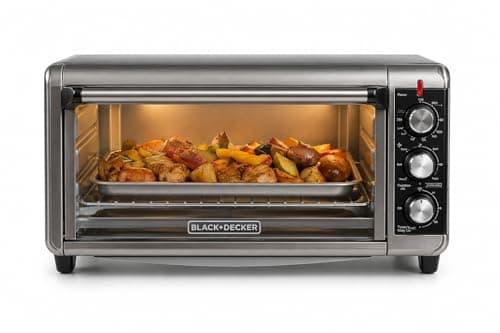
The BLACK+DECKER TO3250XSB is third and is the genuine value pick for batch work: it is the one oven here whose maker publishes a pan claim with the handles included — a 13 x 9 pan with handles goes in — plus the rating line, the exterior dimensions, the weight and a two-year warranty, the longest term in the table. It is a convection baker with dials rather than an air fryer, and it is the only oven on this page honest enough to tell you its dial reads high. The review covers what that means in practice.
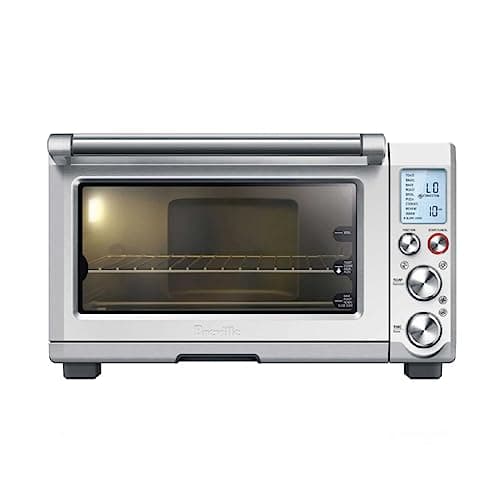
The Breville Smart Oven Pro (BOV845) is fourth and is here for one published number: a 120°F floor on Bake and Roast. Holding a low set point is harder than getting hot, and a stated low end is what makes proofing possible without a separate box. It has no Air Fry, no Proof preset and no Dehydrate — which for a bakery is mostly a saving. The bread-specific ranking goes deeper on the proof floor.
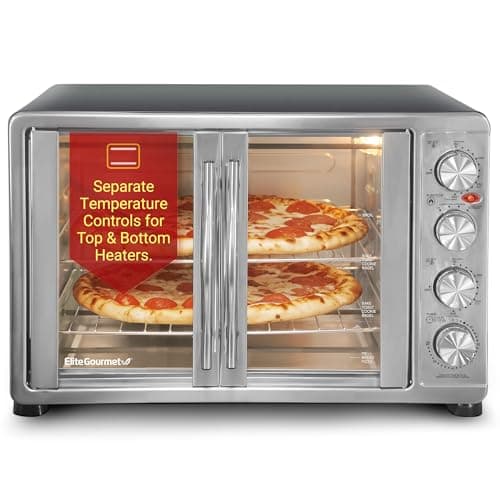
The Elite Gourmet ETO4510B is fifth and is the only oven here that publishes a double-digit slice count: 18, in 47.5 quarts, for less than the Cuisinart. If raw batch volume is the constraint and the product is forgiving, it is the cheapest room on the market. It publishes no wattage, no pan claim and no tolerance, and its thermostat is four manual knobs — which for a business selling consistency is the wrong trade, and is why it is last rather than first.
The half-sheet problem, stated plainly
Nearly every recipe scaled for a home bakery assumes a half-sheet. The widest oven in this roundup is 22 inches wide on the outside, and the pan claim its maker publishes is a 13 x 9 with handles. The Elite Gourmet's 47.5 quarts sounds like it should swallow a half-sheet, and Elite Gourmet does not say that it does — it says 18 slices. We are not going to convert a slice count into a pan dimension and present the result as a fit claim.
So the honest plan for a countertop oven in a home bakery is quarter-sheet batches, run in parallel or in sequence, with a published pan claim behind the decision. Every published pan and dimension figure we have is tabulated here, including the ovens that publish an interior you can measure a tray against.
How to buy an oven you intend to make money with
Start from the pan and work back to the oven. Decide the tray you will sell from — quarter-sheet, 9-inch round, a dozen-cup muffin tray — then buy only from ovens whose maker publishes that object. An oven with a published fit claim is one you can plan a production run around; one with a liter figure is one you will be re-measuring in your own kitchen.
Treat the warranty as the only published durability figure. No maker publishes a duty cycle, so the term is the proxy, and it does not track price here: the two-year BLACK+DECKER costs a fraction of ovens that publish no term at all in the specs we carry. If the oven runs four hours a day, that gap is the whole argument.
Buy a separate oven thermometer and budget for it. One manufacturer in this entire catalog publishes anything about accuracy, and it is a disclosure that the dial reads high. For a business, an unspecified thermostat is a risk you remove with a fifteen-dollar instrument rather than with a more expensive oven.
Count the circuit, not just the counter. Three of these ovens draw 1,800 W — about fifteen amps — and a home kitchen circuit is usually fifteen or twenty. Two ovens on one circuit is a tripped breaker in the middle of a bake. We worked through the amperage here, and the per-hour cost of running one all morning is here.