The short answer
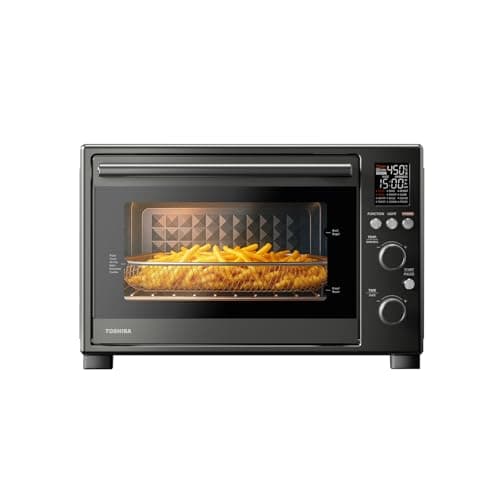
The ChefFry buys you interior room and a stainless exterior in a price band where painted finishes and four-slice cavities are common. Twelve functions, and unusually for the count, the useful ones are present rather than padded — dehydrate and proof both appear. What you do not get is a paper trail: Toshiba publishes no wattage, no interior volume and no temperature range for it that we could find, which for a two-hundred-dollar appliance is a fair thing to want more of.
What the cavity buys
The reason to choose this oven over the better-documented ones near it is space. In the middle of this market you are usually choosing between a well-specified small oven and a vague large one, and the ChefFry is firmly the second — a genuinely large cavity for what it costs, which is the specification that decides whether an oven does weeknight cooking or only reheating. Our large-capacity ranking puts it against the other big cavities.
Twelve functions is a number we normally discount, because a function in this category is a heat profile at a set point and adding one costs a manufacturer almost nothing. What is worth noting here is which twelve: dehydrate and proof are both genuinely useful and both genuinely absent from plenty of ovens that advertise more functions than this. Whether either works well depends on a temperature floor Toshiba does not publish, so we cannot promise you it does — our dehydrator ranking is built on published floors for exactly that reason, and the ChefFry is not in it.
The documentation problem
Almost everything we can tell you about this oven comes from listing copy. No manufacturer wattage means no running-cost figure from us, and we will not derive one from a plausible assumption — a number we cannot source is a number we do not publish, which is the stated position of this whole site. No published interior volume means “large cavity” is a relative judgment against the ovens beside it rather than a figure you can check against your own pans. And no published temperature range means the ceiling and floor are unknown, which matters for pizza at one end and proofing at the other.
It is also a newer SKU, which compounds the same problem from a different direction: a thin service history alongside a thin specification sheet. That is not an accusation, it is an absence of evidence, and we would rather say so than imply either more or less than we know.
How it compares in the band
Against the Ninja DT201, which sits nearby: Ninja publishes 1,800 watts and a checkable capacity claim of two 12-inch pizzas across two levels. That is a materially better position to buy from, and the DT201 wins our overall ranking partly on it. Against the Instant Omni Plus: Instant publishes 19 quarts and a 170–450°F range, which is why it wins the dehydrator page. The ChefFry's case against both is room for the money and a stainless finish, and if you value those above the paperwork it is a reasonable buy.
What it costs to run
Unknown, and we will not guess. What we can say is what the category does: nearly every full-size countertop oven that publishes a figure sits at 1,800 watts, because that is the ceiling of a standard 15-amp, 120-volt US kitchen circuit. Our method page shows the arithmetic for any wattage — if you find a figure on the rating plate when it arrives, you can run it yourself in about fifteen seconds.
Who should skip it
Anyone who wants to know what they bought. If you compare ovens on published numbers, this one gives you almost nothing to compare with, and there are ovens at this price that publish a rating plate and an interior volume. Skip it too if you need a reliable proof or dehydrate temperature, because the floor is unpublished and those two functions depend entirely on it. Buy it if the cavity size and the finish are what you are optimizing for, and you are willing to take the rest on the brand.
How we picked
Ovens we claim to have cooked in: 0
Everyone in this category tells you they roasted forty chickens. We have roasted none, and we say so. Here is what we do instead: read the manufacturer's manual and spec sheet, record the published wattage, interior volume, temperature range and warranty term, work out what the oven costs to run for an hour and for a year, show the arithmetic so you can redo it with your own electricity rate, and cite all of it. Where a brand publishes no wattage, we print no running cost rather than borrowing a number from a similar model. Prices come live from Amazon's API and disappear rather than go stale.
The scores above are judgments from that documented research — not test results. One of the five metrics is Documentation: whether the manufacturer will tell you what its oven draws at all. The full rubric, including what disqualifies an oven, is published in full.